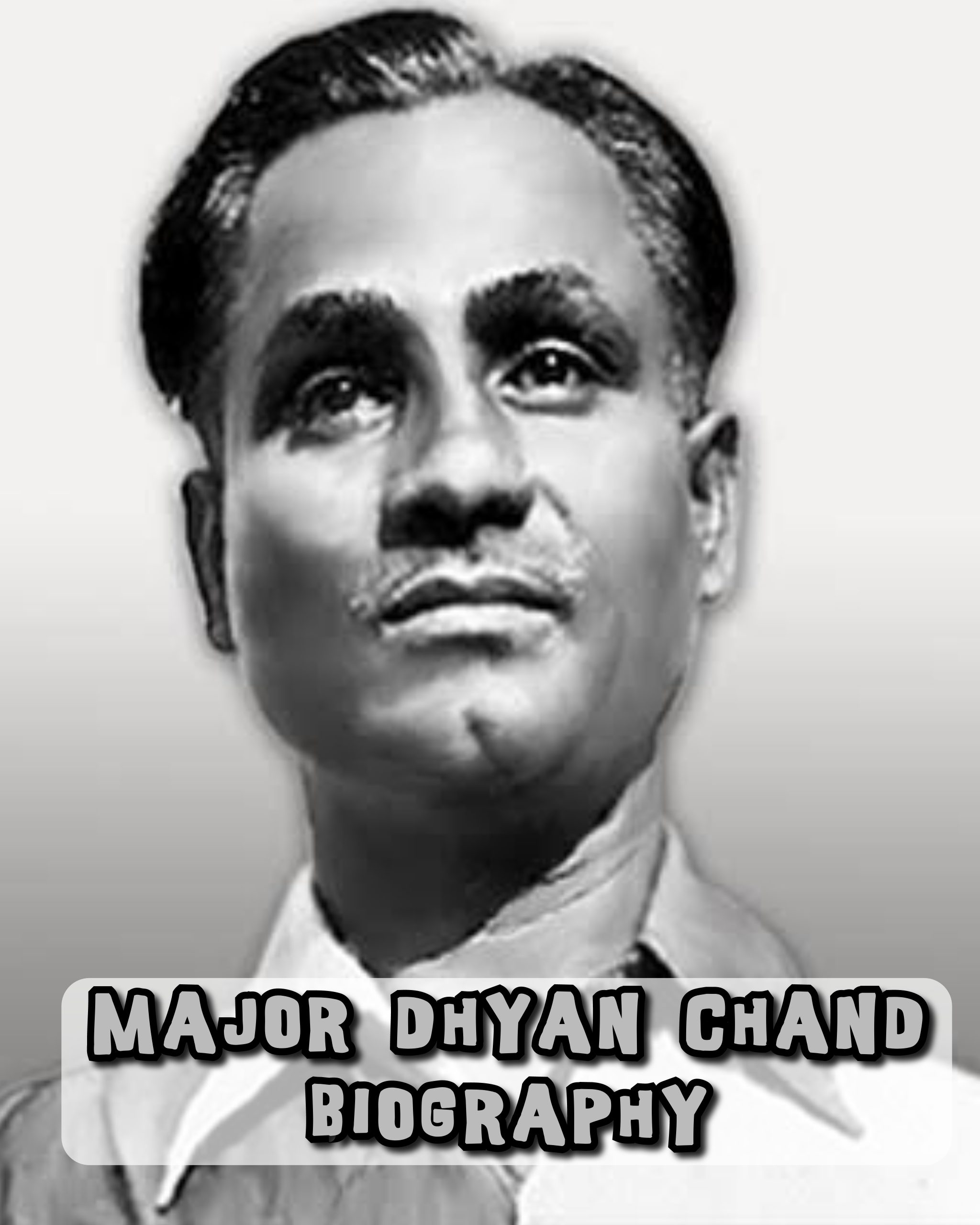
Major Dhyan Chand was born as Dhyan Chand Singh on 29 August 1905 in Allahabad, now known as Prayagraj, Uttar Pradesh, India. He was born into a Rajput family to Sameshwar Singh, who served in the British Indian Army. Because of his father’s military service, the family moved to different places during Dhyan Chand’s childhood. He grew up in an environment closely connected with the army, which later played an important role in shaping his life and career.
As a young boy, Dhyan Chand did not initially show the extraordinary passion for hockey that would later make him famous. He completed his early schooling while moving with his family and developed an interest in sports. His life changed significantly when he joined the Indian Army at the age of 16 in 1922. It was during his time in the army that he began developing his hockey skills under military influence and training.
The young Dhyan Chand quickly demonstrated exceptional control, timing and goal-scoring ability. He became deeply committed to improving his game, often practising hockey after his military duties and, according to widely told accounts, playing under moonlight when training opportunities were limited. This dedication earned him the nickname “Chand,” meaning moon, and marked the beginning of the journey that would eventually make him one of the greatest hockey players in sporting history.
Major Dhyan Chand Education
Major Dhyan Chand received his early education while growing up in a family that frequently moved because of his father’s service in the British Indian Army. His schooling was relatively modest, and unlike many later sporting personalities, he did not pursue higher academic education at a university. His childhood and teenage years were shaped more by family circumstances, discipline and his growing interest in sports.
At the age of 16, Dhyan Chand joined the Indian Army in 1922. His entry into military service became an important part of his education and personal development. The army provided him with a disciplined environment where he learned values such as dedication, fitness, teamwork and perseverance. It was also during his military years that his natural talent for hockey began to receive serious attention and training.
Although Dhyan Chand did not become known for formal academic qualifications, his military experience served as a major foundation for his sporting career. Through regular practice, physical conditioning and exposure to competitive hockey, he developed the remarkable skills that eventually earned him the nickname “The Hockey Wizard.” His life demonstrated how discipline and continuous practice could become an education in themselves, ultimately helping him rise from a young army recruit to one of India’s most celebrated athletes.
Major Dhyan Chand Career
Major Dhyan Chand began his hockey career in the Indian Army, where his extraordinary ball control and goal-scoring ability quickly attracted attention. He represented the Army in hockey competitions and became part of the Indian team that toured New Zealand in 1926. His performances on the tour helped establish him as one of India’s leading hockey players. He later became a key member of the Indian Olympic hockey team, helping India win its first Olympic gold medal in hockey at the 1928 Amsterdam Olympics.
Dhyan Chand continued to dominate international hockey during the 1930s. At the 1932 Los Angeles Olympics, he played a major role as India won another gold medal, with the team producing a remarkable 24–1 victory over the United States in the final. His greatest Olympic performance came at the 1936 Berlin Olympics, where he captained the Indian team to its third consecutive gold medal. India defeated Germany 8–1 in the final, with Dhyan Chand scoring three goals. His exceptional stick work, precision and ability to control the ball earned him the enduring nickname “The Hockey Wizard.”
After the 1936 Olympics, Dhyan Chand continued playing hockey and serving in the Army before retiring from international hockey in 1948. He remained involved with the sport after his playing career and later worked as a hockey coach, helping develop younger players. Over the course of his career, he became associated with more than 1,000 goals, although exact totals vary depending on which matches are counted. His achievements, discipline and influence transformed him into one of the most celebrated figures in Indian sporting history, and his legacy continues through National Sports Day, observed in India every year on his birth anniversary, 29 August.
Major Dhyan Chand Personal Life and Family
Major Dhyan Chand married Janki Devi in 1936. Their marriage took place during the period when Dhyan Chand was at the height of his hockey career and serving in the Indian Army. Despite his growing international fame, he was known for maintaining a relatively private family life and remained strongly connected to his military responsibilities and sporting career.
Dhyan Chand and Janki Devi had several children, including sons Brij Mohan Singh, Ashok Kumar Singh and Roop Singh. His son Ashok Kumar Singh later followed in his father’s footsteps and became a distinguished Indian hockey player. Ashok Kumar represented India at the Olympics and famously scored the winning goal in the 1975 Hockey World Cup final, helping India win its only men’s Hockey World Cup title.
Dhyan Chand’s family therefore continued his sporting legacy across generations. His younger brother Roop Singh was also an outstanding hockey player and represented India at the 1932 and 1936 Olympic Games. Major Dhyan Chand remained associated with his family and hockey until his later years. He died on 3 December 1979 in New Delhi at the age of 74, leaving behind a sporting legacy that continues to influence Indian hockey and generations of players.
Major Dhyan Chand Death and Cause of Death
Major Dhyan Chand died on 3 December 1979 in New Delhi, India, at the age of 74. The Government of India records his date of death as 3 December 1979 and continues to commemorate his contribution to Indian hockey and sport.
In the final years of his life, Dhyan Chand’s health had deteriorated, and he was receiving medical treatment. He was reportedly suffering from liver cancer, which is widely cited as the cause of his death. His passing marked the end of the life of one of India’s most celebrated sporting legends, whose career had helped establish Indian hockey as a dominant force on the international stage.
Following his death, Major Dhyan Chand’s legacy continued to grow. He is remembered for winning three consecutive Olympic gold medals for India in 1928, 1932 and 1936, while his birthday, 29 August, is observed as India’s National Sports Day. His name was also given to India’s highest sporting honour, the Major Dhyan Chand Khel Ratna Award, in 2021, ensuring that his contribution to Indian sport remains part of the country’s sporting history.
Major Dhyan Chand Age, Religion, Nationality, Height and Physical Appearance
Major Dhyan Chand was born on 29 August 1905 and died on 3 December 1979, making him 74 years old at the time of his death. He was an Indian national and is remembered as one of the greatest field hockey players in Indian sporting history. He was born in Allahabad, British India, which is now known as Prayagraj, Uttar Pradesh.
Dhyan Chand came from a Hindu Rajput family. However, reliable biographical sources do not provide extensive information about his personal religious practices, so his religion is generally described based on his family background rather than detailed records of his beliefs. His identity was primarily associated with his military service, Indian nationality and extraordinary contribution to hockey.
There is no consistently verified official record of Major Dhyan Chand’s exact height in authoritative biographical sources, so frequently quoted figures online should be treated with caution. Photographs from his playing years show him as a lean, athletic and physically fit man, with the strong build and stamina expected of an elite hockey player and army officer. His controlled movements, balance and exceptional coordination were among the physical qualities that contributed to his remarkable success on the hockey field.
Major Dhyan Chand Social Media Presence
Major Dhyan Chand did not have personal social media accounts, as he died in 1979, decades before platforms such as Instagram existed. However, his legacy continues to be represented through official sports institutions, government accounts and fan pages that share photographs, achievements and historical information about his career. One relevant Instagram presence is @hockeyindia, the official account of Hockey India, which regularly highlights Indian hockey legends and the country’s hockey heritage.
Fans may also encounter Instagram pages using Major Dhyan Chand’s name, but these should not be mistaken for accounts personally operated by him or his family. For an SEO biography, it is therefore more accurate to state that Major Dhyan Chand had no personal Instagram handle, while his legacy is promoted through accounts such as @hockeyindia and other verified sporting platforms.
Major Dhyan Chand Net Worth
There is no reliable official record of Major Dhyan Chand’s exact net worth. Unlike modern professional athletes, he did not earn large commercial endorsement deals or substantial tournament salaries. His primary career was in the Indian Army, where he served from 1922 until his retirement in 1956, eventually retiring as a lieutenant (acting captain), according to biographical records.
Because historical Army salary records for Dhyan Chand are not readily available in a form that allows a reliable calculation of his lifetime wealth, assigning a specific figure in today’s rupees would be speculative. His financial position was also very different from that of modern sports stars, as international hockey in his era was not a highly commercialized professional sport. Therefore, claims online that give an exact figure for Major Dhyan Chand’s net worth should be treated with caution.
Based on his long military service, later coaching career and the economic conditions of his era, it is reasonable to describe Dhyan Chand as having had a modest-to-moderate personal income rather than a millionaire-level fortune. After retiring from the Army, he worked as a hockey coach, including serving as Chief Hockey Coach at the National Institute of Sports, Patiala, from 1961 to 1969. For an accurate biography, the safest wording is: “Major Dhyan Chand’s exact net worth is unknown, and no credible historical source provides a verified figure.”
Legacy
Major Dhyan Chand’s legacy extends far beyond his three Olympic gold medals. He is widely regarded as one of the greatest field hockey players in history and remains an enduring symbol of India’s golden era in hockey. His extraordinary ball control, precision, creativity and goal-scoring ability earned him the nickname “The Hockey Wizard.” His performances at the 1928 Amsterdam, 1932 Los Angeles and 1936 Berlin Olympics helped establish India as a dominant force in international hockey.
His contribution to Indian sport continues to be honoured at the national level. 29 August, his birth anniversary, is celebrated as National Sports Day in India, recognising his contribution to Indian hockey and the wider sporting community. In 2021, India’s highest sporting honour, the Rajiv Gandhi Khel Ratna Award, was renamed the Major Dhyan Chand Khel Ratna Award in his honour. His name has also been associated with sports institutions, stadiums and awards across India, reflecting the lasting respect he commands.
Perhaps the most important part of Dhyan Chand’s legacy is the inspiration he continues to provide to generations of Indian athletes and hockey players. His career demonstrated the importance of discipline, dedication and mastery of one’s craft at a time when professional sports offered little of the financial reward available today. More than four decades after his death in 1979, Major Dhyan Chand remains one of India’s most celebrated sporting icons, and his achievements continue to form an important part of the country’s sporting history.
Conclusion
Major Dhyan Chand remains one of the most iconic figures in Indian sporting history, remembered for his extraordinary hockey skills, three Olympic gold medals and unwavering dedication to the sport. From his early days in the Indian Army to becoming known as the “Hockey Wizard,” his journey reflects discipline, perseverance and sporting excellence. Although he died in 1979, his influence continues through National Sports Day, the Major Dhyan Chand Khel Ratna Award and the generations of hockey players inspired by his achievements. His name remains permanently connected with India’s golden era of hockey and the country’s rich sporting legacy.
Frequently Asked Questions About Major Dhyan Chand
Who was Major Dhyan Chand?
Major Dhyan Chand was a legendary Indian field hockey player and former Indian Army officer. Widely known as the “Hockey Wizard,” he helped India win three consecutive Olympic gold medals in 1928, 1932 and 1936.
When was Major Dhyan Chand born?
Major Dhyan Chand was born on 29 August 1905 in Allahabad, British India, now known as Prayagraj, Uttar Pradesh, India.
When did Major Dhyan Chand die?
Major Dhyan Chand died on 3 December 1979 in New Delhi, India, at the age of 74.
What was the cause of Major Dhyan Chand’s death?
Major Dhyan Chand is widely reported to have died after suffering from liver cancer. He died in New Delhi on 3 December 1979.
How many Olympic gold medals did Major Dhyan Chand win?
Major Dhyan Chand won three Olympic gold medals with India. He was part of the Indian teams that won gold at the 1928 Amsterdam, 1932 Los Angeles and 1936 Berlin Olympics.
Why is Major Dhyan Chand called the Hockey Wizard?
Major Dhyan Chand was called the “Hockey Wizard” because of his exceptional ball control, dribbling, precision, speed and remarkable ability to score goals. His extraordinary performances made him one of the most celebrated hockey players in history.
What was Major Dhyan Chand’s real name?
His full name was Dhyan Chand Singh. He later became popularly known as Major Dhyan Chand because of his military rank and illustrious hockey career.
What was Major Dhyan Chand’s religion?
Major Dhyan Chand came from a Hindu Rajput family. However, detailed information about his personal religious practices is limited in reliable historical records.
Who was Major Dhyan Chand’s wife?
Major Dhyan Chand was married to Janki Devi. They married in 1936 and had several children.
Did Major Dhyan Chand have children?
Yes. Major Dhyan Chand and Janki Devi had several children, including Ashok Kumar Singh, who became a distinguished Indian hockey player and later helped India win the 1975 Hockey World Cup.
What was Major Dhyan Chand’s net worth?
Major Dhyan Chand’s exact net worth is unknown because there are no reliable historical financial records establishing his personal wealth. Unlike modern professional athletes, his primary income came from his Indian Army career, followed later by his work as a hockey coach.
Why is 29 August celebrated as National Sports Day?
India celebrates National Sports Day on 29 August, the birth anniversary of Major Dhyan Chand, to honour his contribution to Indian hockey and recognise sporting excellence across the country.
What is the Major Dhyan Chand Khel Ratna Award?
The Major Dhyan Chand Khel Ratna Award is India’s highest sporting honour. It was renamed from the Rajiv Gandhi Khel Ratna Award in 2021 to honour Major Dhyan Chand’s contribution to Indian sport.
Did Major Dhyan Chand have an Instagram account?
No. Major Dhyan Chand did not have a personal Instagram account, as he died in 1979, long before social media platforms existed. His legacy is instead shared through official hockey organisations and sporting accounts such as @hockeyindia.
What is Major Dhyan Chand famous for?
Major Dhyan Chand is famous for his three Olympic gold medals, extraordinary hockey skills, goal-scoring ability and contribution to India’s golden era of field hockey. His achievements made him one of India’s most revered sporting legends.