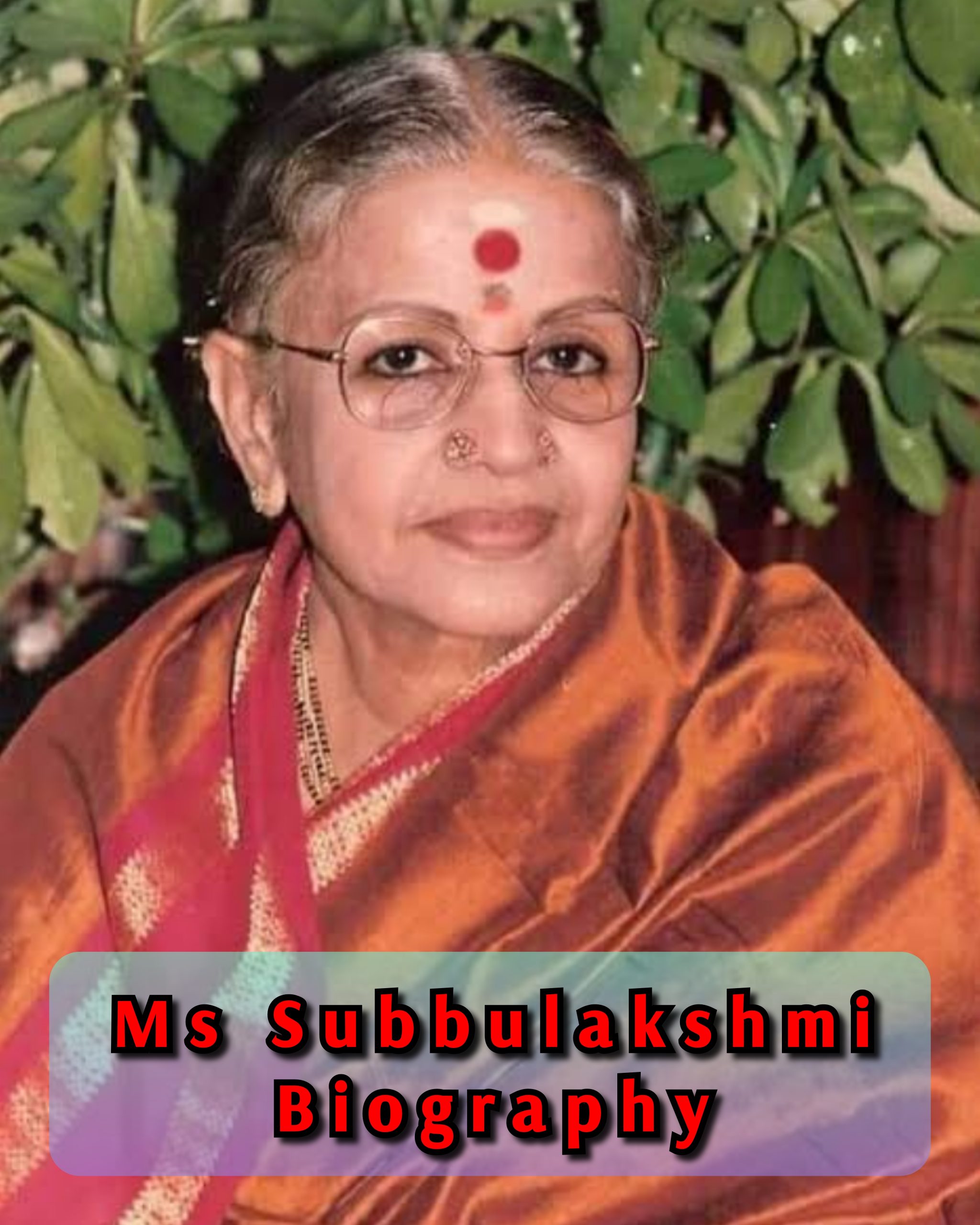
M. S. Subbulakshmi, whose full name was Madurai Shanmukhavadivu Subbulakshmi, was born on September 16, 1916, in Madurai, in the Madras Presidency of British India, now Tamil Nadu, India. She was affectionately known as Kunjamma within her family. Her childhood was surrounded by music because her mother, Madurai Shanmukhavadivu Ammal, was an accomplished veena player, while her grandmother Akkammal was a violinist. This musical environment played a major role in shaping her future as one of India’s greatest Carnatic vocalists.
From a very young age, Subbulakshmi absorbed music by listening to her mother and other musicians around her. She developed a remarkable natural ability for singing and began receiving musical training while still a child. She eventually studied Carnatic music under the respected vocalist Semmangudi Srinivasa Iyer and also received training in Hindustani classical music from Pandit Narayanrao Vyas. Her upbringing gave her an unusually strong foundation in both musical discipline and devotional expression.
Subbulakshmi’s talent became evident remarkably early. She began recording music as a child and gave her first major public performance at about 11 years old in 1927 at the Rockfort Temple in Tiruchirappalli. She later performed at the prestigious Madras Music Academy as a teenager, an achievement that helped establish her as a rising force in Carnatic music. Her early success eventually led her from Madurai to Madras, now Chennai, where she built the career that would make her an international musical icon.
M. S. Subbulakshmi Education
M. S. Subbulakshmi’s formal academic education was limited compared with her extensive musical education. Available biographical accounts indicate that she attended school in Madurai but left formal schooling while she was still young. One account states that her schooling ended around the fourth or fifth standard, after which music became the central focus of her life and daily routine.
Although she did not pursue a conventional higher education, Subbulakshmi received an extraordinary education through music. She learned from experienced musicians and absorbed musical traditions through listening, practice and performance. Her mother was an especially important early influence, and Subbulakshmi developed a sophisticated understanding of Carnatic vocal music through intensive practice.
Her principal musical training included Carnatic instruction under Semmangudi Srinivasa Iyer and a period of Hindustani classical training under Pandit Narayanrao Vyas. Her education was therefore largely based on the traditional guru-shishya approach rather than university study. Her mastery of music eventually earned her honorary recognition from academic institutions and cultural organizations.
M. S. Subbulakshmi Career
M. S. Subbulakshmi’s career became one of the most remarkable stories in Indian classical music. By her teenage years, she was already performing independently, and her appearances at the Madras Music Academy helped establish her reputation among leading Carnatic musicians and audiences. Her voice, technical command, clarity of pronunciation and devotional intensity distinguished her from many of her contemporaries.
She also became involved in Indian cinema. Her film career included appearances in productions such as Sevasadanam, Sakuntalai, Savitri and the highly influential Meera. Her performance in Meera helped introduce her music and devotional persona to an even wider audience. She subsequently became associated with devotional recordings such as Vishnu Sahasranamam, Bhaja Govindam and Venkateswara Suprabhatam, recordings that became familiar in homes across India.
Subbulakshmi’s international career was equally significant. She performed at major international venues and became the first Indian musician to perform at the United Nations General Assembly, in 1966. She also performed at the Edinburgh International Festival, Carnegie Hall in New York, London’s Royal Albert Hall and the Festival of India in Moscow. Her achievements included the Ramon Magsaysay Award in 1974 and the Bharat Ratna in 1998, making her the first musician to receive India’s highest civilian honour.
M. S. Subbulakshmi Personal Life and Family
M. S. Subbulakshmi married Thyagaraja Sadasivam, widely known as T. Sadasivam, a freedom fighter, journalist and cultural figure who became an important partner in her personal and professional life. Their marriage connected Subbulakshmi with an influential circle of writers, artists, political figures and cultural personalities. Sadasivam played an important role in managing aspects of her career and helping shape her public life.
Subbulakshmi’s family continued her musical legacy. Her daughter Radha Viswanathan became a respected musician and was closely associated with her mother’s performances for many years. Radha accompanied Subbulakshmi on stage and became an important part of the musical tradition surrounding the legendary vocalist. The family tradition later continued through her granddaughters, including Aishwarya and Saundarya.
Subbulakshmi was also known for her deep devotion and humility. She maintained a strong connection with Hindu devotional music and was an ardent devotee of the Kanchi Mahaswamigal. Her religious devotion was reflected in many of the songs she performed, helping her music reach audiences beyond the traditional Carnatic concert setting. She died in Chennai in December 2004, leaving behind a family and musical tradition that continues to be remembered in India.
M. S. Subbulakshmi Age, Religion, Nationality, Height and Physical Appearance
M. S. Subbulakshmi was born on September 16, 1916, and died in December 2004 at the age of 88. She was Indian by nationality and was associated with the Hindu religious tradition, particularly devotional Hindu music. Her exact height has not been reliably documented in authoritative biographical sources, so a specific figure should not be presented as fact. Photographs from her career show her with a graceful and dignified appearance, usually dressed in traditional Indian sarees and jewellery, with the characteristic composed presentation that became closely associated with her public image.
M. S. Subbulakshmi Social Media Presence
M. S. Subbulakshmi did not have an official Instagram account because she died in 2004, long before Instagram was launched. Therefore, there is no verified personal Instagram handle that can accurately be attributed to her. Various social-media pages and fan accounts may share her photographs, recordings and tributes, but these should not be confused with an official account belonging to Subbulakshmi herself.
Her music, however, continues to have a substantial digital presence. Recordings of her devotional and classical performances are widely circulated online, allowing younger generations to discover her voice decades after her death. Her continuing online popularity demonstrates how successfully her music has crossed from traditional concert halls into the digital age.
M. S. Subbulakshmi Net Worth
There is no reliable, authoritative public record establishing M. S. Subbulakshmi’s exact net worth at the time of her death. Unlike contemporary entertainers, her financial information was not routinely reported through public databases, and online figures claiming a precise net worth are generally unsupported by strong documentary evidence.
Subbulakshmi earned income through concerts, recordings, films, royalties and other professional musical activities during a career that lasted for decades. She also performed numerous charity concerts and was known for donating royalties and proceeds to charitable and religious causes. Government sources note that she undertook more than 200 charity concerts and contributed significantly to charitable activities.
For that reason, it would be misleading to give a precise modern-dollar or rupee net-worth figure as though it were verified. Her financial legacy is better understood through her extraordinary professional career and philanthropic contributions than through an unsupported estimate.
Legacy
M. S. Subbulakshmi’s legacy extends far beyond her status as a Carnatic vocalist. She helped take South Indian classical music to audiences throughout India and around the world, becoming a cultural ambassador for Indian music. Her performances demonstrated how Carnatic music and devotional compositions could communicate across linguistic and cultural boundaries.
Her honours remain among the most significant achievements in Indian musical history. She was the first Indian musician to receive the Ramon Magsaysay Award and the first musician to receive the Bharat Ratna. She was also the first Indian musician to perform at the United Nations General Assembly. These milestones established her as a figure of international cultural importance rather than merely a celebrated regional performer.
Her recordings continue to form an important part of India’s devotional and classical musical heritage. Songs such as Venkateswara Suprabhatam, Vishnu Sahasranamam and Bhaja Govindam remain widely heard, while musicians continue to study and perform works associated with her style. Her influence has also been reinforced through statues, commemorative events, educational programs, documentaries and tributes.
Latest 2026 Development: M. S. Subbulakshmi Biopic
One of the biggest recent developments surrounding M. S. Subbulakshmi is the announcement of a major biographical film titled M.S. – A Legacy on Screen. The project was launched around her 110th birth anniversary in September 2026, with actress Rashmika Mandanna set to portray the legendary singer. The film is being directed by Gowtam Tinnanuri, while Anirudh Ravichander is composing the music.
The biopic has attracted considerable attention because the filmmakers intend to explore more than Subbulakshmi’s musical achievements. Reports surrounding the project indicate that the story will also examine her personal journey, sacrifices, dreams and struggles. The film therefore has the potential to introduce her life and legacy to a new generation of audiences.
The project is particularly significant because it arrives more than two decades after Subbulakshmi’s death and at a time when interest in her contribution to Indian culture remains strong. The announcement of Rashmika Mandanna in the title role has generated substantial discussion, making the biopic one of the most notable contemporary developments connected to Subbulakshmi’s enduring legacy.
Conclusion
M. S. Subbulakshmi remains one of the most influential figures in the history of Indian classical music. From her childhood in a musical family in Madurai to international performances, the United Nations stage, the Ramon Magsaysay Award and the Bharat Ratna, her life represented an extraordinary combination of talent, discipline, devotion and service. Although she died in 2004 at the age of 88, her recordings and musical influence remain alive, while the 2026 announcement of M.S. – A Legacy on Screen is bringing her remarkable story to a new generation.
Frequently Asked Questions
Who was M. S. Subbulakshmi?
M. S. Subbulakshmi was an Indian Carnatic classical vocalist and one of the most celebrated musicians of the 20th century. She was also known for her devotional music and international performances.
When was M. S. Subbulakshmi born?
M. S. Subbulakshmi was born on September 16, 1916, in Madurai, Tamil Nadu, India.
How old was M. S. Subbulakshmi when she died?
M. S. Subbulakshmi was 88 years old when she died in December 2004.
Who was M. S. Subbulakshmi’s husband?
M. S. Subbulakshmi’s husband was T. Sadasivam, a freedom fighter, journalist and cultural figure who played an important role in her career.
Did M. S. Subbulakshmi have children?
Yes. Her daughter Radha Viswanathan was a musician who performed with her mother and helped continue her musical tradition.
What was M. S. Subbulakshmi famous for?
She was famous for Carnatic classical singing, devotional music, international concerts and her historic performances, including her appearance at the United Nations General Assembly.
Did M. S. Subbulakshmi receive the Bharat Ratna?
Yes. She received the Bharat Ratna in 1998 and became the first musician to receive India’s highest civilian honour.
What was M. S. Subbulakshmi’s net worth?
There is no reliably documented public figure for her exact net worth. She earned from concerts, recordings, films and royalties but was also well known for charity work and donations.
Did M. S. Subbulakshmi have an Instagram account?
No official personal Instagram account can be attributed to her because she died in 2004, before Instagram existed. Social-media accounts using her name are generally tribute or fan accounts rather than a personal account.
Is there an M. S. Subbulakshmi biopic?
Yes. A biopic titled M.S. – A Legacy on Screen was launched in 2026, with Rashmika Mandanna portraying M. S. Subbulakshmi, Gowtam Tinnanuri directing and Anirudh Ravichander composing the music.