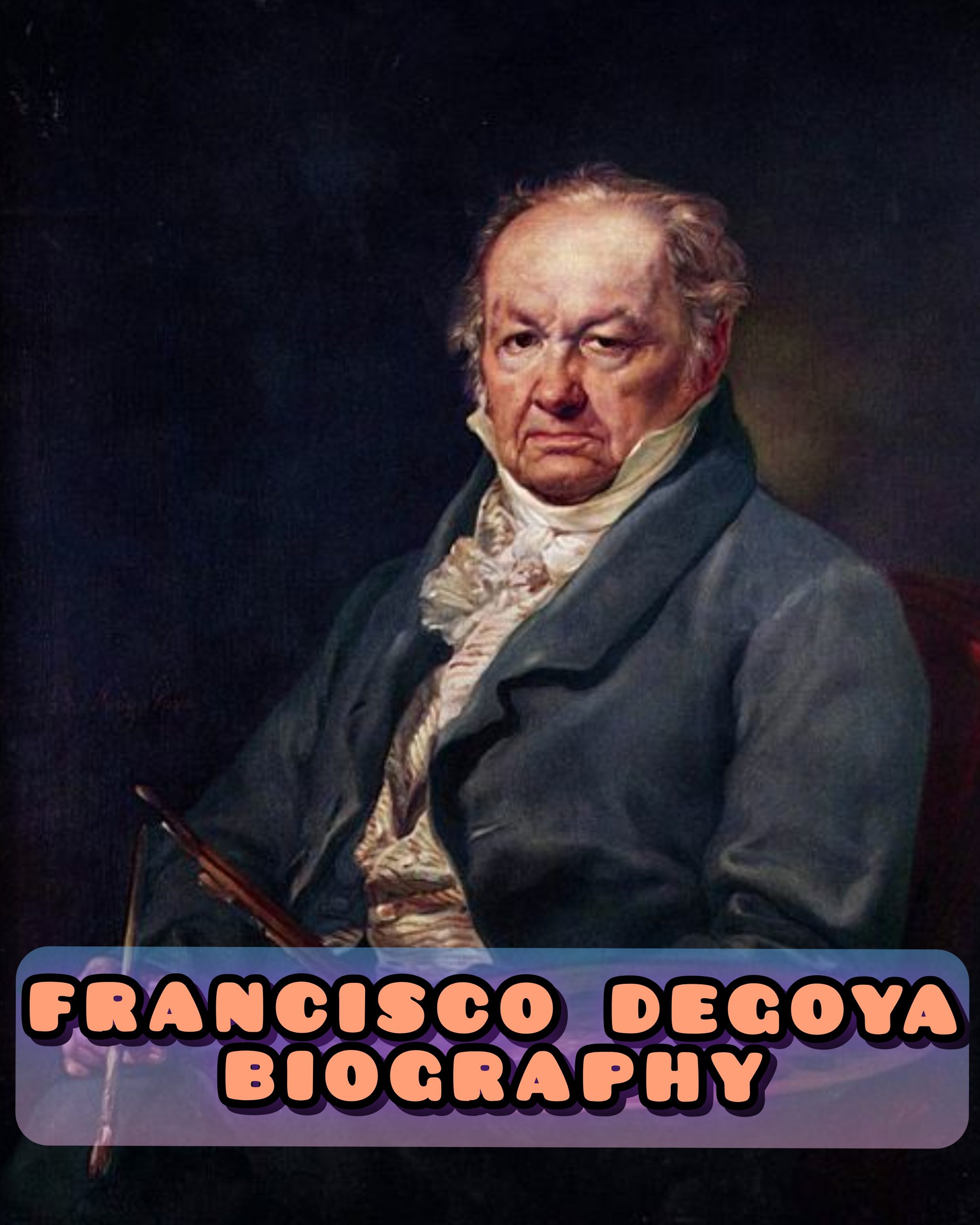
Francisco José de Goya y Lucientes was born on March 30, 1746, in the small village of Fuendetodos, Aragón, Spain, near Zaragoza. He was the son of José Benito de Goya y Franque, a master gilder, and Gracia Lucientes y Salvador, who came from a family with some local standing. Goya grew up in Zaragoza, where his family’s artistic environment and the region’s rich cultural traditions helped shape his early interest in painting.
As a young man, Goya began his formal artistic training in Zaragoza, studying under the painter José Luzán y Martínez, who had himself trained in Naples. Goya later traveled to Madrid, where he sought opportunities to develop his career and compete for recognition. In 1769, he traveled to Italy, studying the works of Renaissance and Baroque masters and gaining valuable experience that broadened his artistic ambitions.
After returning to Spain, Goya began receiving important commissions, including work connected with the Royal Tapestry Factory in Madrid. His tapestry designs brought him increasing attention and helped establish his reputation as a talented young artist. In 1773, he married Josefa Bayeu, the sister of fellow painter Francisco Bayeu, who was an influential figure in Madrid’s artistic circles. This marriage and Goya’s growing professional connections helped open the way for his eventual rise within the Spanish royal court.
Francisco de Goya Education
Francisco de Goya received his earliest formal artistic education in Zaragoza, where he studied under the respected painter José Luzán y Martínez. Luzán had trained in Naples and introduced Goya to the traditions of Italian and European painting. During these formative years, Goya developed his skills in drawing, composition, color and religious painting, while studying the techniques of established masters.
Goya later moved to Madrid, where he sought to advance his artistic training and career. He became associated with the influential painter Francisco Bayeu, whose guidance and connections helped him gain greater exposure within Madrid’s competitive artistic community. Goya also entered competitions organized by the Royal Academy of San Fernando, although his early attempts to win a scholarship were unsuccessful.
In 1769, Goya traveled to Italy at his own expense to further his artistic education. He visited Rome, where he studied classical sculpture, Renaissance art and the works of leading Italian painters. His Italian journey exposed him to a broader range of artistic styles and techniques and helped refine his approach to composition and figure painting. After returning to Spain, Goya used this experience to strengthen his professional career, eventually securing important commissions and becoming one of the leading artists of the Spanish court.
Francisco de Goya Career
Francisco de Goya’s professional career began to gain momentum after his return from Italy in the early 1770s. He received commissions for religious paintings and, in 1775, began working on designs for tapestries at the Royal Tapestry Factory in Madrid. His colorful scenes of everyday Spanish life, festivals and popular customs attracted attention and helped establish him within Madrid’s artistic circles. His marriage to Josefa Bayeu, sister of the influential painter Francisco Bayeu, also strengthened his connections in the Spanish art world.
Goya’s reputation continued to grow, and in 1786 he was appointed court painter to King Charles III of Spain. He later became court painter to Charles IV, producing portraits of the royal family, aristocrats and other prominent figures. Works such as The Family of Charles IV demonstrated his ability to portray powerful people while also revealing his distinctive realism and sharp observation. Although he worked within the traditions of court painting, Goya gradually developed a more personal and psychologically complex style.
The political and social upheavals of the late 18th and early 19th centuries profoundly influenced Goya’s later career. The Peninsular War and its brutality inspired works such as The Disasters of War and The Third of May 1808, which presented the suffering of ordinary people rather than glorifying military conflict. In his later years, Goya produced increasingly dark and experimental works, including the famous Black Paintings. He eventually left Spain for Bordeaux, France, in 1824, where he continued creating art until his death in 1828. His career ultimately positioned him as a crucial bridge between traditional European painting and modern art.
Francisco de Goya Personal Life and Family
Francisco de Goya was born into the family of José Benito de Goya y Franque, a skilled master gilder, and Gracia Lucientes y Salvador. He grew up in Fuendetodos and Zaragoza, Aragón, alongside his siblings. His family was not part of the Spanish aristocracy, but his father’s craft and the family’s connections in Zaragoza gave Goya an environment in which his artistic ambitions could develop. His early years also brought him into contact with Francisco Bayeu, an established painter who later became an important professional and family connection.
In 1773, Goya married Josefa Bayeu, the sister of Francisco Bayeu. The couple had several children, although most did not survive infancy or childhood. Their best-known surviving child was Francisco Javier de Goya y Bayeu, born in 1784, who later became an artist himself. Goya’s marriage to Josefa also connected him to an influential artistic family and helped strengthen his position within Madrid’s cultural and professional circles. There is no well-documented record of a major engagement or fiancé before his marriage to Josefa.
Goya’s later personal life was marked by illness, deafness, political upheaval and increasing isolation. After becoming profoundly deaf following a serious illness in the 1790s, his art became increasingly introspective and sometimes dark. In his later years, he developed a close relationship with Leocadia Zorrilla de Weiss, who lived with him in Bordeaux after he left Spain; she was married to another man at the time, so she is generally described as his companion rather than his wife. Goya spent his final years in Bordeaux, France, where he continued painting and experimenting with new artistic techniques before his death on April 16, 1828.
Francisco de Goya Age, Religion, Nationality, Height and Physical Appearance
Francisco de Goya was 82 years old when he died on April 16, 1828, having been born on March 30, 1746, in Fuendetodos, Aragón, Spain. He was Spanish by nationality and was raised within the Roman Catholic tradition, which was deeply influential in 18th-century Spanish society and in much of his early artistic work. However, his later paintings and writings often revealed a complex and sometimes critical relationship with religious institutions and social conventions.
There is no reliable historical record of Goya’s exact height, so a precise figure should not be stated as fact. Contemporary portraits and surviving self-portraits depict him as a mature man with a solid build, dark hair that later became gray, and distinctive facial features. As he aged, his appearance changed considerably, particularly after the severe illness that left him profoundly deaf in the early 1790s.
Goya’s best-known self-portraits show a serious, observant expression that contrasts with the lighter public image often associated with court painters. His appearance in later life became particularly recognizable through portraits showing his aging face and thinning hair. Because photographic records did not exist during his lifetime, descriptions of his physical appearance come primarily from paintings, self-portraits and written accounts, making details such as his exact height impossible to verify.
Francisco de Goya Death and Cause of Death
Francisco de Goya died on April 16, 1828, at the age of 82, in Bordeaux, France, where he had spent the final years of his life. He had left Spain several years earlier and settled in Bordeaux in 1824, joining a community of Spanish expatriates. Despite his advanced age and declining health, Goya remained artistically active during his final years and continued producing paintings, drawings and prints.
The exact cause of Goya’s death is not definitively established. Historical accounts indicate that he experienced significant health problems throughout his later life, including the severe illness that left him deaf decades earlier. In the months before his death, his health deteriorated, and he reportedly suffered a serious illness that left him increasingly weak. However, there is no reliable modern medical diagnosis that can establish a specific cause of death with certainty.
Goya was initially buried in Bordeaux, but his remains were later transferred to Madrid. When his grave was opened in 1888, his body was found to be missing its skull, an unexplained mystery that has persisted in accounts of his life. His remains were eventually reburied in the Real Ermita de San Antonio de la Florida in Madrid, beneath the frescoes he had painted decades earlier.
Francisco de Goya Net Worth
There is no reliable historical record of Francisco de Goya’s exact net worth at the time of his death, so a modern figure in dollars would be speculative. However, surviving financial records show that Goya became financially successful through a combination of royal salaries, private commissions, portrait work, investments and teaching. In 1786, when he was appointed Painter to the King, he received an annual salary of 15,000 reales. Records also indicate that he was earning roughly 28,000 reales a year from private commissions, while his Academy salary and investment income added another 12,000–13,000 reales annually.
Goya’s income increased substantially as his position at court rose. By 1799, when he was appointed First Court Painter, his official salary reached 50,000 reales per year, in addition to 500 ducats annually for carriage expenses. He also continued earning money from portraits and commissions for aristocratic families, including the Duke and Duchess of Osuna, as well as other wealthy patrons. His financial position was sufficiently strong for him to purchase property, own several carriages and invest part of his income in financial institutions.
Therefore, rather than assigning Goya an invented modern “net worth,” it is more accurate to describe him as a wealthy and financially secure artist by the height of his career. His documented earnings, property ownership and investments demonstrate that he accumulated considerable wealth for an artist of his period. Any modern estimate of his net worth would require converting 18th- and 19th-century assets and income into today’s currency, which is highly uncertain and should be presented only as an approximation, not as a verified figure.
Legacy
Francisco de Goya left an extraordinary legacy as one of the most influential Spanish artists in history and a crucial figure in the transition from 18th-century European art to modern art. His career moved beyond traditional court painting, religious subjects and portraiture into increasingly personal and psychologically intense works. Paintings such as The Third of May 1808, The Family of Charles IV, The Nude Maja and The Clothed Maja remain among his most recognized creations, while his print series The Disasters of War established a powerful visual language for depicting the suffering caused by conflict.
Goya’s influence became particularly evident in his later and darker works. The Black Paintings, created on the walls of his house near Madrid, demonstrated an extraordinary willingness to explore fear, violence, madness, aging and human suffering. His loose brushwork, dramatic compositions and willingness to confront disturbing subjects anticipated developments associated with Romanticism, Impressionism and modern art. Artists including Édouard Manet, Pablo Picasso and Francis Bacon were among those influenced by aspects of Goya’s work.
Today, Goya is remembered not only as a celebrated court painter but also as an artist who used his work to examine war, political power, social injustice and the darker aspects of human nature. His paintings and prints are preserved in major museums and collections, particularly in Spain, and his former home, the Quinta del Sordo, remains closely associated with the Black Paintings. Nearly two centuries after his death, Goya’s work continues to attract scholars, artists and museum audiences, reinforcing his reputation as a pioneering figure whose art helped shape the direction of modern visual culture.
Conclusion
Francisco de Goya remains one of the most important and influential artists in Spanish and European history. From his early training in Zaragoza and Italy to his rise as a leading painter of the Spanish royal court, Goya continually evolved and used his art to capture both the beauty and darker realities of human life. His experiences with illness, deafness, war and political upheaval profoundly shaped his later work, producing masterpieces such as The Third of May 1808, The Disasters of War and the Black Paintings. Although he died in Bordeaux in 1828 at the age of 82, Goya’s bold artistic vision, emotional depth and unflinching examination of society continue to influence artists and audiences around the world, securing his place as a pioneer of modern art.
Frequently Asked Questions About Francisco de Goya
Who was Francisco de Goya?
Francisco de Goya was a Spanish painter and printmaker best known for his royal portraits, The Third of May 1808, The Disasters of War and the Black Paintings. He is regarded as an important bridge between the Old Masters and modern art.
When and where was Francisco de Goya born?
Francisco de Goya was born on March 30, 1746, in Fuendetodos, Aragón, Spain. He was raised and trained primarily in nearby Zaragoza before developing his career in Madrid.
How old was Francisco de Goya when he died?
Francisco de Goya was 82 years old when he died on April 16, 1828, in Bordeaux, France.
What was Francisco de Goya’s nationality?
Francisco de Goya was Spanish. He was born in Aragón and spent most of his professional career in Spain before moving to France during the final years of his life.
Who was Francisco de Goya’s wife?
Francisco de Goya’s wife was Josefa Bayeu, whom he married in 1773. She was the sister of painter Francisco Bayeu, an important figure in Goya’s artistic career.
Did Francisco de Goya have children?
Yes. Goya and Josefa Bayeu had several children, although most died young. Their best-known surviving child was Francisco Javier de Goya y Bayeu, who also became an artist.
What religion was Francisco de Goya?
Goya was raised in the Roman Catholic tradition, reflecting the religious environment of 18th-century Spain. He produced numerous religious works, particularly during the early part of his career.
What was Francisco de Goya’s most famous painting?
One of Goya’s most famous paintings is The Third of May 1808, which depicts the execution of Spanish civilians by Napoleon’s forces. It is widely regarded as one of the most powerful anti-war paintings in Western art.
What are Goya’s Black Paintings?
The Black Paintings are a group of 14 dark and disturbing paintings that Goya created on the walls of his house near Madrid between approximately 1819 and 1823. They explore themes such as violence, fear, aging, madness and death.
Why did Francisco de Goya become deaf?
Goya became profoundly deaf after a severe illness around 1792–1793. The exact medical cause of his illness has never been conclusively established.
Where did Francisco de Goya die?
Francisco de Goya died in Bordeaux, France, on April 16, 1828. He had moved to France in 1824 and spent his final years there.
What was Francisco de Goya’s cause of death?
The exact cause of Goya’s death is not known with certainty. Historical records indicate that his health deteriorated during his final months, but there is no definitive medical diagnosis establishing the precise cause.
What was Francisco de Goya’s net worth?
There is no reliable record of Goya’s exact net worth in modern currency. However, surviving financial records show that he became a financially successful artist through royal salaries, private commissions, portraits, property and investments.
What was Francisco de Goya’s height?
Goya’s exact height is not reliably documented. Because there are no photographs or dependable measurements from his lifetime, claims giving a precise height should be treated as estimates.
What is Francisco de Goya famous for?
Goya is famous for his portraits of Spanish royalty, his depictions of war and political violence, and his innovative later works. His best-known works include The Third of May 1808, The Nude Maja, The Family of Charles IV, The Disasters of War and the Black Paintings.
Why is Francisco de Goya important?
Francisco de Goya is important because his work helped transform European art from traditional academic and court painting toward the more personal, emotional and experimental approaches associated with modern art. His influence can be seen in later artists such as Manet, Picasso and Francis Bacon.