Claudius Ptolemy was born around AD 100, although the exact date and place of his birth remain unknown. Historical evidence suggests that he lived and worked in Alexandria, Egypt, an important intellectual center of the Roman Empire. Very little is known about his parents, family background, childhood, or upbringing, and no reliable ancient source provides detailed information about his early years.
Ptolemy grew up during a period when Alexandria was a major center of learning, bringing together Greek mathematical, astronomical and philosophical traditions. Although details of his formal education have not survived, his later writings demonstrate an exceptional knowledge of mathematics, geometry, astronomy and geography. His work also shows that he studied and built upon the achievements of earlier Greek scholars, particularly Hipparchus, whose astronomical observations and methods strongly influenced Ptolemy.
By the middle of the 2nd century AD, Ptolemy had established himself as a serious scholar in Alexandria. His surviving astronomical observations are generally associated with the period between AD 127 and 141, providing important evidence about his activities and the development of his astronomical theories. From this intellectual foundation, he went on to produce works such as the Almagest and Geographia, which eventually made him one of the most influential scholars of the ancient world.
Education of Claudius Ptolemy
Very little is known about Claudius Ptolemy’s formal education, as no surviving historical source identifies his teachers, schools, or specific educational institutions. He appears to have received a highly developed education in the mathematical and philosophical traditions of the Greek-speaking world. His later writings demonstrate extensive knowledge of geometry, arithmetic, astronomy, geography, optics, and related fields.
Ptolemy’s intellectual development was strongly influenced by earlier Greek scholars. He drew particularly on the astronomical work of Hipparchus, while also building upon the mathematical tradition associated with Euclid and other ancient thinkers. Rather than simply preserving earlier ideas, Ptolemy organized, refined, and extended them into mathematical systems that could be used to explain and predict astronomical phenomena.
His years of study eventually led him to conduct astronomical observations and develop his own theories while working in Alexandria, Egypt. His approach combined mathematical calculations with observations of the heavens, laying the foundation for his most famous work, the Almagest. Although the details of his schooling remain unknown, the sophistication of his surviving works shows that Ptolemy possessed an advanced education and belonged to the highest level of scientific scholarship of his era.
Career of Claudius Ptolemy
Claudius Ptolemy built his career as a mathematician, astronomer, geographer, and scholar in Alexandria, Egypt, during the 2nd century AD. Unlike many modern scientists, Ptolemy did not follow a clearly documented professional career path, and little is known about his personal employment or official positions. His reputation instead comes from the substantial body of scholarly works he produced and the astronomical observations he recorded.
Ptolemy’s most influential work was in astronomy. Between roughly AD 127 and 141, he made and recorded observations of celestial bodies and developed a mathematical model of the universe in which Earth remained stationary at the center. His astronomical system, presented in the Almagest, used devices such as deferents, epicycles, and the equant to explain the apparent movements of the Sun, Moon, planets, and stars. The system became the dominant mathematical model of astronomy in Europe and the Islamic world for many centuries.
Beyond astronomy, Ptolemy made important contributions to geography, optics, mathematics, astrology, and music theory. His Geographia compiled geographical coordinates and provided methods for representing the known world on maps, while his Tetrabiblos became a major work on ancient astrology. Through these works, Ptolemy established a lasting intellectual legacy, influencing scholars and mapmakers for centuries after his death.
Personal Life and Family of Claudius Ptolemy
Very little is known about Claudius Ptolemy’s personal life and family. Unlike some ancient rulers and philosophers, Ptolemy left no reliable account of his parents, siblings, wife, children, or other close relatives. Historical sources focus almost entirely on his scholarly work, particularly his studies of astronomy, geography, mathematics, and astrology. As a result, claims about his family life should be treated cautiously because many details found online are speculative or unsupported.
There is also no reliably documented wife, fiancée, or romantic partner associated with Ptolemy in the surviving historical record. No credible ancient source identifies a spouse or fiancé by name, and there is no established evidence that he had children. The name “Theon” sometimes appears in discussions surrounding ancient Alexandrian scholarship, but it should not be presented as Ptolemy’s family member or partner without evidence. Similarly, Ptolemy should not be confused with members of the Ptolemaic dynasty of Egyptian kings, including Cleopatra VII, because there is no established family relationship between the astronomer and that royal dynasty.
Ptolemy appears to have devoted much of his life to intellectual and scientific pursuits in Alexandria, where he studied the heavens and produced works that shaped astronomy and geography for centuries. Although his private relationships remain unknown, his surviving writings reveal a scholar deeply engaged with the scientific traditions of his time. The absence of information about his family is therefore not evidence that he had no family; rather, it reflects how little biographical information about his private life has survived.
Death and Cause of Death of Claudius Ptolemy
Claudius Ptolemy is believed to have died around AD 170, although the exact date of his death is unknown. Most historical accounts place his death in the 2nd century AD, after a scholarly career spent largely in Alexandria, Egypt. Unlike some famous figures from antiquity, there is no reliable contemporary account describing the final period of Ptolemy’s life or the circumstances surrounding his death.
The cause of Ptolemy’s death is unknown. No surviving historical source records whether he died from illness, old age, an accident, or another cause. Consequently, claims identifying a specific disease or medical condition as the cause of his death should not be presented as established fact.
Ptolemy’s death brought an end to the life of one of antiquity’s most influential scholars, but his ideas continued to shape scientific thought for centuries. His astronomical system remained influential until the rise of heliocentric astronomy, while his geographical work continued to influence mapmaking. His surviving writings ensured that his intellectual legacy endured long after his death.
Age, Religion, Nationality, Height and Physical Appearance of Claudius Ptolemy
Claudius Ptolemy was born around AD 100 and is generally believed to have died sometime in the 2nd century AD, possibly around AD 170. This would place his age at death at approximately 70 years, although his exact birth and death dates are uncertain, so his precise age cannot be confirmed. Ptolemy lived and worked mainly in Alexandria, Egypt, which was then part of the Roman Empire.
Ptolemy’s religion and personal religious beliefs are not known with certainty. His writings reflect the intellectual and cultural environment of the Greco-Roman world, but there is insufficient evidence to assign him a specific religious identity with confidence. In terms of nationality, modern categories do not fit neatly onto his life. He lived under Roman rule, wrote in Greek, and was associated with Alexandria, so he is commonly described as an Alexandrian Greek or Greco-Roman scholar rather than given a modern national identity.
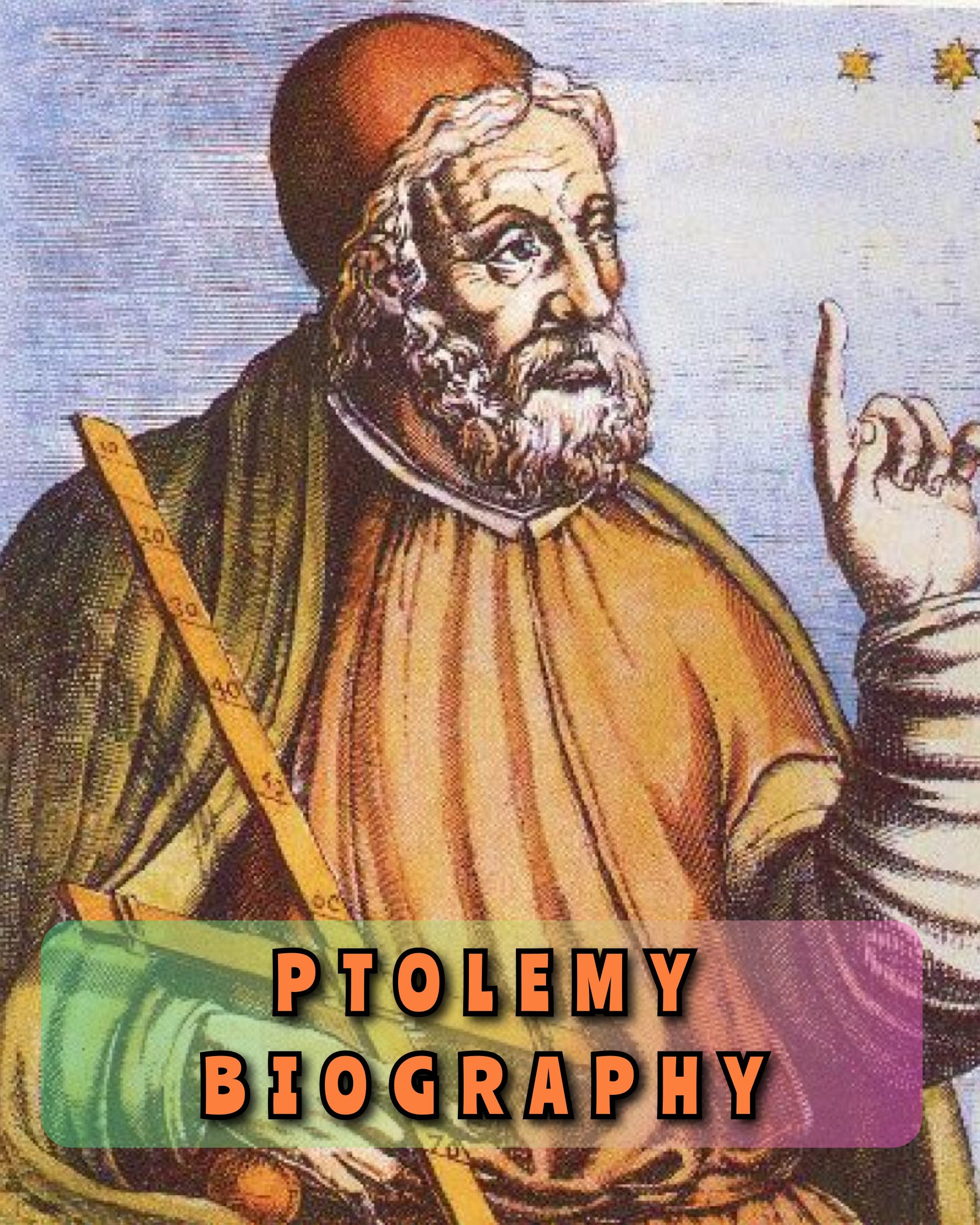
There is no reliable historical record of Ptolemy’s height, weight, or physical appearance. No authenticated contemporary portrait or detailed physical description provides enough evidence to determine what he looked like. Images commonly labeled as portraits of Ptolemy were created long after his lifetime and should therefore be regarded as artistic representations rather than accurate depictions of his appearance.
Claudius Ptolemy Net Worth
Estimating Claudius Ptolemy’s net worth is not possible in the modern sense because he lived in the 2nd century AD, and there are no surviving records of his personal wealth, property, investments, salary, or financial accounts. Historical sources provide very little information about his private life, although evidence suggests that his family was sufficiently affluent to allow him to devote himself to intellectual pursuits.
Ptolemy was primarily a scholar, astronomer, mathematician and geographer, and there is no reliable evidence establishing a specific salary or official income for his work. He may have had access to resources associated with Alexandria’s scholarly environment, but historians cannot determine how much he earned or owned. His surviving works show that he spent decades conducting astronomical observations and scholarly research, including the work that eventually became the Almagest.
Therefore, Ptolemy’s net worth is best listed as “Unknown” rather than assigning an invented monetary figure. Any website claiming an exact modern-dollar net worth for him would be speculative. For a biography, a reasonable wording is: “Claudius Ptolemy’s net worth cannot be reliably estimated because no records of his income or personal assets survive. However, evidence that his family was sufficiently affluent to support his intellectual career suggests that he was not dependent on ordinary manual employment.”
Legacy of Claudius Ptolemy
Claudius Ptolemy left one of the most influential intellectual legacies of the ancient world, particularly through his work in astronomy and mathematics. His Almagest presented a comprehensive mathematical model of the heavens and organized centuries of Greek astronomical knowledge. Although his Earth-centered model was eventually replaced by the heliocentric theories of Nicolaus Copernicus, Ptolemy’s methods remained central to astronomy for many centuries.
Ptolemy also had a lasting impact on geography and cartography through his Geographia. The work compiled geographical coordinates for numerous locations and described mathematical methods for representing the curved surface of Earth on maps. Centuries later, European scholars rediscovered and studied the work, contributing to the revival of classical geographical knowledge and influencing the development of Renaissance mapmaking.
Beyond astronomy and geography, Ptolemy’s writings on optics, astrology, mathematics, and music theory broadened his influence across several fields of learning. His works were preserved, translated, and studied by scholars in the Byzantine, Islamic, and later European intellectual traditions. Despite major changes in scientific understanding, Ptolemy remains remembered as one of antiquity’s most important scholars and as a major figure in the history of astronomy and geography.
Conclusion
Claudius Ptolemy remains one of the most influential scholars of the ancient world, remembered for his groundbreaking contributions to astronomy, mathematics, geography, and related fields. Although little is known about his personal life, family, wealth, or exact circumstances of death, his surviving works provide a lasting record of his intellectual achievements. His Almagest shaped astronomical thought for centuries, while his Geographia influenced cartography and geographical scholarship. Even though later discoveries overturned some of his theories, Ptolemy’s systematic approach to studying and explaining the natural world secured his place as a major figure in the history of science.
Frequently Asked Questions About Claudius Ptolemy
Who was Claudius Ptolemy?
Claudius Ptolemy was a 2nd-century Greek-speaking astronomer, mathematician, geographer and scholar who lived and worked in Alexandria, Egypt. He is best known for the Almagest and Geographia.
When was Claudius Ptolemy born?
Claudius Ptolemy was probably born around AD 100. His exact birth date and birthplace are unknown.
When did Claudius Ptolemy die?
Ptolemy is generally believed to have died around AD 170, although the exact date of his death is uncertain.
How old was Claudius Ptolemy when he died?
If he was born around AD 100 and died around AD 170, Ptolemy was approximately 70 years old. His exact age cannot be confirmed because his birth and death dates are uncertain.
What was Claudius Ptolemy famous for?
Ptolemy was famous for developing a detailed Earth-centered model of the universe and for his influential works on astronomy and geography. His Almagest became one of the most important astronomical texts of antiquity.
What was Ptolemy’s greatest contribution to astronomy?
Ptolemy’s greatest contribution was his mathematical model of the geocentric universe, which used deferents, epicycles and the equant to explain planetary movements. The model remained influential for more than a millennium.
What is Ptolemy’s Almagest?
The Almagest is Ptolemy’s major astronomical treatise, containing mathematical models and astronomical observations concerning the Sun, Moon, planets and stars. It became a foundational work of ancient astronomy.
What did Ptolemy contribute to geography?
Ptolemy’s Geographia compiled geographical coordinates for many locations and described mathematical methods for creating maps. It became highly influential in the later development of cartography.
Where did Claudius Ptolemy live and work?
Ptolemy lived and worked mainly in Alexandria, Egypt, then an important intellectual center within the Roman Empire.
What was Claudius Ptolemy’s nationality?
Modern nationality categories do not fit Ptolemy neatly. He was a Greek-speaking scholar associated with Alexandria in Roman Egypt and wrote his major works in Greek.
What religion did Claudius Ptolemy follow?
Ptolemy’s personal religion is unknown. Although his writings reflect the Greco-Roman intellectual world, there is insufficient evidence to identify his specific religious beliefs.
Did Claudius Ptolemy have a wife or children?
There is no reliable historical evidence identifying Ptolemy’s wife, fiancée, children, parents, or siblings. His surviving biographies and writings provide very little information about his private life.
What was Claudius Ptolemy’s net worth?
Ptolemy’s net worth is unknown because no reliable records of his salary, property, savings or personal assets survive. Assigning him a modern monetary net worth would be speculative.
What was Claudius Ptolemy’s height?
Ptolemy’s height is unknown. No reliable ancient source provides measurements or a detailed physical description of him.
Why is Claudius Ptolemy important today?
Ptolemy remains important because his works influenced astronomy, mathematics, geography and cartography for centuries. His methods and writings played a major role in transmitting ancient scientific knowledge to later civilizations.
Was Claudius Ptolemy related to Cleopatra?
There is no established evidence that the astronomer Claudius Ptolemy was related to Cleopatra VII. He should not be confused with the members of the Ptolemaic royal dynasty who ruled Egypt.