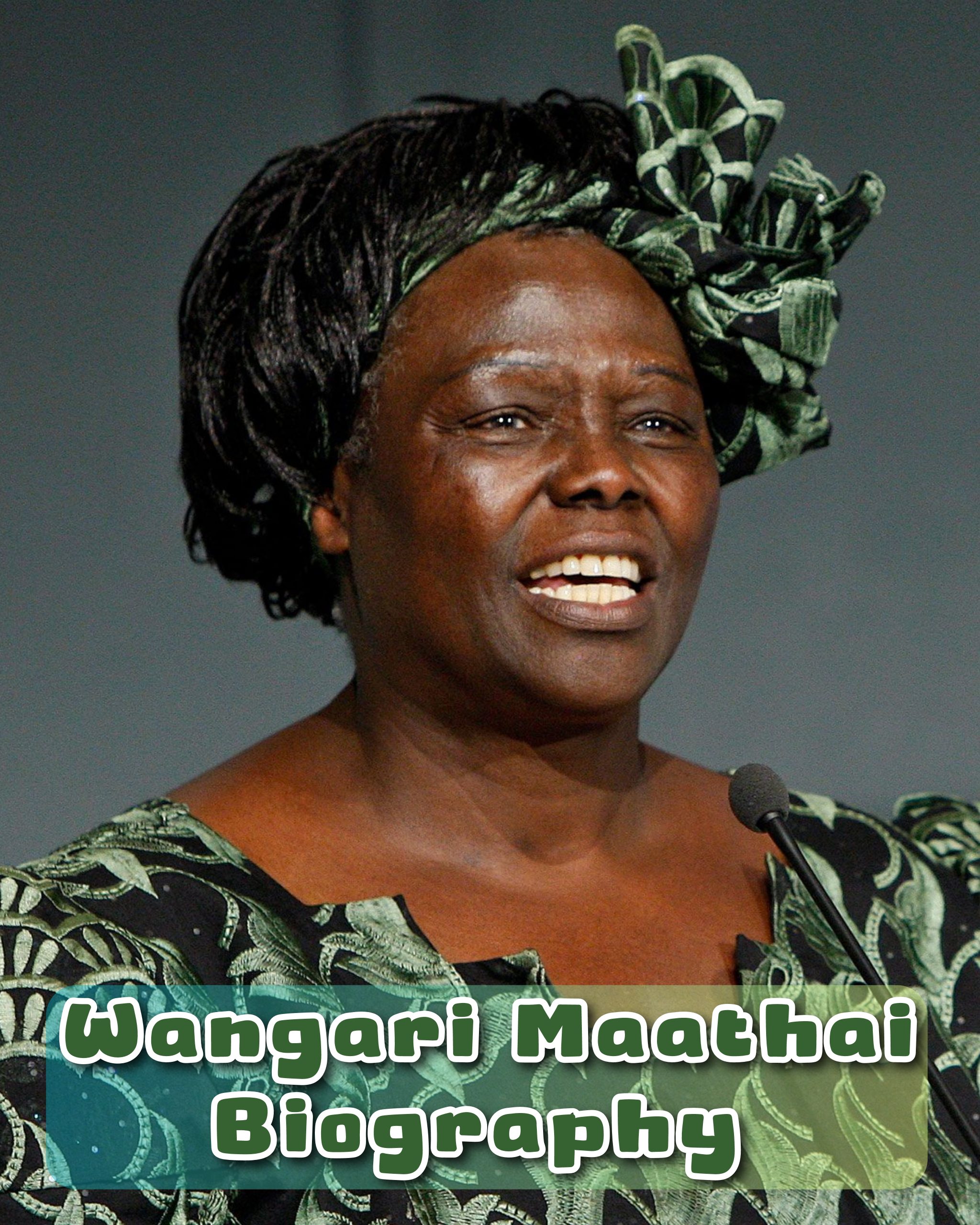
Wangari Muta Maathai was born on April 1, 1940, in Ihithe, in the Nyeri area of central Kenya, which was then part of British-ruled Kenya. She was born into a Kikuyu family to Muta Njugi and Wanjiru Muta. Her father worked as a tenant farmer, and Wangari grew up in a rural environment where farming, forests, streams and access to natural resources were important parts of everyday life. Her early exposure to the countryside would later influence the environmental ideas that became central to her life’s work.
At a time when formal education for African girls was far from guaranteed, Maathai showed exceptional academic ability. She began her schooling at Ihithe Primary School and later attended St. Cecilia’s Intermediate Primary School at the Mathari Catholic Mission in Nyeri. She subsequently attended Loreto High School in Limuru, where she excelled academically. Her education also introduced her to Catholicism, a faith that remained an important part of her identity.
Maathai’s childhood was also shaped by the political and social changes taking place in colonial Kenya. Her family moved between rural areas as her father sought agricultural work, exposing her to different aspects of Kenyan rural life. Her elder brother Nderitu reportedly encouraged the family to allow Wangari to attend school, an opportunity that proved transformative. Her academic achievements eventually placed her among a group of Kenyan students selected for overseas study through the program commonly known as the Kennedy Airlift.
Wangari Maathai Education
Wangari Maathai’s higher education began in the United States after she was selected for the Kennedy Airlift, an educational initiative that enabled promising young East Africans to study abroad. In 1960, she travelled to the United States and enrolled at Mount St. Scholastica College in Atchison, Kansas, now known as Benedictine College. She studied biological sciences and graduated with a bachelor’s degree in 1964.
After completing her undergraduate studies, Maathai pursued postgraduate education at the University of Pittsburgh, where she earned a Master of Science degree in biological sciences. Her time in the United States broadened her intellectual and social outlook. She encountered environmental restoration efforts in Pittsburgh and was also exposed to the civil-rights and social-justice movements of the period, experiences that later influenced her approach to environmental and political activism.
Maathai continued her doctoral studies in Germany and at the University of Nairobi. In 1971, she earned a PhD in veterinary anatomy from the University of Nairobi, becoming the first woman in East and Central Africa to earn a doctorate. She later became the first woman to chair a department at the University of Nairobi and one of the first women in the region to attain senior academic positions. Her educational achievements were therefore not only personal milestones but also significant breakthroughs for African women in higher education.
Wangari Maathai Career
Wangari Maathai began her professional career in academia, teaching and conducting research in veterinary anatomy at the University of Nairobi. She rose through the academic ranks and became chair of the Department of Veterinary Anatomy in 1976 and an associate professor in 1977. Her appointments were historic because she was the first woman in the region to reach those positions.
Her career gradually expanded beyond university life into women’s advocacy and environmental conservation. She became active in the National Council of Women of Kenya, serving as its chairwoman from 1981 to 1987. Through her interaction with rural women, she learned about shortages of firewood, declining food supplies, drying streams and environmental degradation. These experiences helped inspire her community-based tree-planting initiative.
In 1977, Maathai founded the Green Belt Movement, initially encouraging women to plant trees to address deforestation, soil erosion, shortages of fuelwood and declining agricultural productivity. The movement eventually developed into a much broader campaign linking environmental conservation with women’s rights, democracy, human rights and sustainable development. The Nobel Committee later recognized this holistic approach when it awarded her the 2004 Nobel Peace Prize.
Maathai also entered Kenyan politics. In 2002, she was elected to Kenya’s Parliament with approximately 98% of the vote and was subsequently appointed Assistant Minister for Environment, Natural Resources and Wildlife. Her political career gave her another platform from which to advocate for environmental protection, democratic governance and social justice.
In 2004, Maathai reached the highest international level of recognition when she received the Nobel Peace Prize for her contribution to sustainable development, democracy and peace. She became the first African woman to win the Nobel Peace Prize and one of the most internationally recognized African environmental and human-rights advocates of her generation.
Wangari Maathai Personal Life and Family
Wangari Maathai married Mwangi Mathai in 1969. Mwangi was also Kenyan and had studied in the United States before becoming involved in business and politics. Their marriage produced three children: Waweru Mathai, Wanjira Mathai and Muta Mathai. The family later experienced marital difficulties, and Wangari and Mwangi eventually divorced in 1979.
Despite the difficulties surrounding her marriage and divorce, Maathai remained closely connected to her children. Her daughter Wanjira Mathai later became an environmental and sustainability advocate and has continued work connected to her mother’s vision. Wanjira has held prominent international roles in environmental and development organizations, making her one of the most visible members of the next generation carrying forward the Maathai family’s environmental legacy.
Maathai was also known for combining her professional life with a strong commitment to faith, community and public service. She was a Catholic and had been involved with the Legion of Mary during her school years. Her public life was characterized by a willingness to challenge political authority, defend vulnerable communities and advocate for women’s participation in leadership.
Wangari Maathai Death and Cause of Death
Wangari Maathai died on September 25, 2011, in Nairobi, Kenya, at the age of 71. She died after a battle with ovarian cancer, with reports describing her death as resulting from complications associated with the disease. Her death prompted tributes from across Kenya, Africa and the international environmental and human-rights community.
Her death marked the end of the life of one of Africa’s most influential environmental activists, but it did not end the movement she created. The Green Belt Movement continues its work in environmental conservation, community empowerment, climate resilience and advocacy, keeping many of Maathai’s ideas active more than a decade after her death.
Wangari Maathai Age, Religion, Nationality, Height and Physical Appearance
Wangari Maathai was 71 years old when she died in 2011. She was Kenyan by nationality and was a Catholic Christian. Her exact height is not reliably documented by authoritative biographical sources, so commonly repeated height figures online should be treated with caution. Photographs from her public life show a distinctive Kenyan woman who frequently appeared in professional clothing and traditional African-inspired attire, often wearing colorful headscarves or other forms of head covering. Her public image became closely associated with her calm but determined demeanor and her advocacy for environmental and social justice.
Wangari Maathai Social Media Presence
Wangari Maathai herself died in 2011, before social-media platforms such as Instagram became a major part of public life. Consequently, there is no reliably verified personal Instagram account that can confidently be attributed to Maathai herself. Some social-media accounts use her name, while others are associated with organizations, fan pages or institutions connected to her legacy. Searches identify an Instagram account using the handle @wangari_maathai, but its historical ownership cannot be independently verified as Maathai’s personal account.
Her legacy is nevertheless represented online by organizations and institutions inspired by her work. The Green Belt Movement maintains an active digital presence and continues to promote environmental conservation, climate resilience, women’s empowerment and community development using tree planting as an entry point.
Wangari Maathai Net Worth
There is no authoritative public record establishing Wangari Maathai’s exact net worth at the time of her death. Online estimates vary considerably and are generally unsupported by audited financial records. For that reason, it would be misleading to present a precise dollar figure as fact.
Maathai’s income during her lifetime came from several professional areas, including her academic career, writing, public speaking, political service and environmental work. She also received major international awards, including the Nobel Peace Prize in 2004, but receiving a prestigious award does not mean that its monetary value should automatically be treated as personal wealth. Her work with the Green Belt Movement was fundamentally an advocacy and community-development enterprise rather than a conventional commercial business.
A more responsible assessment is therefore that Wangari Maathai was a highly accomplished academic, author, public figure and Nobel laureate, but her net worth remains undisclosed and cannot be reliably calculated from available public records. Any website claiming an exact multimillion-dollar net worth should be regarded as an estimate rather than a verified financial figure. Her most measurable contribution was arguably social and environmental rather than financial, with the Green Belt Movement reporting millions of trees grown and communities engaged in conservation.
Legacy
Wangari Maathai’s most enduring institutional legacy is the Green Belt Movement, which she founded in 1977. What began as an effort to help rural Kenyan women respond to environmental problems grew into a globally recognized movement connecting tree planting with poverty reduction, women’s empowerment, environmental protection, democracy and human rights. The movement continues to operate in Kenya and remains focused on ecosystem restoration and community empowerment.
Her legacy also rests on the historic barriers she broke. She became the first woman in East and Central Africa to earn a doctorate, one of the first women to hold senior academic leadership positions at the University of Nairobi, and the first African woman to receive the Nobel Peace Prize. These achievements helped demonstrate that women could occupy influential positions in science, academia, environmental leadership and politics.
More than a decade after her death, Maathai’s ideas remain relevant to debates about climate change, deforestation, women’s leadership and sustainable development. The Green Belt Movement continues to describe its work as an effort to protect forests, restore ecosystems, strengthen climate resilience and improve livelihoods. Her legacy therefore extends beyond the millions of trees associated with her movement: it is also the idea that ordinary communities can become powerful agents of environmental and political change.
Conclusion
Wangari Maathai’s life brought together science, environmental conservation, women’s empowerment, democracy and peace in a way that transformed how the world understood environmental activism. From her rural childhood in Nyeri and groundbreaking academic career to the creation of the Green Belt Movement and her historic 2004 Nobel Peace Prize, she demonstrated how local action could have global significance. Although she died in 2011 at 71 after complications from ovarian cancer, her work continues through the Green Belt Movement, her family and the many environmental and social-justice initiatives influenced by her vision.
Frequently Asked Questions About Wangari Maathai
Who was Wangari Maathai?
Wangari Maathai was a Kenyan environmentalist, academic, political activist and women’s-rights advocate who founded the Green Belt Movement. She won the 2004 Nobel Peace Prize for her contribution to sustainable development, democracy and peace.
When was Wangari Maathai born?
Wangari Maathai was born on April 1, 1940, in Nyeri, Kenya.
How old was Wangari Maathai when she died?
Wangari Maathai was 71 years old when she died on September 25, 2011.
What was Wangari Maathai’s cause of death?
Wangari Maathai died after battling ovarian cancer. She died in Nairobi on September 25, 2011, at the age of 71.
Who was Wangari Maathai’s husband?
Wangari Maathai’s husband was Mwangi Mathai, whom she married in 1969. They later divorced in 1979.
Did Wangari Maathai have children?
Yes. Wangari Maathai and Mwangi Mathai had three children: Waweru Mathai, Wanjira Mathai and Muta Mathai.
What did Wangari Maathai study?
Maathai studied biological sciences, earning her bachelor’s degree from Mount St. Scholastica College in 1964 and a master’s degree from the University of Pittsburgh. She later earned a PhD in veterinary anatomy from the University of Nairobi in 1971.
What was Wangari Maathai famous for?
She was best known for founding the Green Belt Movement, an environmental organization that encouraged communities, particularly women, to plant trees while addressing poverty, environmental degradation and women’s empowerment.
Did Wangari Maathai win the Nobel Peace Prize?
Yes. Wangari Maathai won the Nobel Peace Prize in 2004, becoming the first African woman to receive the award.
What is Wangari Maathai’s religion?
Wangari Maathai was a Catholic Christian. She attended Catholic schools and was involved with the Legion of Mary during her youth.
What was Wangari Maathai’s nationality?
Wangari Maathai was Kenyan. She was born in Nyeri, Kenya, in 1940.
What was Wangari Maathai’s net worth?
Her exact net worth has not been reliably documented. Although she earned income from academia, writing, public service and other professional activities, there is no authoritative financial record establishing a precise net-worth figure.
What is Wangari Maathai’s greatest legacy?
Her greatest legacy is the Green Belt Movement and the model of linking environmental conservation with women’s empowerment, democracy, human rights and sustainable development. The movement remains active in Kenya today.
Is Wangari Maathai on Instagram?
There are Instagram accounts using Wangari Maathai’s name, including @wangari_maathai, but there is no reliable evidence that this was a personal account operated by Maathai herself. She died in 2011, before Instagram became a major social-media platform.