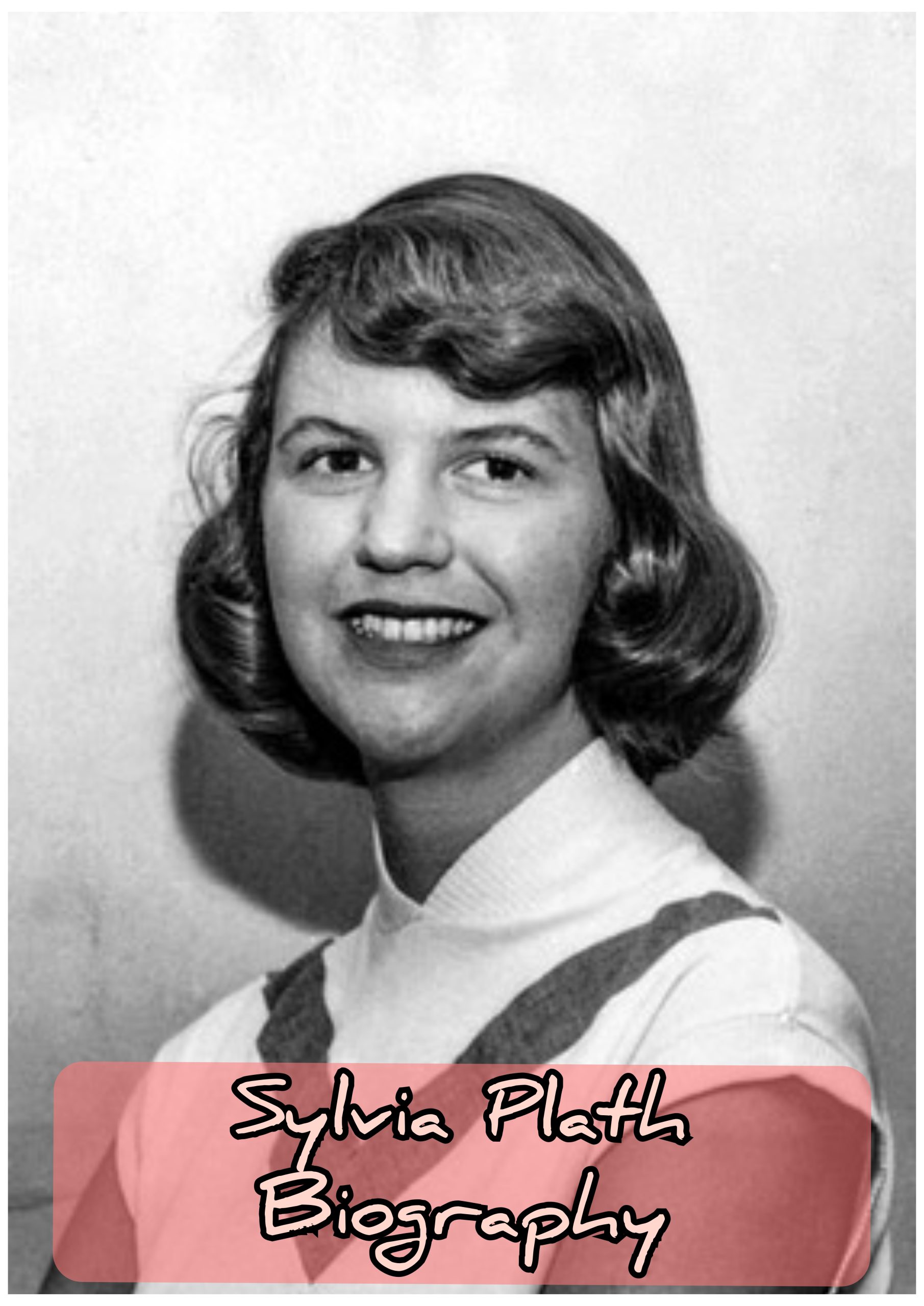
Sylvia Plath was born on October 27, 1932, in Boston, Massachusetts, United States. She was the first child of Otto Plath, a German-born entomologist and professor, and Aurelia Schober Plath, an American of Austrian descent. Her younger brother, Warren, was born in 1935. Plath spent much of her early childhood in the Boston area, where she developed a strong interest in reading, writing, and poetry from a young age. Her talent became evident early, and she began publishing poems while still a teenager.
A major turning point in Plath’s childhood came in 1940 when her father died from complications related to diabetes when she was only eight years old. His death had a lasting emotional impact on her and later became an important theme in some of her poetry, particularly the poem “Daddy.” After her father’s death, her mother raised Sylvia and her brother in Wellesley, Massachusetts. Despite the personal loss, Plath remained academically gifted and continued to excel in school while developing her ambitions as a writer.
Plath attended Bradford Senior High School in Wellesley, where she distinguished herself as an exceptional student and aspiring poet. She wrote extensively, submitted poems and stories to magazines, and won several awards for her writing. After graduating in 1950, she enrolled at Smith College in Northampton, Massachusetts, on a scholarship. Her years at Smith marked the beginning of her professional literary ambitions and eventually led her to Cambridge University in England on a Fulbright Scholarship, setting the stage for the international literary career that would make her one of the most influential American poets of the 20th century.
Sylvia Plath’s Education
Sylvia Plath began her formal education in Massachusetts and quickly distinguished herself as an exceptionally talented student. She attended Bradford Senior High School in Wellesley, where she performed strongly in her studies while continuing to develop her passion for poetry and creative writing. During her teenage years, Plath wrote extensively and began submitting her work to magazines and literary publications. Her academic achievements and growing reputation as a young writer helped prepare her for higher education.
In 1950, Plath enrolled at Smith College in Northampton, Massachusetts, where she studied English and became deeply involved in literature and writing. She was an outstanding student and continued to publish poetry and prose while at college. In 1952, she won the prestigious Mademoiselle magazine fiction contest and later worked as a guest editor for the publication in New York City. Plath graduated from Smith College in 1955 summa cum laude and was awarded a scholarship that enabled her to continue her studies in England.
After Smith College, Plath attended Newnham College at the University of Cambridge in England on a Fulbright Scholarship. She studied English literature and continued writing poetry while immersing herself in British literary culture. Cambridge was also an important period in her personal life, as she met English poet Ted Hughes there in 1956. Plath completed her studies at Cambridge and earned her degree in 1957, establishing an international academic and literary foundation for the writing career that followed.
Sylvia Plath’s Career
Sylvia Plath began her literary career while still a teenager, publishing poems and short stories in magazines and winning writing competitions. After graduating from Smith College, she worked briefly as a guest editor for Mademoiselle magazine in New York in 1953. She later returned to Cambridge, England, where she continued developing her poetry while studying at Newnham College. Her early experiences in America and England provided important material for the intensely personal writing that would later become central to her reputation.
Plath published her first major poetry collection, The Colossus, in 1960. The collection established her as an important emerging poet and demonstrated her distinctive style, characterized by vivid imagery, symbolism, emotional intensity, and carefully controlled language. She also wrote short stories, essays, journals, and other prose during this period. Her most famous novel, The Bell Jar, was published in 1963 under the pseudonym Victoria Lucas. The semi-autobiographical novel explored themes of identity, mental health, depression, relationships, and the pressures placed on women in 1950s society.
The final stage of Plath’s career produced some of her most influential poetry. After separating from Ted Hughes in 1962, she returned to London with their two children and entered an exceptionally productive period of writing. During the final months of her life, she wrote many of the poems later collected in Ariel, including some of her most celebrated works. Although Plath died in February 1963 at the age of 30, her literary career continued to grow in influence after her death. Ariel was published posthumously in 1965, while The Collected Poems later won the Pulitzer Prize for Poetry in 1982, cementing her place as one of the most significant poets of the 20th century.
Sylvia Plath’s Personal Life and Family
Sylvia Plath was born into a close but complicated family. Her father, Otto Plath, was a German-born professor and entomologist, while her mother, Aurelia Schober Plath, was an American teacher who later raised Sylvia and her younger brother, Warren Plath, largely on her own after Otto died in 1940. Her father’s death when Sylvia was eight had a profound influence on her emotional life and later writing. As a young woman, Plath had several romantic relationships, including relationships with Richard Sassoon and Gordon Lameyer, before meeting the man who would become her husband, English poet Ted Hughes.
Plath met Ted Hughes at a Cambridge literary party in February 1956, and the two married on June 16, 1956, in London. Their marriage combined two ambitious literary careers, and the couple lived in both the United States and England before settling for periods in London and Devon. They had two children: daughter Frieda Hughes, born in 1960, and son Nicholas Hughes, born in 1962. Plath’s roles as a wife and mother became closely connected with her writing, and her experiences of domestic life, motherhood, marriage, and women’s expectations frequently appeared in her poetry and prose.
Plath and Hughes’s marriage deteriorated in 1962, and they separated after Hughes began a relationship with Assia Wevill. Plath subsequently moved to London with Frieda and Nicholas and entered one of the most productive periods of her writing career, producing many of the poems later published in Ariel. Despite the difficulties in her personal life, her children remained an important part of her world during her final months. Plath died on February 11, 1963, at the age of 30. Her daughter Frieda later became a poet and artist and played an important role in preserving and managing aspects of her parents’ literary legacy.
Sylvia Plath’s Death and Cause of Death
Sylvia Plath died on February 11, 1963, in London, England, at the age of 30. She had recently published her semi-autobiographical novel, The Bell Jar, under the pseudonym Victoria Lucas, and was living in a flat in London with her two young children, Frieda and Nicholas Hughes. Her death came during a particularly difficult period following her separation from her husband, poet Ted Hughes. Her death was ruled a suicide. She had experienced depression for years and had previously survived a serious suicide attempt in 1953. In the months before her death, she was also dealing with the breakdown of her marriage, caring for two young children, and significant emotional difficulties.
Despite her short life, Plath’s death did not end her literary influence. Her poetry collection Ariel was published posthumously in 1965 and became one of the most celebrated poetry collections of the 20th century. Her Collected Poems later won the 1982 Pulitzer Prize for Poetry, making Plath the first poet to receive the Pulitzer posthumously. Her work continues to be studied for its treatment of identity, motherhood, marriage, depression, and personal struggle.
Sylvia Plath’s Age, Religion, Nationality, Height and Physical Appearance
Sylvia Plath was 30 years old when she died on February 11, 1963. She was American by nationality, having been born in Boston, Massachusetts, and later spent significant periods of her life in England. Plath was raised in a Christian environment, although her personal religious views became more complex over time. She explored questions of faith, spirituality, mortality, and belief in some of her writing, but she is not generally identified with a particular religious denomination.
Plath’s exact height is not reliably documented in authoritative biographical sources, so frequently repeated figures online should be treated cautiously. Contemporary photographs and descriptions portray her as a slender, fair-skinned woman with light-colored hair, blue eyes, and distinctive facial features. She was often photographed with her hair styled in a short or shoulder-length fashion, and her appearance changed somewhat throughout different stages of her life.
As a young woman and professional writer, Plath was often described as intelligent, poised, and striking in appearance. Photographs from her college years, marriage to Ted Hughes, and later years show different aspects of her personal style, from the polished appearance of a young academic to the more understated look of a mother and working poet. Her physical appearance, however, has generally been less significant to her enduring legacy than her literary achievements and influence on modern poetry.
Sylvia Plath Net Worth
Sylvia Plath’s exact net worth at the time of her death is not publicly documented, and modern websites that give a specific dollar figure should therefore be treated with caution. Unlike contemporary celebrities, Plath did not have a publicly tracked fortune. Her income came primarily from poetry, short stories, magazine writing, teaching, and book publications. In a 1955 letter to her mother, Plath reportedly calculated that she had earned about $470 from writing during the previous year, while Smith College later paid her $4,200 for nine months of teaching Freshman English in 1957.
Based on these documented earnings and her relatively short professional career, a reasonable historical estimate would place Plath’s personal wealth at death in the low five-figure range in 1963 dollars, rather than the millions sometimes claimed by unreliable celebrity-net-worth websites. Her literary works, particularly The Bell Jar and her poetry, became considerably more valuable after her death. The Bell Jar was described by Cambridge scholarship as the most lucrative of Plath’s literary properties, while royalties from her poetry were eventually placed in trusts for her children, Frieda and Nicholas Hughes.
In 2026, it would be misleading to describe Sylvia Plath as personally having a conventional “net worth,” because her literary estate and future royalties have passed through different forms of management and inheritance over the decades. Her books and poems continue to generate commercial and academic interest, meaning the economic value associated with her work is far greater than what she personally accumulated during her lifetime. Estimated personal net worth at death: approximately $10,000–$25,000 in 1963 dollars (an estimate, not a documented figure).
Legacy
Sylvia Plath left an enduring mark on American literature and is widely regarded as one of the most influential poets of the 20th century. Her intensely personal style helped establish and popularize confessional poetry, a form of writing that explored private experiences, relationships, identity, motherhood, death, and emotional suffering. Her major works, including The Colossus, The Bell Jar, and Ariel, continue to be widely read, studied, and discussed in schools and universities around the world.
Plath’s literary reputation grew significantly after her death. Ariel, published posthumously in 1965, became one of her most celebrated collections, containing poems such as “Lady Lazarus,” “Daddy,” and “Ariel.” Her Collected Poems, edited by her former husband Ted Hughes, was awarded the Pulitzer Prize for Poetry in 1982, nearly two decades after her death. The Bell Jar has also remained an important work of 20th-century literature, particularly for its exploration of female identity, social expectations, ambition, and psychological distress.
Beyond her published works, Plath’s life, journals, letters, and relationship with Ted Hughes have continued to generate biographies, academic research, documentaries, adaptations, and public discussion. Her daughter, Frieda Hughes, became a poet and artist in her own right, while Plath’s literary estate has helped preserve and promote her work for new generations. More than six decades after her death, Sylvia Plath remains a major figure in modern poetry, and her writing continues to influence readers and writers because of its distinctive imagery, emotional intensity, and fearless examination of difficult human experiences.
Conclusion
Sylvia Plath remains one of the most influential and enduring literary figures of the 20th century. Although her life ended tragically at the age of 30, her remarkable body of work—including The Bell Jar, The Colossus, and Ariel—secured her place in literary history. Through her deeply personal poetry and prose, Plath explored identity, love, motherhood, ambition, suffering, and mortality with an honesty that continues to resonate with readers worldwide. Her posthumous Pulitzer Prize, continuing academic study, and lasting influence on modern poetry demonstrate that Sylvia Plath’s literary legacy remains powerful more than six decades after her death.
Frequently Asked Questions About Sylvia Plath
Who was Sylvia Plath?
Sylvia Plath was an American poet, novelist, and short-story writer best known for The Bell Jar, Ariel, and The Colossus. She is widely associated with confessional poetry and remains one of the most influential American writers of the 20th century.
When was Sylvia Plath born?
Sylvia Plath was born on October 27, 1932, in Boston, Massachusetts, United States.
How old was Sylvia Plath when she died?
Sylvia Plath was 30 years old when she died on February 11, 1963, in London, England.
What was Sylvia Plath’s cause of death?
Sylvia Plath’s death was ruled a suicide. She died in London on February 11, 1963, at the age of 30.
Who was Sylvia Plath’s husband?
Sylvia Plath was married to Ted Hughes, the prominent English poet. They married in 1956 and had two children together before separating in 1962.
Did Sylvia Plath have children?
Yes. Sylvia Plath had two children, daughter Frieda Hughes and son Nicholas Hughes, with her husband Ted Hughes.
What is Sylvia Plath most famous for?
Sylvia Plath is most famous for her novel The Bell Jar and poetry collection Ariel. Her work is known for its intense imagery and exploration of identity, relationships, motherhood, depression, and mortality.
What was Sylvia Plath’s education?
Sylvia Plath attended Smith College in Massachusetts and graduated summa cum laude in 1955. She later studied English at Newnham College, University of Cambridge, in England on a Fulbright Scholarship.
What was Sylvia Plath’s nationality?
Sylvia Plath was American. She was born in Boston, Massachusetts, and spent substantial parts of her adult life in England.
What religion was Sylvia Plath?
Sylvia Plath was raised in a Christian environment, but her personal religious beliefs were complex and evolved throughout her life. Her writing frequently explored themes of faith, spirituality, death, and existence.
What was Sylvia Plath’s height?
Sylvia Plath’s exact height is not reliably documented in authoritative biographical sources. Figures commonly published online should therefore be treated as unverified estimates.
What was Sylvia Plath’s net worth?
Sylvia Plath’s exact net worth at the time of her death is not known. Based on documented earnings from teaching and writing, a cautious historical estimate would place her personal wealth in the low five-figure range in 1963 dollars, rather than the much larger figures sometimes claimed online.
What awards did Sylvia Plath receive?
Sylvia Plath received numerous literary honors during and after her lifetime. Most notably, The Collected Poems won the Pulitzer Prize for Poetry in 1982, making her a posthumous Pulitzer Prize winner.
What books did Sylvia Plath write?
Sylvia Plath’s best-known books include The Bell Jar, The Colossus, and Ariel. Her other published works include The Collected Poems, Winter Trees, Crossing the Water, and various collections of prose, letters, and journals.
Why is Sylvia Plath important?
Sylvia Plath is important because her poetry and prose helped transform modern literature through their personal, psychologically intense, and innovative treatment of identity, suffering, relationships, motherhood, and mortality. Her influence continues in contemporary poetry, fiction, feminism, and literary scholarship.