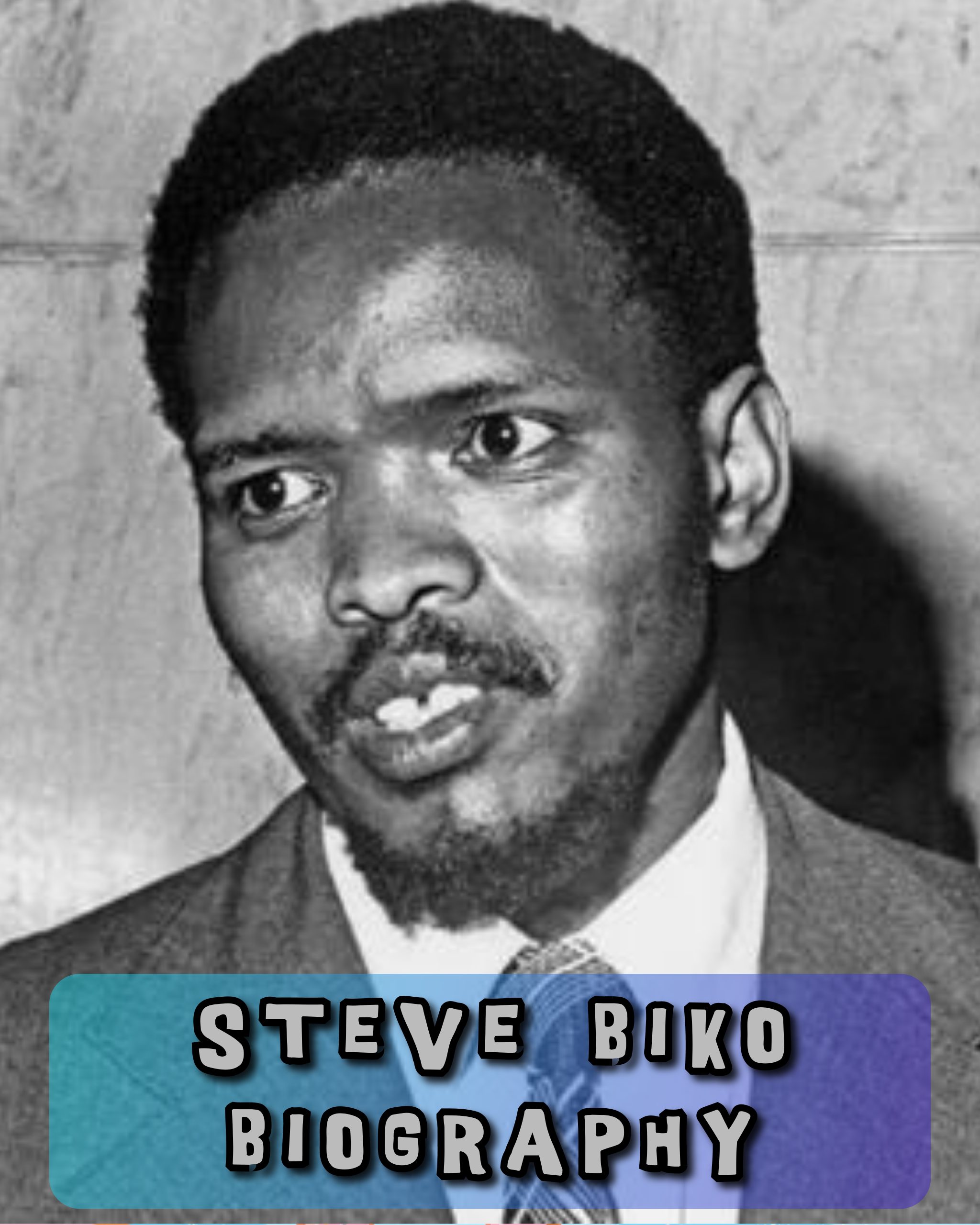
Steve Biko was born Bantu Stephen Biko on 18 December 1946 in Tarkastad, Eastern Cape, South Africa, and grew up during the early years of apartheid. He was raised in a modest family that valued education, discipline and community responsibility. His father, Mzingaye Mathew Biko, worked as a civil servant and later became a teacher, while his mother, Alice ‘Mamcete’ Biko, worked as a domestic worker and was also involved in community activities. Biko had siblings, including his older brother Khaya and sister Nobandile, and his upbringing in the Eastern Cape helped shape his awareness of the social and racial inequalities experienced by Black South Africans.
Biko received his early education in the Eastern Cape before attending Lovedale, a prominent African educational institution. He later enrolled at St. Francis College in Mariannhill, where he developed a strong interest in politics, history and social issues. His academic ability and outspoken personality became increasingly evident during his school years. He was also influenced by the political environment around him, particularly the restrictions imposed on Black South Africans under apartheid.
In 1966, Biko enrolled at the University of Natal Medical School in Durban, where he studied medicine. His university years marked the beginning of his emergence as a prominent student leader and political thinker. He became increasingly critical of organisations in which white leadership dominated the struggle against apartheid and argued that Black South Africans needed to develop confidence, dignity and self-reliance. These ideas eventually led him to become one of the most important figures in the Black Consciousness Movement, which sought to empower Black people psychologically and politically in their struggle against apartheid.
Steve Biko Education
Steve Biko began his formal education in the Eastern Cape, where he attended local schools before studying at Lovedale, a well-known institution for Black South Africans. He later continued his secondary education at St. Francis College in Mariannhill, KwaZulu-Natal, a Catholic school where he developed a strong interest in academic subjects, politics and social issues. His experiences as a Black student during apartheid contributed to his growing understanding of racial discrimination and inequality.
In 1966, Biko was admitted to the University of Natal Medical School in Durban to study medicine. During his time at university, he became actively involved in student politics and joined the National Union of South African Students (NUSAS). However, he became increasingly critical of the organisation’s predominantly white leadership and believed that Black students needed their own independent platform to address the realities of apartheid.
Biko’s university education ultimately became closely connected to his political development. In 1968, he helped establish the South African Students’ Organisation (SASO), which promoted Black Consciousness, self-reliance, dignity and psychological liberation. Although he did not complete his medical degree, his education and intellectual experiences at university played a crucial role in shaping his philosophy and his emergence as one of South Africa’s most prominent anti-apartheid leaders.
Steve Biko Career
Steve Biko’s career was primarily defined by his work as an anti-apartheid activist, student leader, political thinker and writer. While studying medicine at the University of Natal, he became increasingly involved in student politics and emerged as a strong advocate for Black leadership in the struggle against apartheid. In 1968, he helped establish the South African Students’ Organisation (SASO), which became an important platform for promoting Black Consciousness and challenging racial oppression in South Africa.
Through SASO and other organisations associated with the Black Consciousness Movement, Biko encouraged Black South Africans to reject the psychological effects of apartheid and develop a stronger sense of dignity, self-worth and political independence. He later became involved with the Black People’s Convention (BPC) and helped establish community-based projects designed to improve the lives of disadvantaged Black communities. His activism extended beyond formal political organisations, as he promoted education, community development and economic self-reliance as important tools for liberation.
Biko was also a powerful writer and public speaker. Under the pseudonym Frank Talk, he wrote essays and articles explaining the principles of Black Consciousness and criticising apartheid and racial inequality. His political activities eventually attracted the attention of the apartheid security authorities, who imposed restrictions on his movements and political activities. Despite these restrictions, Biko continued to influence young activists and became one of the most important intellectual figures in South Africa’s anti-apartheid struggle until his death in police custody in September 1977.
Steve Biko Personal Life and Family
Steve Biko married Motsokoane Charlotte Biko, commonly known as Ntsiki Biko, in 1970. The couple had four children together: Nkosinathi Biko, Samora Biko, Hlumelo Biko and Motlatsi Biko. Biko was deeply committed to his family, although his political activities and the restrictions imposed on him by the apartheid government placed considerable pressure on his personal life.
Biko was also in a long-term relationship with Mamphela Ramphele, a medical doctor and fellow anti-apartheid activist who became one of the prominent figures associated with the Black Consciousness Movement. They had two children together, Biko and Lerato, although Lerato died as an infant. Ramphele later became a leading academic, author and public figure in South Africa. Biko’s relationships and family life were closely intertwined with the political environment in which he lived and worked.
Beyond his immediate family, Biko came from a close-knit family in the Eastern Cape. His parents were Mzingaye Mathew Biko and Alice ‘Mamcete’ Biko, and he had siblings including Khaya Biko and Nobandile Biko. His family background, upbringing and experiences within Black communities influenced his understanding of racial inequality and helped shape the ideas about dignity, identity and self-reliance that later became central to his philosophy of Black Consciousness.
Steve Biko Death and Cause of Death
Steve Biko died on 12 September 1977, at the age of 30, while in the custody of South Africa’s apartheid-era security police. He had been arrested on 18 August 1977 and detained in Port Elizabeth. During his detention, Biko suffered severe head injuries while being interrogated by security police. Despite showing serious signs of neurological damage, he was kept in custody and was eventually transported approximately 1,200 kilometres to Pretoria in a police vehicle rather than receiving appropriate hospital treatment in Port Elizabeth.
The medical evidence established that Biko’s death resulted from extensive brain damage caused by severe head injuries. Post-mortem findings showed serious brain trauma and other complications. Historical records indicate that the injuries occurred during the period of his interrogation in September 1977, after which his condition deteriorated rapidly. He died alone in a cell at the Pretoria prison hospital on 12 September 1977.
The circumstances surrounding Biko’s death became one of the most notorious cases of apartheid-era police brutality. An initial inquest concluded that although Biko had suffered a fatal head injury, no individual could be held criminally responsible. The Truth and Reconciliation Commission later classified his death in detention as a gross human-rights violation. Importantly for a current biography, South Africa’s Minister of Justice ordered the reopening of the inquest in September 2025, with the matter enrolled at the Gqeberha High Court, renewing efforts to establish accountability for the circumstances surrounding his death.
Steve Biko Age, Religion, Nationality, Height and Physical Appearance
Steve Biko was born on 18 December 1946 and died on 12 September 1977, making him 30 years old at the time of his death. He was a South African national and was born in Tarkastad in the Eastern Cape. Biko was raised in a Christian family, and his early education at Catholic institutions influenced aspects of his upbringing, although his public legacy is primarily associated with his philosophy of Black Consciousness rather than religious leadership.
Biko’s exact height is not reliably documented in authoritative historical sources, so a precise figure should not be presented as fact. Photographs and historical descriptions generally portray him as a tall, solidly built Black African man with a broad face, short natural hair and a distinctive moustache. His appearance, confident posture and serious expression became familiar through photographs taken during his years as a student leader and anti-apartheid activist.
At the time of his death, Biko was only 30, but he had already established himself as one of the most influential young intellectuals of the anti-apartheid struggle. His physical appearance is now closely associated with the historical photographs and portraits used to commemorate his life, while his greatest legacy remains his ideas about Black dignity, self-worth, identity and psychological liberation.
Steve Biko Social Media Presence
Steve Biko died in 1977, decades before social media platforms such as Instagram existed, so he did not have personal social media accounts. His legacy, however, continues to have a strong online presence through organisations and initiatives dedicated to preserving his ideas and history. The Steve Biko Foundation uses digital platforms to share information about his philosophy, writings, Black Consciousness and ongoing heritage work.
On Instagram, content about Biko can be found through the Steve Biko Foundation’s official account, @stevebikofoundation, which helps keep his legacy visible to younger generations. Posts and discussions commonly focus on his writings, historical photographs, Black Consciousness, commemorative events and educational programmes. Because Biko himself never used social media, accounts using his name should not be mistaken for personal accounts belonging to him.
Biko’s continued presence online reflects the enduring influence of his ideas more than a personal social-media career. Through organisations, historians, activists and members of the public, his message about Black dignity, self-worth, identity and liberation continues to reach audiences around the world.
Steve Biko Net Worth
Steve Biko did not leave behind a documented personal net worth, and there is no reliable historical record showing that he accumulated substantial wealth during his lifetime. His main work was as an anti-apartheid activist, student leader, writer and political thinker, rather than as a businessman or highly paid professional. He studied medicine at the University of Natal but did not complete his medical degree, and his life became increasingly devoted to political activism and community work.
Because reliable records of Biko’s salary, assets and personal finances are unavailable, assigning a specific modern net-worth figure would be speculative. Some contemporary websites publish estimates, but these figures are not supported by authoritative historical evidence. For an accurate biography, it is better to state that Steve Biko’s net worth is unknown/not publicly documented rather than present an invented amount. His financial circumstances should also be considered in the context of his activism, which was focused on Black liberation and community development rather than personal wealth.
After Biko’s death in 1977, his family received a government payment of approximately US$78,000 at the time as an indemnity to his widow, according to historical reporting. This payment was compensation related to his death and should not be interpreted as Biko’s personal net worth. Therefore, a suitable 2026 biography estimate is: Steve Biko’s net worth: Unknown (no reliable public figure available).
Legacy
Steve Biko’s legacy is closely associated with the Black Consciousness Movement, which challenged apartheid by encouraging Black South Africans to reclaim their dignity, identity and self-worth. Biko argued that political freedom required psychological liberation and that oppressed people needed to recognise their own value rather than define themselves through the attitudes of their oppressors. His ideas inspired a generation of young activists and became an important influence on the broader struggle against apartheid.
Biko’s death in police custody in 1977 transformed him into an international symbol of resistance to apartheid and state oppression. His writings, particularly those published under the pseudonym Frank Talk, continue to be studied by scholars, activists and students. The Steve Biko Foundation and the Steve Biko Centre in Ginsberg have also helped preserve his intellectual and cultural legacy through education, research, community programmes and heritage initiatives.
Decades after his death, Biko remains an influential figure in discussions about racial justice, human dignity, equality and social liberation. His philosophy continues to resonate beyond South Africa, particularly among movements addressing racism, inequality and the effects of colonialism. His enduring influence demonstrates that although Steve Biko’s life ended at just 30, his ideas became far more powerful and lasting than his years on earth.
Conclusion
Steve Biko remains one of the most influential figures in South Africa’s struggle against apartheid, remembered for his leadership of the Black Consciousness Movement and his powerful ideas about dignity, identity, self-worth and freedom. Although he died at just 30 after suffering fatal injuries in police custody, his writings and activism inspired generations of South Africans and continue to influence conversations about equality and justice. His enduring legacy, preserved through his family, writings, the Steve Biko Foundation and the Steve Biko Centre, ensures that his contribution to the fight for freedom remains an important part of South African history.
Frequently Asked Questions About Steve Biko
Who was Steve Biko?
Steve Biko was a South African anti-apartheid activist, political thinker and founder of the Black Consciousness Movement. He became known for promoting Black dignity, self-worth, identity and psychological liberation.
When was Steve Biko born?
Steve Biko was born on 18 December 1946 in Tarkastad, Eastern Cape, South Africa.
How old was Steve Biko when he died?
Steve Biko was 30 years old when he died on 12 September 1977.
How did Steve Biko die?
Steve Biko died in police custody in Pretoria after suffering severe head injuries during his detention by apartheid-era security police.
What was Steve Biko’s cause of death?
The cause of Steve Biko’s death was severe brain damage resulting from head injuries sustained while he was in police custody.
Was Steve Biko married?
Yes. Steve Biko was married to Ntsiki Biko, also known as Motsokoane Charlotte Biko. He also had a long-term relationship with Mamphela Ramphele.
How many children did Steve Biko have?
Steve Biko had six children with Ntsiki Biko and Mamphela Ramphele, although one of his children, Lerato Biko, died as an infant.
What did Steve Biko study?
Steve Biko studied medicine at the University of Natal Medical School in Durban, although he did not complete his medical degree.
What was Steve Biko’s religion?
Steve Biko was raised in a Christian family and attended Christian and Catholic educational institutions during his youth.
What was Steve Biko’s nationality?
Steve Biko was South African.
What was Steve Biko’s height?
Steve Biko’s exact height is not reliably documented in authoritative historical sources, so a precise measurement cannot be confirmed.
What was Steve Biko’s net worth?
Steve Biko’s net worth is unknown because reliable records of his personal assets, income and wealth have not been publicly documented.
What is Steve Biko best known for?
Steve Biko is best known for Black Consciousness, a philosophy that encouraged Black South Africans to reject psychological oppression and embrace dignity, self-reliance and equality.
What is Steve Biko’s legacy?
Steve Biko’s legacy is his lasting influence on the anti-apartheid struggle, Black Consciousness, racial equality and human dignity. His writings and ideas continue to be studied and discussed internationally.
Did Steve Biko have social media accounts?
No. Steve Biko died in 1977, before social media existed. His legacy is represented online by organisations such as the Steve Biko Foundation, rather than by personal social-media accounts.