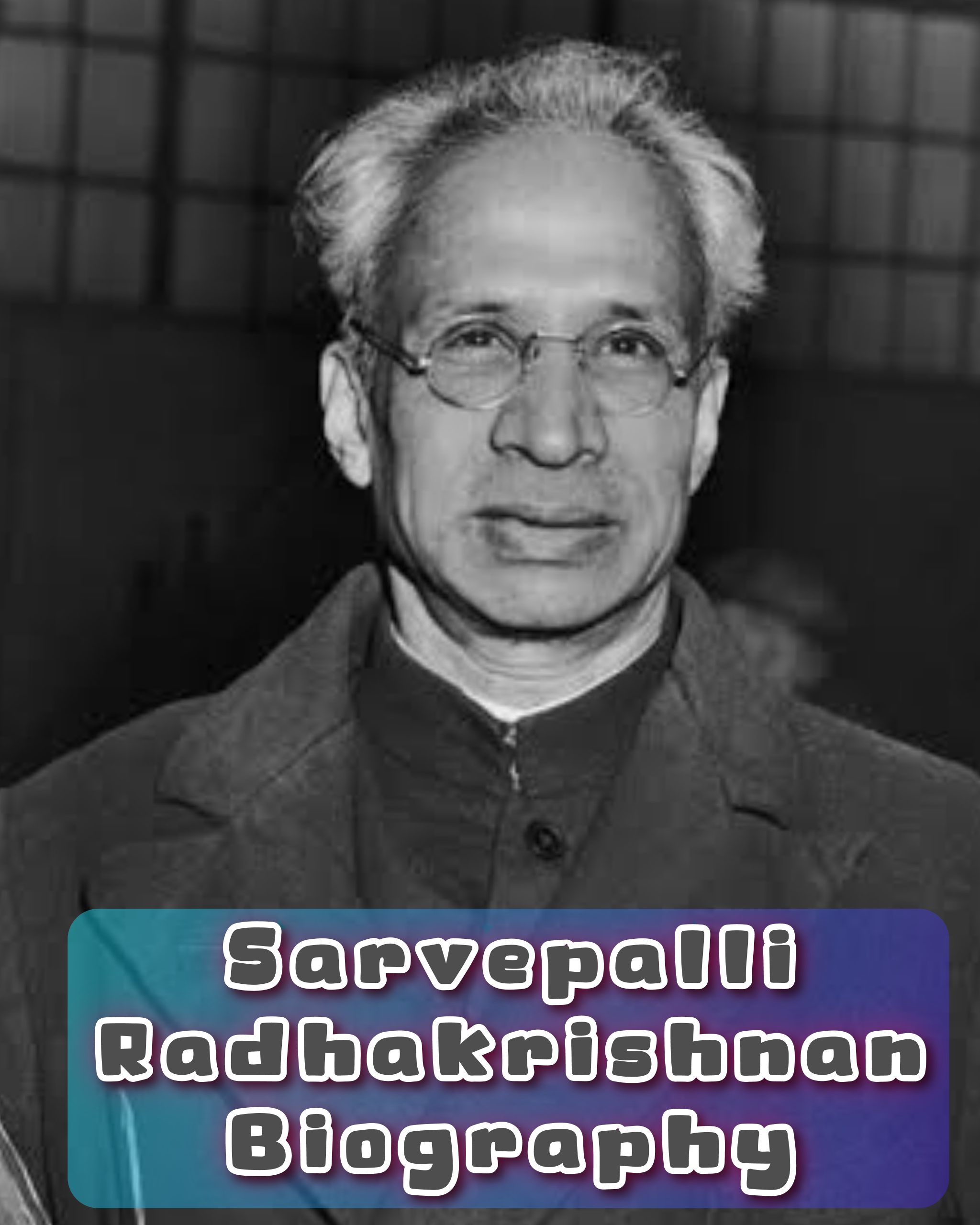
Sarvepalli Radhakrishnan was born on September 5, 1888, in Tiruttani, a town in the Madras Presidency of British India, which is now part of Tamil Nadu, India. He was born into a Telugu-speaking Brahmin family, and his father, Sarvepalli Veeraswami, worked as a subordinate revenue official. His mother was Sitamma. Radhakrishnan grew up in a traditional family environment and received his early education in schools in Tiruttani and Tirupati.
From an early age, Radhakrishnan developed a strong interest in learning, religion, philosophy and the study of different systems of thought. He later attended Voorhees College in Vellore before moving to Christian College, Madras, where he studied philosophy. His academic performance and growing interest in philosophy laid the foundation for the distinguished teaching and intellectual career that followed.
Radhakrishnan’s years as a student were also shaped by his exposure to both Indian religious traditions and Western philosophical ideas. His study of philosophy encouraged him to explore Indian thought and its relationship with Western intellectual traditions. After completing his studies, he began his academic career as a philosophy teacher, eventually becoming one of India’s most respected philosophers, educators and scholars before entering public life.
Sarvepalli Radhakrishnan Education
Sarvepalli Radhakrishnan began his formal education in schools in Tiruttani and Tirupati. He later attended Voorhees College in Vellore, where he continued developing his academic interests. He eventually enrolled at Christian College, Madras, one of the leading educational institutions of the time, to study philosophy. His studies there introduced him to major Western philosophical thinkers while also encouraging him to examine Indian philosophical traditions.
Radhakrishnan completed his undergraduate and postgraduate studies in philosophy at Christian College, Madras. His academic ability became evident during his university years, and his master’s thesis, which focused on the ethical ideas of the Vedanta philosophy, reflected his growing interest in Indian philosophical thought. His education gave him a strong foundation in both Indian and Western philosophy and influenced much of his later academic writing.
After completing his education, Radhakrishnan pursued an academic career and continued studying and teaching philosophy. His intellectual reputation grew steadily, eventually leading to appointments at major Indian universities and later to an academic position at the University of Oxford. His education and lifelong commitment to scholarship played a major role in establishing him as an internationally respected philosopher, educator and thinker.
Sarvepalli Radhakrishnan Career
Sarvepalli Radhakrishnan began his professional career as a philosophy teacher in 1909 when he joined the Madras Presidency College. He later taught at the University of Mysore and the University of Calcutta, where he became known for his deep knowledge of Indian philosophy and comparative religion. His academic work quickly earned him recognition, and he went on to hold several important positions in India’s higher-education system.
Radhakrishnan’s international reputation grew through his teaching and writings on Indian philosophy. He served as the Spalding Professor of Eastern Religions and Ethics at the University of Oxford and was also associated with Oxford’s Manchester College. He played an important role in strengthening academic understanding between Eastern and Western philosophical traditions. He later became Vice-Chancellor of Andhra University and Banaras Hindu University, contributing significantly to the development of higher education in India.
After establishing himself as a distinguished scholar and educator, Radhakrishnan entered public service. He served as India’s Ambassador to the Soviet Union from 1949 to 1952 before becoming the country’s first Vice-President in 1952. He served two terms as Vice-President and, in 1962, succeeded Dr. Rajendra Prasad as the second President of India. Radhakrishnan remained President until 1967, after which he retired from public office but continued to be remembered for his contributions to education, philosophy and Indian public life.
Sarvepalli Radhakrishnan Personal Life and Family
Sarvepalli Radhakrishnan married Sivakamu Ammal at a young age, in accordance with the customs of the time. Their marriage was arranged, and the couple remained together throughout Radhakrishnan’s life. Sivakamu Ammal largely stayed away from public life and supported her husband’s demanding academic and public career. They had five daughters and one son, Sarvepalli Gopal, who later became a distinguished historian and writer.
Radhakrishnan’s son, Sarvepalli Gopal, was born in 1923 and went on to build a respected career as a historian and biographer. He wrote notable works on modern Indian history, including biographies of Jawaharlal Nehru and his father, Radhakrishnan. The family’s intellectual tradition therefore continued through Gopal’s own scholarship and historical writings.
Radhakrishnan was known for maintaining a relatively private family life despite his prominent public career. His wife, Sivakamu Ammal, died in 1956, after which he continued his academic and public responsibilities. Radhakrishnan himself died on April 17, 1975, in Madras (now Chennai), at the age of 86. His family and intellectual legacy remain an important part of his story, particularly through the continued recognition of his contributions to education and philosophy.
Sarvepalli Radhakrishnan Age, Religion, Nationality, Height and Physical Appearance
Sarvepalli Radhakrishnan was born on September 5, 1888, and died on April 17, 1975, at the age of 86. He was an Indian national and came from a Telugu-speaking Brahmin family, with Hindu traditions forming an important part of his cultural and philosophical background. His exact height has not been reliably documented in authoritative biographical sources, so a specific measurement should not be stated as fact. In photographs, Radhakrishnan was recognizable by his traditional Indian attire, dignified bearing, round spectacles and distinctive white turban, which became closely associated with his public image. He maintained a calm and scholarly appearance throughout his years as an educator, philosopher and statesman.
Sarvepalli Radhakrishnan Net Worth
There is no reliable official record of Sarvepalli Radhakrishnan’s personal net worth, so any figure published online should be treated as an estimate rather than a verified amount. Unlike modern public figures, Radhakrishnan did not leave behind publicly documented financial disclosures that would allow his wealth at the time of his death in 1975 to be calculated accurately.
Radhakrishnan’s income came primarily from his long academic career, government appointments and public service. As President of India, his official monthly salary was ₹10,000, although he voluntarily accepted only ₹2,500 per month, with the remaining ₹7,500 donated to the Prime Minister’s National Relief Fund. Contemporary parliamentary records confirm that he made this salary reduction during his entire presidential term from 1962 to 1967.
Based on his long career as a professor, university administrator, internationally recognized philosopher, ambassador, Vice-President and President, it is reasonable to describe Radhakrishnan as financially comfortable, but a specific net-worth figure cannot be established from reliable historical records. Therefore, for an SEO biography, it is safer to state that his estimated net worth is unknown/not publicly documented, rather than presenting an invented dollar figure as fact. His financial legacy is perhaps better reflected by his decision to donate a substantial portion of his presidential salary to national relief efforts.
Sarvepalli Radhakrishnan Death and Cause of Death
Sarvepalli Radhakrishnan died on April 17, 1975, in Madras (now Chennai), Tamil Nadu, India, at the age of 86. By the time of his death, he had established a lasting legacy as a philosopher, educator, author and statesman who had served as both the first Vice-President and second President of India.
The specific cause of Radhakrishnan’s death is not consistently detailed in widely cited official biographical records. He had experienced declining health in his later years and had largely withdrawn from public life after completing his presidential term in 1967. Therefore, it is more accurate to state that he died in 1975 after a period of ill health rather than attribute his death to a specific disease without reliable documentation.
His death marked the end of the life of one of India’s most influential intellectual figures. His contributions to philosophy and education continue to be remembered, particularly through Teachers’ Day, celebrated annually in India on September 5, his birth anniversary.
Legacy
Sarvepalli Radhakrishnan left a lasting legacy as a philosopher, educator and statesman who helped bring Indian philosophical thought to a wider international audience. Through books, lectures and academic work, he interpreted Indian philosophy for both Indian and Western readers and emphasized the importance of understanding different religious and philosophical traditions. His scholarship remains an important part of the study of Indian philosophy and comparative religion.
His influence on education is particularly remembered through Teachers’ Day, which is celebrated across India every year on September 5, his birth anniversary. The occasion reflects his belief in the important role teachers play in shaping individuals and society. Schools, colleges and educational institutions use the day to recognize teachers and celebrate their contribution to learning and national development.
Radhakrishnan also left a significant legacy in public service, having served as India’s first Vice-President and second President. He was awarded the Bharat Ratna in 1954 in recognition of his exceptional contribution to the nation. Although he died in 1975, his writings, educational ideals and public service continue to influence discussions about Indian philosophy, education and the responsibilities of intellectual and political leaders.
Conclusion
Sarvepalli Radhakrishnan remains one of India’s most respected philosophers, educators and statesmen, whose life combined scholarship, teaching and public service. From his early academic career to becoming India’s first Vice-President and second President, he made lasting contributions to education and philosophy while promoting greater understanding between Indian and Western thought. His books, ideas and commitment to teachers continue to shape his legacy, with his September 5 birth anniversary celebrated across India as Teachers’ Day. Although he died in 1975, Radhakrishnan’s influence continues to live on through his writings, educational ideals and enduring contribution to India’s intellectual and public life.
Frequently Asked Questions About Sarvepalli Radhakrishnan
Who was Sarvepalli Radhakrishnan?
Sarvepalli Radhakrishnan was an Indian philosopher, educator, author and statesman. He served as India’s first Vice-President from 1952 to 1962 and second President from 1962 to 1967.
When was Sarvepalli Radhakrishnan born?
Sarvepalli Radhakrishnan was born on September 5, 1888, in Tiruttani, in the Madras Presidency of British India, now in Tamil Nadu, India.
When did Sarvepalli Radhakrishnan die?
Sarvepalli Radhakrishnan died on April 17, 1975, in Madras, now Chennai, Tamil Nadu, India. He was 86 years old.
What was Sarvepalli Radhakrishnan’s cause of death?
The specific medical cause of Sarvepalli Radhakrishnan’s death is not clearly documented in major authoritative biographical records. He died in 1975 after experiencing declining health in his later years.
Why is Sarvepalli Radhakrishnan famous?
Sarvepalli Radhakrishnan is famous for his contributions to Indian philosophy and education and for serving as India’s first Vice-President and second President. He is also remembered because his birthday, September 5, is celebrated as Teachers’ Day in India.
Why is September 5 celebrated as Teachers’ Day in India?
September 5 is celebrated as Teachers’ Day in India because it is Sarvepalli Radhakrishnan’s birthday. When his students wanted to celebrate his birthday, he reportedly suggested that the day instead be observed as a celebration honoring teachers.
Who was Sarvepalli Radhakrishnan’s wife?
Sarvepalli Radhakrishnan’s wife was Sivakamu Ammal. They married when Radhakrishnan was young and had five daughters and one son, Sarvepalli Gopal.
Who was Sarvepalli Radhakrishnan’s son?
Sarvepalli Radhakrishnan’s son was Sarvepalli Gopal, a respected Indian historian and biographer. Gopal wrote biographies of major Indian figures, including Jawaharlal Nehru and his father, Radhakrishnan.
What did Sarvepalli Radhakrishnan study?
Sarvepalli Radhakrishnan studied philosophy at Christian College, Madras. His academic studies developed his interest in Indian philosophy, Western philosophy, religion and comparative thought.
Where did Sarvepalli Radhakrishnan work?
Radhakrishnan taught at several major Indian institutions, including Madras Presidency College, the University of Mysore and the University of Calcutta. He also served as a professor at the University of Oxford and held vice-chancellorships at Andhra University and Banaras Hindu University.
What was Sarvepalli Radhakrishnan’s net worth?
Sarvepalli Radhakrishnan’s exact net worth is not publicly documented. Because reliable historical financial records do not provide enough information to calculate his personal wealth, any specific net-worth figure found online should be treated as an unverified estimate.
What awards did Sarvepalli Radhakrishnan receive?
Sarvepalli Radhakrishnan received several major honours, including the Bharat Ratna, India’s highest civilian award, in 1954. He was also knighted by the British government in 1931 before Indian independence.
What books did Sarvepalli Radhakrishnan write?
Some of Sarvepalli Radhakrishnan’s best-known books include Indian Philosophy, The Hindu View of Life, An Idealist View of Life, The Philosophy of the Upanishads and Eastern Religions and Western Thought.
What was Sarvepalli Radhakrishnan’s religion?
Sarvepalli Radhakrishnan was born into a Telugu-speaking Brahmin family and was associated with Hindu philosophical and religious traditions. His writings frequently examined Hindu philosophy and its relationship with other religious and philosophical traditions.
What was Sarvepalli Radhakrishnan’s nationality?
Sarvepalli Radhakrishnan was Indian. He was born in British India in 1888 and later became one of independent India’s most prominent educators, philosophers and statesmen.
How old was Sarvepalli Radhakrishnan when he died?
Sarvepalli Radhakrishnan was 86 years old when he died on April 17, 1975.
What is Sarvepalli Radhakrishnan’s greatest legacy?
Sarvepalli Radhakrishnan’s greatest legacy is his contribution to education, Indian philosophy and public service. His birthday is commemorated as Teachers’ Day in India, keeping his influence closely connected with teachers and education.