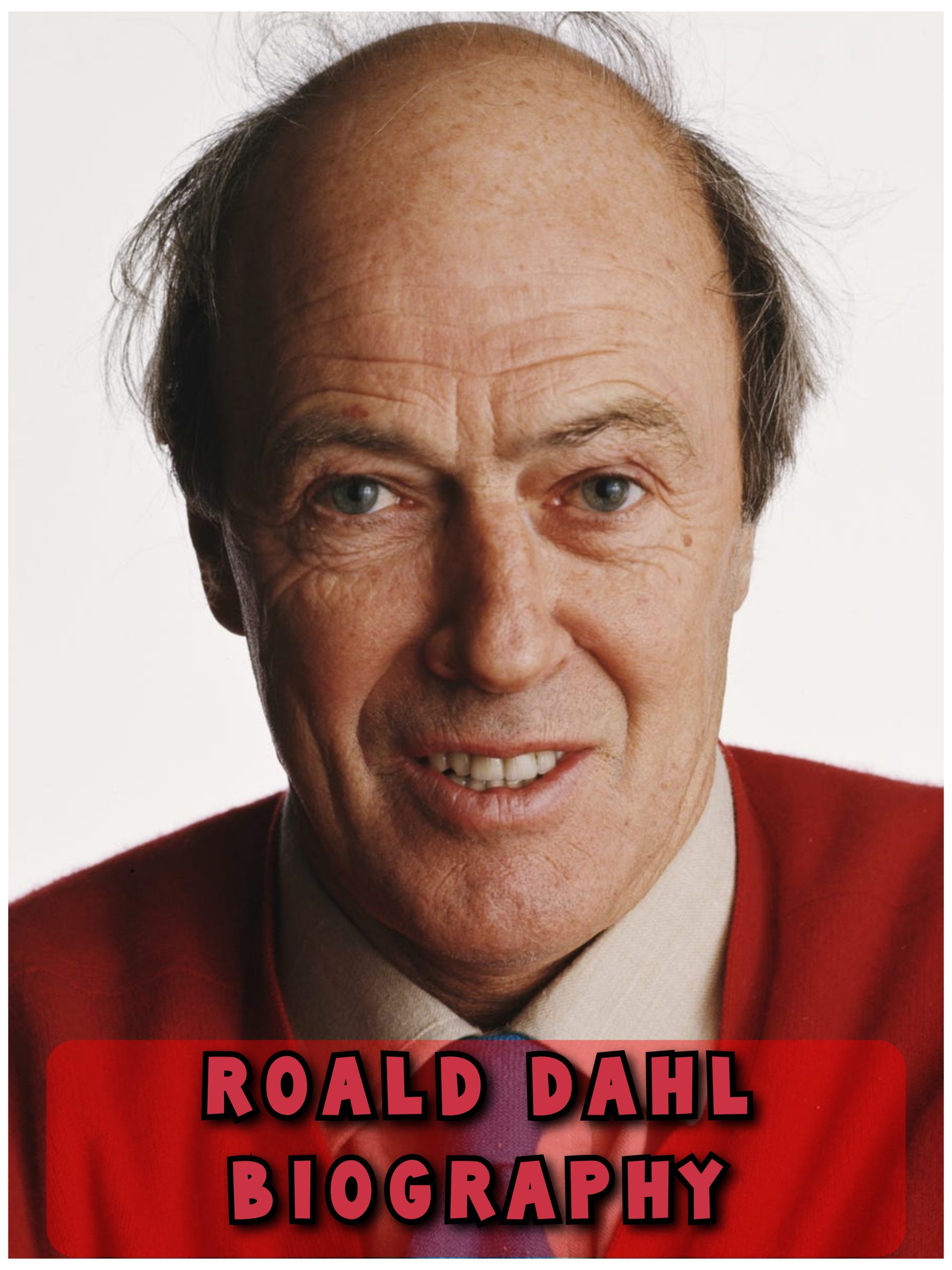
Roald Dahl was born on September 13, 1916, in Llandaff, a district of Cardiff, Wales, to Norwegian parents Harald Dahl and Sofie Magdalene Dahl. His father was a successful shipbroker, while his mother maintained strong Norwegian traditions within the family. Dahl grew up with several siblings, but his childhood was marked by tragedy. His father and one of his sisters died within a few weeks of each other in 1920, leaving his mother to raise the children. Despite these difficult circumstances, Dahl retained a strong connection to his Norwegian heritage throughout his life.
Dahl received his early education at the Cathedral School in Llandaff before attending St Peter’s School in Weston-super-Mare and later Repton School in Derbyshire. His experiences at school strongly influenced his imagination and later writing. He disliked the harsh discipline and strict traditions of the British boarding-school system, and some of his childhood experiences were eventually reflected in stories such as Boy: Tales of Childhood and Matilda. His vivid memories of school life helped shape the mischievous humor, eccentric characters and rebellious themes that became characteristic of his work.
After leaving Repton in 1934, Dahl decided against attending university and instead joined the Shell Petroleum Company. He worked in East Africa, particularly in Tanzania, where he experienced a very different life from the one he had known in Britain. When the Second World War began, Dahl joined the Royal Air Force (RAF) and trained as a fighter pilot. He was involved in combat and survived a serious crash in Libya in 1940. His wartime experiences later became an important part of his early career as a writer and helped establish the adventurous storytelling style that would eventually make him one of the world’s most celebrated authors.
Roald Dahl’s Education
Roald Dahl began his formal education at Llandaff Cathedral School in Wales. He later attended St Peter’s School in Weston-super-Mare, England, where he experienced the strict discipline and traditions of the British boarding-school system. These school years had a lasting impact on his imagination and later writing, providing inspiration for several of the memorable characters and school-related episodes in his autobiographical works.
In 1929, Dahl moved to Repton School in Derbyshire, one of England’s prominent boarding schools. He remained there until 1934. Although he was not particularly interested in traditional academic achievement, he developed a strong interest in reading, writing and adventure. His experiences at Repton, including his encounters with teachers and school authorities, later influenced stories such as Boy: Tales of Childhood and Matilda. His school experiences also helped develop the sharp sense of humor and independence that became prominent in his writing.
After leaving Repton, Dahl did not attend university. Instead, he began working for the Shell Petroleum Company, which eventually took him to East Africa. His decision to enter the workforce rather than pursue higher education allowed him to experience different cultures and environments at a young age. His time abroad, followed by his service as a Royal Air Force fighter pilot during the Second World War, provided experiences that would later contribute to his development as a storyteller and author.
Roald Dahl’s Career
Roald Dahl began his professional career in 1934 when he joined the Shell Petroleum Company. After completing his training in England, he was sent to East Africa, where he worked in what was then Tanganyika, now Tanzania. His time there exposed him to unfamiliar environments, wildlife and different cultures. When the Second World War began in 1939, Dahl left his position with Shell and joined the Royal Air Force (RAF), beginning an extraordinary period that would later influence his writing.
Dahl trained as a fighter pilot and served with No. 80 Squadron in the Middle East and North Africa. In 1940, he was seriously injured after his aircraft crashed in Libya. After recovering, he returned to active service for a period before being transferred to Washington, D.C., where he worked in a diplomatic role and began writing. His first published story, A Piece of Cake, appeared in the Saturday Evening Post in 1942 and was based on his experiences as an RAF pilot. This marked the beginning of his professional writing career.
Dahl eventually became one of the world’s most successful and influential children’s authors. His breakthrough children’s book, James and the Giant Peach, was published in 1961, followed by classics including Charlie and the Chocolate Factory, The BFG, Fantastic Mr Fox, The Witches and Matilda. Alongside children’s fiction, he wrote short stories for adults, screenplays and autobiographical works. His distinctive combination of dark humor, fantasy, suspense and unforgettable characters made his books popular internationally, and many were later adapted into successful films, television productions and stage shows. His literary career continued until his death in 1990, and his work has remained influential for generations of readers.
Roald Dahl’s Personal Life and Family
Roald Dahl married American actress Patricia Neal in 1953. Their marriage became one of the notable celebrity relationships of the period, and they had five children: Olivia, Tessa, Theo, Ophelia and Lucy Dahl. The family initially lived in New York before moving to England, where Dahl continued developing his writing career. His relationship with Neal was affected by several serious family tragedies, including the death of their daughter Olivia in 1962 at the age of seven from complications related to measles encephalitis.
Dahl and Neal also faced another devastating family crisis in 1960, when their young son Theo Dahl was struck by a taxi in New York and suffered a severe brain injury. Dahl became deeply involved in finding ways to help his son recover and worked with engineer Kenneth Branaugh and others on the development of a medical device known as the Wade-Dahl-Till valve, designed to help treat hydrocephalus. Despite these challenges, Dahl remained closely involved in his children’s lives. His daughter Tessa Dahl later became a writer, while Lucy Dahl became involved in the entertainment industry.
Dahl’s marriage to Patricia Neal ended in divorce in 1983. Later that same year, he married Felicity Ann Crosland, whom he affectionately called Liccy. They remained together until Dahl’s death in 1990. Felicity subsequently became involved in preserving and promoting his literary legacy through the Roald Dahl Story Company and the charitable work associated with his name. Dahl’s family life—including his marriages, children and the tragedies he experienced—had a profound influence on his worldview and contributed to the themes of resilience, loss, courage and imagination found throughout his work.
Roald Dahl’s Death and Cause of Death
Roald Dahl died on November 23, 1990, at the age of 74. He died at John Radcliffe Hospital in Oxford, England, after experiencing health problems associated with a blood disorder. His death marked the end of the life of one of the most celebrated children’s authors of the 20th century, although his stories and characters have continued to reach new generations around the world.
The cause of Dahl’s death was myelodysplastic syndrome (MDS), a group of disorders in which the bone marrow does not produce healthy blood cells properly. The condition can lead to serious complications, including severe infections and bleeding. Dahl’s death came after decades of extraordinary experiences that included working in East Africa, serving as a Royal Air Force fighter pilot during World War II and building a highly successful career as an author.
Following his death, Dahl was buried at St Peter and St Paul’s Church in Great Missenden, Buckinghamshire, near the home where he spent many of his later years writing. His literary legacy has continued to grow, with his books selling hundreds of millions of copies worldwide and being translated into dozens of languages. The Roald Dahl Story Company states that more than 300 million copies of his books have been sold globally and that his stories have been translated into 63 languages, underscoring the enduring impact of his work.
Roald Dahl’s Age, Religion, Nationality, Height and Physical Appearance
Roald Dahl was born on September 13, 1916, in Llandaff, Cardiff, Wales, and died on November 23, 1990, at the age of 74. He was British by nationality, although he was born to Norwegian parents and maintained a strong connection to his Norwegian heritage throughout his life. Dahl was baptized and raised in the Lutheran tradition of the Church of Norway, but as an adult his religious views became more skeptical, and following the death of his daughter Olivia, he became openly critical of Christianity and struggled with belief in God.
Dahl was exceptionally tall, standing approximately 6 feet 6 inches (1.98 metres). His unusual height was one of his most recognizable physical characteristics and was frequently noted in biographies of his life. He had a lean, imposing appearance, with a long face, prominent features and a distinctive, somewhat stern expression. His tall frame also presented practical difficulties during his RAF career, particularly when flying aircraft with limited cockpit space.
In photographs from his later years, Dahl was often recognizable by his tall, slender build, receding hairline and distinctive facial features. He also developed a characteristic appearance with age, including white hair and a prominent nose. Beyond his physical appearance, his larger-than-life personality, eccentric manner and famously vivid imagination became closely associated with his public image as one of the most distinctive children’s authors of the 20th century.
Roald Dahl’s Net Worth
Roald Dahl’s estimated net worth at the time of his death in 1990 was around $20 million, according to Celebrity Net Worth. Other historical estimates have placed the figure lower, so the exact amount cannot be confirmed from public records. His wealth came primarily from his long career as a bestselling author, with additional income from short stories, screenwriting, film rights and adaptations. His first published story reportedly earned him $1,000 in 1942, while his later success with books such as Charlie and the Chocolate Factory, The BFG and Matilda generated substantially greater publishing and licensing income.
Dahl’s greatest financial asset was ultimately the intellectual property created by his books and characters. His works have sold more than 300 million copies worldwide and have been translated into 63 languages, creating continuing revenue through publishing, licensing, theatre, film, television and merchandise. Before the family’s sale of the rights, reports indicated that the Dahl estate generated significant annual profits; one 2018 estimate put pre-tax profits at approximately $17 million for that year. These figures illustrate why the value of Dahl’s literary estate grew considerably beyond the fortune he personally accumulated during his lifetime.
The value of Dahl’s intellectual property became even more significant after his death. In 2021, Netflix acquired the Roald Dahl Story Company, which managed the rights to his characters and stories. The exact purchase price was not officially disclosed by Netflix, although contemporary reports estimated the transaction at more than $700 million. Therefore, it is important not to describe the Netflix transaction as Roald Dahl’s personal net worth: he had already died three decades earlier, and the payment was for the rights and company owned by his estate and family. As a result, a reasonable biography should list about $20 million as his estimated personal net worth at death, while noting that the broader value of his literary estate became far greater after his death.
Legacy
Roald Dahl’s legacy rests on his extraordinary influence on children’s literature. His distinctive storytelling combined dark humor, fantasy, mischief and larger-than-life characters in ways that appealed to both children and adults. Books such as Charlie and the Chocolate Factory, Matilda, The BFG, The Witches, Fantastic Mr Fox and James and the Giant Peach have become enduring classics, introducing generations of readers to his imaginative worlds. His works have sold more than 300 million copies worldwide and have been translated into 63 languages, making him one of the most widely read children’s authors in modern literary history.
Dahl’s stories have also had a remarkable life beyond books. Many have been adapted into films, television productions, stage musicals and other forms of entertainment, including Willy Wonka & the Chocolate Factory, Matilda the Musical, The Witches and The BFG. In 2021, Netflix acquired the Roald Dahl Story Company, bringing together the rights to his extensive catalogue and creating opportunities for new film, television and other adaptations. This has helped keep Dahl’s characters and stories relevant to contemporary audiences decades after his death.
His influence also continues through the Roald Dahl Museum and Story Centre in Great Missenden, England, which celebrates his life, creativity and literary work. The charitable organizations associated with his name have supported causes including children’s health, literacy and neurological research. Although some aspects of Dahl’s personal views and language have attracted criticism and debate, his contribution to children’s storytelling remains significant. More than three decades after his death, his books continue to inspire young readers, writers, filmmakers and performers around the world, securing his place as one of the defining storytellers of the 20th century.
Conclusion
Roald Dahl remains one of the most influential and recognizable children’s authors of the 20th century. From his early life in Wales and experiences as an RAF fighter pilot to his remarkable career as a bestselling writer, his life was filled with adventure, tragedy, creativity and resilience. Despite his death in 1990 at the age of 74, his unforgettable characters and imaginative stories continue to entertain readers worldwide through books, films, television and theatre. His enduring literary success, charitable legacy and continuing adaptations ensure that Roald Dahl’s name remains firmly established in the history of children’s literature.
Frequently Asked Questions About Roald Dahl
Who was Roald Dahl?
Roald Dahl was a British author best known for writing popular children’s books such as Charlie and the Chocolate Factory, Matilda, The BFG, The Witches, Fantastic Mr Fox and James and the Giant Peach. He was also a former Royal Air Force fighter pilot and wrote short stories for adults.
When was Roald Dahl born?
Roald Dahl was born on September 13, 1916, in Llandaff, Cardiff, Wales. He was born to Norwegian parents and grew up with a strong connection to his family’s Norwegian heritage.
How old was Roald Dahl when he died?
Roald Dahl was 74 years old when he died on November 23, 1990, in Oxford, England.
What was Roald Dahl’s cause of death?
Roald Dahl died from myelodysplastic syndrome (MDS), a blood disorder affecting the production of healthy blood cells. He died at the age of 74.
Who was Roald Dahl’s wife?
Roald Dahl was married twice. His first wife was American actress Patricia Neal, whom he married in 1953. After their divorce in 1983, he married Felicity Ann Crosland, known as Liccy Dahl, later that year.
How many children did Roald Dahl have?
Roald Dahl had five children with Patricia Neal: Olivia, Tessa, Theo, Ophelia and Lucy Dahl. His daughter Olivia died in 1962 at the age of seven from measles encephalitis.
What was Roald Dahl’s most famous book?
One of Roald Dahl’s most famous books is Charlie and the Chocolate Factory, first published in 1964. Other major works include Matilda, The BFG, The Witches and Fantastic Mr Fox.
What was Roald Dahl’s net worth?
Roald Dahl’s personal net worth at the time of his death is often estimated at around $20 million, although exact figures are difficult to verify. Much of his wealth came from book sales, publishing rights, adaptations and other literary income.
What was Roald Dahl’s nationality?
Roald Dahl was British, having been born in Wales. His parents were Norwegian, and he retained a strong connection to Norwegian culture and family heritage.
How tall was Roald Dahl?
Roald Dahl was approximately 6 feet 6 inches (1.98 metres) tall. His unusually tall and slender appearance became one of his most recognizable physical characteristics.
What religion was Roald Dahl?
Roald Dahl was baptized and raised in the Lutheran tradition, reflecting his Norwegian family background. As an adult, however, his views on religion became increasingly skeptical.
Where is Roald Dahl buried?
Roald Dahl is buried at St Peter and St Paul’s Church in Great Missenden, Buckinghamshire, England, near the home where he spent much of his later life.
What is Roald Dahl famous for?
Roald Dahl is famous for creating imaginative children’s stories featuring humor, fantasy, eccentric characters and rebellious young heroes. His books have sold hundreds of millions of copies worldwide and inspired numerous films, television productions and stage adaptations.
Is Roald Dahl still alive?
No. Roald Dahl died on November 23, 1990, at the age of 74. His books and characters, however, remain popular worldwide and continue to be adapted for new audiences.