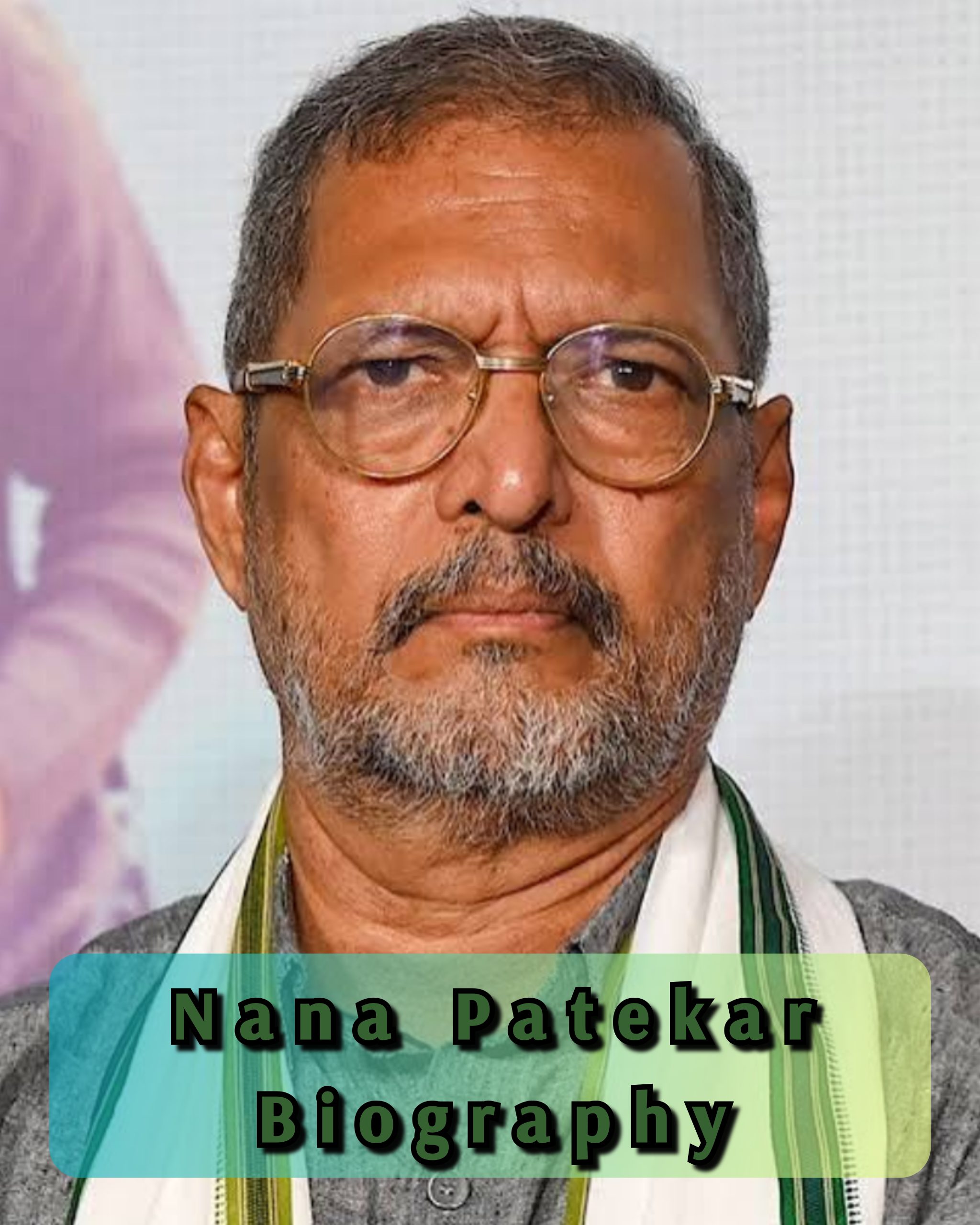
Nana Patekar was a celebrated Indian actor, filmmaker, screenwriter, and philanthropist best known for his powerful performances in Hindi and Marathi cinema. Born Vishwanath Patekar on January 1, 1951, in Murud-Janjira, Maharashtra, he built a remarkable career spanning nearly five decades. He became famous for his intense acting style, distinctive dialogue delivery, and ability to portray complex characters in films such as Parinda, Krantiveer, Agni Sakshi, Ab Tak Chhappan, Welcome, and Natsamrat. He also earned recognition for his charitable activities, particularly his efforts to support farmers through the Naam Foundation. Nana Patekar died on October 8, 2026, at the age of 75, following a cardiac arrest at his residence in Goa. His life remains an important part of the history of Indian cinema.
Early Life of Nana Patekar
Nana Patekar was born Vishwanath Patekar on January 1, 1951, in Murud-Janjira, Maharashtra, India. He grew up in a Marathi-speaking family and experienced financial difficulties during his childhood. His early years were shaped by the challenges of making ends meet, which influenced his practical outlook and relatively modest lifestyle later in life. Unlike many actors who enter the entertainment industry through established family connections, Patekar built his career through determination, artistic ability, and years of hard work.
His childhood was marked by financial hardship, particularly after his family experienced difficulties that affected their economic stability. As a teenager, he began working to help support himself and his family. Reports about his early life describe him painting cinema posters and undertaking other small jobs to earn money. Some accounts state that he earned approximately ₹35 a month from poster-painting work. These experiences exposed him to the realities of working-class life and helped shape his understanding of the struggles faced by ordinary people.
Before becoming a recognised actor, Nana Patekar developed an interest in art and performance. His early experiences with visual art eventually led him towards theatre, where he discovered his ability to communicate emotions through dialogue, expression, and body language. His journey from financial hardship to becoming an award-winning actor became an important part of his biography. The determination he displayed during his early years remained evident throughout his career and contributed to the authenticity of his performances.
Education of Nana Patekar
Nana Patekar pursued his education in Mumbai, where he attended the Sir J. J. Institute of Applied Art, a respected institution known for its artistic and design programmes. His studies helped him develop an understanding of visual composition, creativity, and artistic expression. Before entering the film industry, he had already gained practical experience through work involving painting and visual design.
His background in applied art provided him with skills that complemented his later career in cinema. Although acting eventually became his principal profession, his artistic education helped him appreciate visual storytelling and the importance of presentation. His experience also distinguished him from performers whose careers began exclusively through formal acting schools or family connections in the entertainment industry.
Nana Patekar subsequently developed his performance skills through theatre and practical experience rather than relying solely on academic training. Theatre allowed him to strengthen his dialogue delivery, stage presence, and ability to portray emotionally demanding characters. These skills later became defining features of his acting career. His educational journey demonstrated how an artistic foundation, combined with discipline and experience, can open opportunities in different creative fields.
Nana Patekar’s Career
Nana Patekar began his film career with the Hindi drama Gaman in 1978. He initially appeared in supporting roles and gradually gained recognition for his ability to portray realistic, emotionally complex characters. His work in Hindi and Marathi cinema helped him establish a reputation as a versatile performer who could convincingly play villains, police officers, political figures, troubled family members, and ordinary people facing difficult circumstances.
His breakthrough came with Parinda (1989), in which he played the gangster Anna. The performance demonstrated his ability to combine menace, vulnerability, and emotional intensity. It earned him the National Film Award for Best Supporting Actor and significantly strengthened his position in the Indian film industry. He later received further acclaim for Krantiveer (1994), in which his portrayal of Pratap Narayan Tilak earned him the National Film Award for Best Actor. His performance in Agni Sakshi (1996) also brought him major recognition.
During the 2000s, Patekar continued to take on challenging roles in films such as Ab Tak Chhappan (2004), Apaharan (2005), and Raajneeti (2010). In Ab Tak Chhappan, he played police inspector Sadhu Agashe, delivering a performance that became closely associated with his career. He also demonstrated his comic abilities in Welcome (2007), portraying Uday Shetty, a gangster whose serious demeanour frequently produced humorous situations. The film introduced his acting to a broader audience and established one of his most memorable commercial roles.
Patekar’s contributions to Marathi cinema were equally important. His performance in Natsamrat (2016), a film about an ageing theatre actor confronting family conflict and personal loss, received widespread acclaim. He also directed Prahaar: The Final Attack (1991), demonstrating his interest in filmmaking beyond acting. Other notable projects included Dr. Prakash Baba Amte: The Real Hero (2014) and The Vaccine War (2023). His later film appearances continued to attract attention, and reports following his death identified several projects awaiting release. His career remains notable for the balance he maintained between artistic cinema and mainstream entertainment.
Nana Patekar’s Personal Life and Family
Nana Patekar married actress and writer Neelkanti Patekar in 1978. Their relationship remained largely private, although reports over the years described periods of separation and personal difficulties. Despite the public interest surrounding their marriage, Patekar generally avoided discussing intimate family matters in detail. His preference for privacy meant that much of his personal life remained separate from the attention surrounding his film career.
Nana and Neelkanti had two sons, although their first child died at a young age. Their surviving son, Malhar Patekar, has maintained a relatively low public profile and has been associated with filmmaking. Nana’s experiences as a father and his family’s personal difficulties were among the more sensitive aspects of his life. His family relationships were rarely the centre of his public appearances, as he generally preferred to be recognised for his professional work.
Outside his immediate family, Patekar maintained connections with fellow actors, theatre professionals, filmmakers, and people involved in social work. His association with Marathi actor Makarand Anaspure was particularly significant because they worked together to establish the Naam Foundation. Their shared interest in helping rural communities demonstrated how professional relationships could develop into meaningful charitable initiatives. Following Patekar’s death on October 8, 2026, his wife, son, and wider family became an important focus of public attention as audiences reflected on his life and contributions.
Nana Patekar’s Age, Religion, Nationality, Height and Physical Appearance
Nana Patekar was born on January 1, 1951, and died on October 8, 2026, at the age of 75. He was Indian by nationality and came from Maharashtra, where Marathi language, theatre, and cinema played important roles in his cultural background. He was associated with Hindu cultural traditions, although detailed claims about his personal religious beliefs should be treated cautiously unless supported by direct statements. His height is commonly reported as approximately 5 feet 7 inches (170 cm), but published measurements vary and should be regarded as approximate. He was recognisable for his expressive eyes, prominent facial features, distinctive voice, and intense screen presence. His relatively understated appearance and natural acting style allowed him to portray a wide range of characters without relying on conventional film-star glamour. His ability to communicate emotion through facial expressions, pauses, and dialogue delivery became one of the most distinctive features of his performances.
Nana Patekar’s Social Media Presence
Nana Patekar maintained a relatively private public image despite his long career in the entertainment industry. Unlike many contemporary celebrities, he was not primarily known for sharing details of his personal life online. His professional achievements, film appearances, interviews, and charitable activities were the main subjects of public interest.
His Instagram handle was reported as @iamnanapatekar. The account was associated with his public identity, although its management and current status should be verified before being described as personally operated by him. His name has also appeared in posts shared by colleagues, film-industry professionals, news organisations, and admirers.
Following his death in October 2026, social media became an important platform for sharing tributes, memorable film scenes, interviews, and recollections of his contributions to Indian cinema. His performances in Krantiveer, Parinda, Welcome, and Natsamrat continued to attract attention as fans revisited some of his most celebrated roles. His charitable activities also remained an important part of the public discussion surrounding his life and legacy.
Nana Patekar’s Net Worth
Nana Patekar’s net worth was never officially disclosed through publicly verified financial statements. However, media reports published in October 2026 estimated his wealth at approximately ₹50 crore to ₹80 crore. These figures should be treated as estimates rather than confirmed financial records. His wealth was accumulated over a career spanning nearly five decades in Hindi and Marathi cinema, during which he worked as an actor, director, screenwriter, and occasional brand endorser.
Acting was his principal reported source of income. Some entertainment and business publications estimated that he earned approximately ₹2 crore to ₹3 crore per film during the later years of his career, although remuneration varied according to the production, role, and contractual arrangements. Earlier in his career, his earnings were considerably more modest, and reports about his teenage years describe him earning approximately ₹35 per month from poster-painting work. His financial journey therefore reflected a substantial change from his early working life to his eventual position as an established Indian film star.
In addition to his film earnings, Patekar was reported to have held property and other assets in Maharashtra and Goa. Reports described a modest Mumbai apartment and a farmhouse near Pune, where he maintained an interest in farming and rural life. Despite estimates placing his wealth in the tens of crores, he was widely associated with a relatively simple lifestyle. His involvement in charitable work, particularly assistance for drought-affected farmers, also shaped public perceptions of his relationship with money. His financial legacy is therefore best understood alongside his professional achievements and social contributions rather than through an estimated net-worth figure alone.
Nana Patekar’s Awards and Achievements
Nana Patekar received numerous honours throughout his career for his contributions to Indian cinema. His performances earned him three National Film Awards, including recognition for Parinda, Krantiveer, and Agni Sakshi. These achievements established him as one of the most respected actors of his generation and demonstrated his ability to excel in demanding dramatic roles.
He also received several Filmfare and regional awards for his acting. His performance in Natsamrat was especially celebrated within Marathi cinema, while his role in Welcome demonstrated that he could succeed in comedy as well as serious drama. His directorial work on Prahaar: The Final Attack further reflected his interest in exploring different aspects of filmmaking.
In 2013, Patekar received the Padma Shri, one of India’s highest civilian honours, in recognition of his contributions to the arts. Beyond awards, his association with the Naam Foundation became an important part of his public life. His career combined artistic achievement, commercial success, and social engagement, making him a distinctive figure in Indian entertainment.
Nana Patekar’s Legacy
Nana Patekar’s legacy begins with his contribution to acting in Hindi and Marathi cinema. He demonstrated that a performer could build a lasting reputation through emotional authenticity, disciplined preparation, and a willingness to portray difficult or unconventional characters. His performances in Parinda, Krantiveer, Ab Tak Chhappan, and Natsamrat remain significant examples of his range and screen presence. His distinctive voice and delivery also helped make his dialogue memorable to generations of film audiences.
Another important aspect of his legacy was his ability to move between artistic dramas and mainstream entertainment. While he earned critical recognition for serious performances, his portrayal of Uday Shetty in Welcome demonstrated his comic timing and willingness to experiment with different genres. This versatility helped him connect with audiences across generations and establish a career that was not limited to a single type of role. His work also contributed to the continued visibility of Marathi cinema among wider Indian audiences.
His social contributions further shaped the way many people remembered him. Through the Naam Foundation, which he co-founded with Makarand Anaspure, he became involved in efforts to support drought-affected farmers and rural communities in Maharashtra. His connection with farming and his preference for a comparatively simple lifestyle reinforced his public image as someone who remained interested in issues beyond celebrity culture. Following his death on October 8, 2026, tributes highlighted both his artistic achievements and his charitable activities. His enduring legacy rests on his films, his influence on Indian acting, and his efforts to help vulnerable communities.
Conclusion
Nana Patekar’s life was a remarkable journey from financial hardship in Maharashtra to becoming one of India’s most respected actors. Through films such as Parinda, Krantiveer, Agni Sakshi, Ab Tak Chhappan, Welcome, and Natsamrat, he demonstrated exceptional versatility and established a distinctive place in Hindi and Marathi cinema. His marriage to Neelkanti Patekar, his family life, his reported wealth, and his involvement in the Naam Foundation added further dimensions to his story. Although he died on October 8, 2026, at the age of 75, his performances and social contributions continue to shape his legacy. Nana Patekar will be remembered not only for the characters he portrayed but also for the determination, individuality, and commitment to charitable work that defined his life.
Frequently Asked Questions About Nana Patekar
1. Who was Nana Patekar?
Nana Patekar was an Indian actor, filmmaker, and philanthropist known for his powerful performances in Hindi and Marathi films. He was celebrated for movies such as Parinda, Krantiveer, Welcome, and Natsamrat.
2. What was Nana Patekar’s real name?
Nana Patekar’s real name was Vishwanath Patekar. He was professionally known as Nana Patekar throughout his acting career.
3. How old was Nana Patekar when he died?
Nana Patekar was 75 years old when he died on October 8, 2026. He was born on January 1, 1951, in Murud-Janjira, Maharashtra, India.
4. What was Nana Patekar’s cause of death?
Nana Patekar died following a cardiac arrest at his residence in Goa on October 8, 2026. Subsequent reporting attributed the fatal heart attack to a blood clot blocking the left main coronary artery.
5. Who was Nana Patekar’s wife?
Nana Patekar’s wife was Neelkanti Patekar, an actress and writer whom he married in 1978. Their relationship remained largely private, and reports described periods of separation during their marriage.
6. Did Nana Patekar have children?
Yes. Nana Patekar and Neelkanti Patekar had two sons. Their first child died at a young age, while their surviving son, Malhar Patekar, has been associated with filmmaking.
7. What was Nana Patekar’s net worth?
Nana Patekar’s net worth was estimated at approximately ₹50 crore to ₹80 crore in media reports published in 2026. These figures were not officially confirmed and should be treated as estimates.
8. What was Nana Patekar’s height?
Nana Patekar’s height is commonly reported as approximately 5 feet 7 inches, or 170 centimetres. However, published measurements vary, so this figure should be regarded as approximate.
9. What was Nana Patekar’s religion and nationality?
Nana Patekar was Indian by nationality and came from Maharashtra. He was associated with Hindu cultural traditions, although detailed descriptions of his personal religious beliefs should be treated cautiously.
10. Where did Nana Patekar study?
Nana Patekar studied at the Sir J. J. Institute of Applied Art in Mumbai. His artistic education provided a foundation for his later work in theatre and cinema.
11. What were Nana Patekar’s most famous movies?
Some of Nana Patekar’s best-known films include Parinda (1989), Krantiveer (1994), Agni Sakshi (1996), Ab Tak Chhappan (2004), Welcome (2007), and Natsamrat (2016).
12. What awards did Nana Patekar win?
Nana Patekar received three National Film Awards and several Filmfare and regional honours. He was also awarded the Padma Shri in 2013 for his contributions to the arts.
13. What was Nana Patekar’s Instagram handle?
Nana Patekar’s reported Instagram handle was @iamnanapatekar. The account’s management and current status should be verified before attributing posts directly to him.
14. What was the Naam Foundation, and how was Nana Patekar involved?
The Naam Foundation is a charitable organisation co-founded by Nana Patekar and actor Makarand Anaspure in 2015. It has worked to support drought-affected farmers and rural communities, particularly in Maharashtra.
15. What is Nana Patekar’s legacy?
Nana Patekar’s legacy includes his award-winning performances, his influence on Hindi and Marathi cinema, his versatility across dramatic and comic roles, and his charitable work supporting rural communities. His films and social contributions continue to shape how audiences remember him.