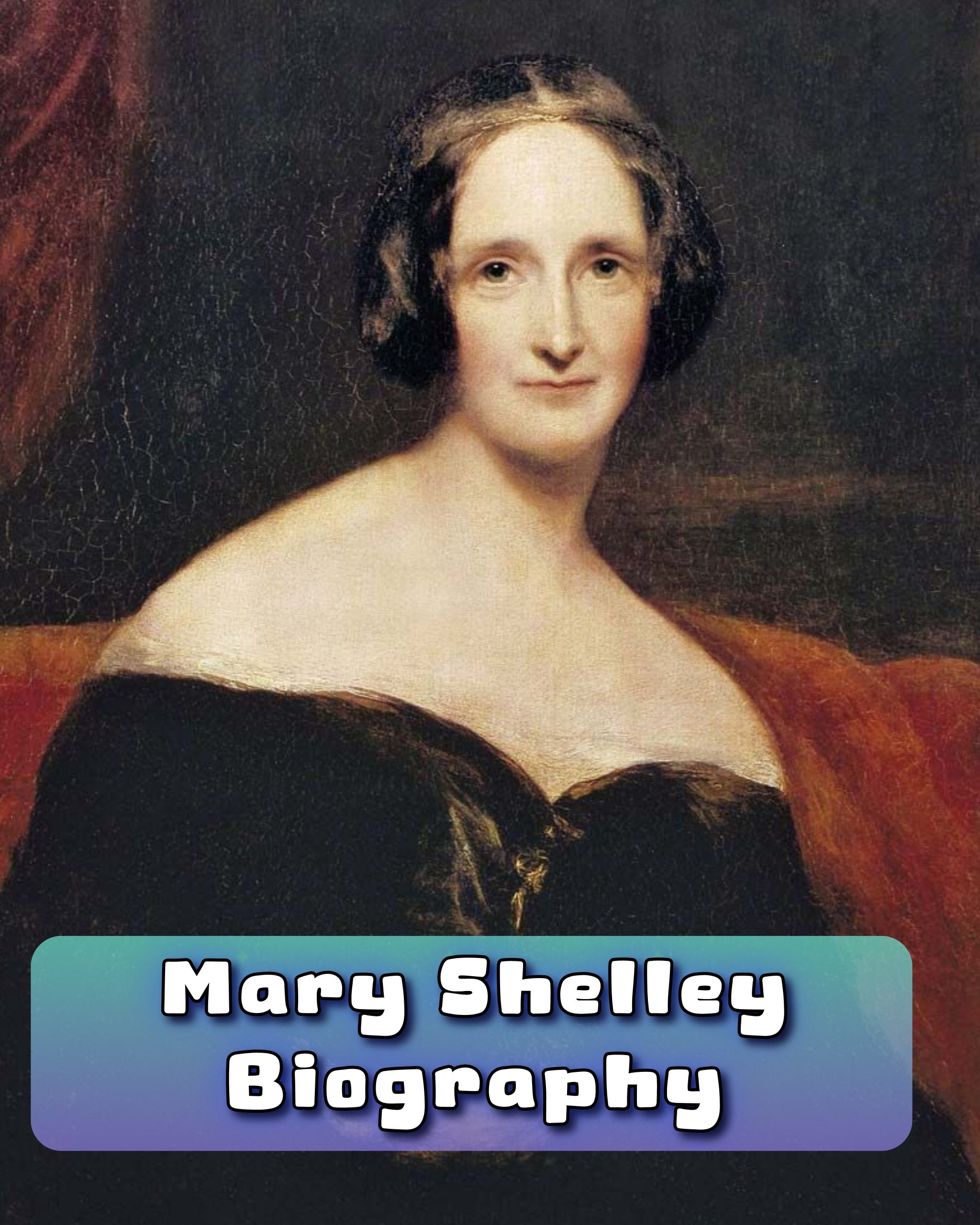
Mary Wollstonecraft Shelley was born Mary Wollstonecraft Godwin on August 30, 1797, in London, England. She was the daughter of two of the most influential intellectuals of their generation: philosopher and political writer William Godwin and pioneering feminist writer Mary Wollstonecraft, author of A Vindication of the Rights of Woman. Her mother died from complications following childbirth on September 10, 1797, only 11 days after Mary was born. As a result, Mary grew up knowing her mother primarily through her writings and through the intellectual legacy she left behind.
Mary’s childhood was shaped by her father’s household, which attracted writers, philosophers, political thinkers and other intellectuals. She grew up alongside her older half-sister, Fanny Imlay, Wollstonecraft’s daughter from her relationship with American businessman Gilbert Imlay. William Godwin later married Mary Jane Clairmont, who brought her own children into the family. This unconventional household exposed Mary to a wide range of literature, political ideas and philosophical debates from an early age.
As a teenager, Mary developed an intense intellectual and emotional relationship with the young poet Percy Bysshe Shelley. Percy was already married to Harriet Westbrook when he and Mary became involved. In 1814, the 16-year-old Mary left England with Percy and her stepsister Claire Clairmont, beginning a turbulent period of travel, romance, financial difficulties and literary development. These experiences would later become important influences on her writing and her understanding of love, loss, isolation and social rejection.
Mary Shelley Education
Mary Shelley did not attend a conventional university or follow the formal educational path available to many privileged men of her period. Instead, her education was largely self-directed. Her father’s extensive library provided access to literature, philosophy, history and political thought, while the intellectual visitors who passed through the Godwin household exposed her to ideas far beyond what many girls of her generation encountered.
Her education also developed through intensive reading and writing. Mary studied the works of major literary and philosophical figures and became familiar with the political and intellectual debates of the Romantic era. Her mother’s writings were particularly important to her intellectual identity, and Mary eventually became deeply conscious of the literary inheritance she had received from Mary Wollstonecraft and William Godwin.
Her relationship with Percy Bysshe Shelley further expanded her intellectual world. Through Percy and their circle of friends, including Lord Byron, Mary encountered discussions about poetry, philosophy, science, medicine and contemporary theories about electricity and the possibility of reanimating dead matter. These interests became especially important in the conception of Frankenstein. Modern scholarship strongly supports Mary’s authorship of the novel and finds it highly improbable that Percy Shelley played a major role in composing it.
Mary Shelley Career
Mary Shelley became one of the most important writers of the Romantic period, although her literary career extended far beyond Frankenstein. Her breakthrough came with Frankenstein; or, The Modern Prometheus, which was published anonymously in 1818. The novel follows Victor Frankenstein, a young scientist who creates a living being and then abandons it. The British Library describes it as one of the most influential English novels and notes its enduring place in Gothic literature.
Following the success of Frankenstein, Shelley continued to write novels, short stories, essays, travel literature, biographies and editorial work. Her later novels included Valperga (1823), The Last Man (1826), The Fortunes of Perkin Warbeck (1830), Lodore (1835) and Falkner (1837). The Last Man, in particular, has attracted considerable scholarly interest because it imagines a future devastated by a plague and explores humanity’s survival in the face of catastrophe.
After Percy Bysshe Shelley’s death in 1822, Mary increasingly relied on her writing to support herself and her surviving son. She contributed stories and essays to literary annuals, wrote reviews and produced biographical material. Financial necessity was an important part of her professional life; after Percy died, his father restricted the financial settlement available to Mary and their son, encouraging her to seek additional income through her writing.
Mary Shelley Personal Life and Family
Mary Shelley married Percy Bysshe Shelley in 1816 after their relationship began several years earlier. Their marriage was controversial because Percy had previously been married to Harriet Westbrook. The couple travelled extensively through Europe and became associated with some of the leading figures of the Romantic movement. Their famous stay near Lake Geneva in 1816, where they spent time with Lord Byron and John Polidori, became closely connected with the origins of Frankenstein.
Mary and Percy had four children, but tragedy repeatedly affected their family. Their children were Clara Everina Shelley, William Shelley, an unnamed daughter who died shortly after birth, and Percy Florence Shelley. Clara and William died while still young, while Percy Florence survived to adulthood. The repeated loss of her children became one of the defining tragedies of Mary’s personal life and has often been discussed in connection with themes of death, parenthood and loss in her writing.
Percy Bysshe Shelley died in 1822, aged 29, after his sailing boat was caught in a storm and sank off the coast of Italy. Mary never remarried. She devoted much of her later life to raising Percy Florence and preserving her husband’s literary reputation while simultaneously developing her own career. A surviving British Library record documents Mary’s correspondence concerning her son’s 1848 marriage to Jane St John, who became Lady Shelley.
Mary Shelley Age, Religion, Nationality, Height and Physical Appearance
Mary Shelley was 53 years old when she died in 1851. She was English by birth and is generally described as an English or British writer. Her religious position is more complicated than a simple denomination: she was raised in the intellectual and radical environment of William Godwin, whose philosophical outlook was strongly associated with religious skepticism, and Mary’s writings frequently engage with religious, moral and philosophical questions. There is no reliable historical source establishing a conventional church denomination for her. Mary Shelley’s exact height is not reliably documented in authoritative historical sources, so a numerical height should not be presented as fact. Portraits and descriptions show her as a pale, dark-haired woman with a serious and thoughtful appearance, although historical visual representations should not be treated as precise photographic records.
Mary Shelley Social Media Presence
Mary Shelley did not have social media accounts because she lived from 1797 to 1851, long before the invention of the internet. Consequently, there is no authentic Instagram handle belonging to Mary Shelley. Some modern social-media accounts use her name for literary, educational or entertainment purposes, but they should not be presented as her official Instagram account. A search result for an account called “Mary Shelley” actually belongs to a contemporary punk-rock musician using the same name, not the nineteenth-century author.
For readers interested in Mary Shelley’s work online, her novels and manuscripts are represented through major libraries, archives and literary institutions. The British Library, for example, maintains extensive records and collections relating to Shelley, including manuscripts and correspondence.
Mary Shelley Net Worth
There is no reliable modern net worth figure for Mary Shelley. Unlike contemporary authors, she did not accumulate wealth that can be converted meaningfully into a present-day celebrity net-worth estimate. Giving her a specific figure in dollars or pounds would therefore be speculative and potentially misleading.
Mary did, however, earn money from her writing. Her financial circumstances were often difficult, particularly after Percy Bysshe Shelley’s death. The New York Public Library notes that after Percy died, his father reduced the financial settlement available to Mary and her surviving child to £200 per year, subject to restrictions concerning publication of Percy’s works and the Shelley family name. Mary subsequently wrote for literary annuals and other publications to supplement her income.
Her financial situation also explains why her career should not be viewed simply as a literary hobby. Mary was a professional writer who repeatedly used her literary abilities to support herself and her family. Cambridge scholarship notes that she wrote for money throughout much of her career, while the Open University records her extensive output of novels, articles, stories, travel writing and biographical works. Therefore, the most accurate description of Mary Shelley’s “net worth” is that her historical wealth cannot be reliably calculated, rather than assigning her an invented modern figure.
Legacy
Mary Shelley’s greatest legacy is Frankenstein; or, The Modern Prometheus, a novel that has survived for more than two centuries and influenced literature, film, theatre, television and popular culture. Published in 1818, the story’s questions about scientific ambition, responsibility, creation, isolation and humanity’s treatment of outsiders remain relevant in the modern world. The British Library continues to describe Frankenstein as one of the most influential English novels.
Her influence also extends into the development of science fiction. Frankenstein is frequently regarded as a foundational work of the genre because it combines scientific speculation with philosophical and ethical questions. Her later novel The Last Man, with its vision of a future devastated by plague, has likewise attracted attention from scholars examining the early development of science fiction.
Perhaps one of Mary’s most important modern legacies is the recognition of her as a major writer in her own right. For generations, she was sometimes presented primarily as Percy Bysshe Shelley’s wife or as the young woman behind Frankenstein. Contemporary scholarship has increasingly emphasized her broader body of work, intellectual independence and professional achievements. Her surviving manuscripts, letters and novels continue to inspire literary scholarship, while Frankenstein remains one of the world’s most recognizable stories.
Conclusion
Mary Shelley remains one of the most influential writers in English literary history. Born into an extraordinary intellectual family, she transformed personal tragedy, philosophical questions and contemporary scientific ideas into Frankenstein, a novel whose influence has lasted for more than 200 years. Although her life was marked by the deaths of her mother, several children and her husband Percy Bysshe Shelley, she continued writing and supporting her surviving son while building an important literary legacy of her own. Today, Mary Shelley is remembered not merely as the wife of Percy Shelley or the author of Frankenstein, but as a pioneering novelist whose ideas continue to shape discussions about science, technology, responsibility, identity and what it means to be human.
Frequently Asked Questions About Mary Shelley
Who was Mary Shelley?
Mary Shelley was an English novelist best known for writing Frankenstein; or, The Modern Prometheus, first published in 1818. She was the daughter of philosopher William Godwin and feminist writer Mary Wollstonecraft.
When was Mary Shelley born?
Mary Shelley was born on August 30, 1797, in London, England.
How old was Mary Shelley when she died?
Mary Shelley was 53 years old when she died on February 1, 1851.
Who was Mary Shelley’s husband?
Mary Shelley’s husband was the English Romantic poet Percy Bysshe Shelley. They married in 1816.
Did Mary Shelley have children?
Yes. Mary Shelley and Percy Bysshe Shelley had four children, although only their son Percy Florence Shelley survived to adulthood.
Who were Mary Shelley’s parents?
Her parents were philosopher and political writer William Godwin and feminist writer Mary Wollstonecraft.
What is Mary Shelley famous for?
Mary Shelley is most famous for writing Frankenstein; or, The Modern Prometheus, one of the most influential Gothic and early science-fiction novels.
How old was Mary Shelley when she wrote Frankenstein?
Mary Shelley began developing Frankenstein in 1816, when she was 18 years old. The novel was published in 1818.
Did Percy Shelley write Frankenstein?
No. Modern scholarly analysis provides strong evidence that Mary Shelley was the author of Frankenstein and finds it highly improbable that Percy Shelley played a major role in composing the novel.
What was Mary Shelley’s religion?
Mary Shelley’s religious outlook was unconventional and influenced by the radical intellectual environment in which she was raised. It is more accurate to describe her religious views as complex than to assign her confidently to a conventional denomination.
What was Mary Shelley’s height?
Mary Shelley’s exact height is not reliably documented, so claims giving a precise measurement should be treated cautiously.
What was Mary Shelley’s net worth?
There is no reliable historical calculation of Mary Shelley’s net worth. She earned income through her writing but experienced significant financial difficulties, particularly after Percy Shelley’s death.
When did Mary Shelley die?
Mary Shelley died on February 1, 1851, in London, England, at the age of 53.
What was Mary Shelley’s cause of death?
Mary Shelley died after suffering from serious health problems in her later years. A brain tumour is commonly identified as the suspected cause of her death, although modern medical certainty is impossible because nineteenth-century diagnostic records were limited.
What books did Mary Shelley write besides Frankenstein?
Her major works include Valperga, The Last Man, The Fortunes of Perkin Warbeck, Lodore and Falkner, along with short stories, essays, travel writing, biographies and editorial work.
What is Mary Shelley’s legacy?
Mary Shelley’s legacy rests primarily on Frankenstein, her contribution to Gothic literature and early science fiction, and her broader achievements as a professional Romantic-era writer. Her work continues to influence literature, film, theatre and debates about science and human responsibility.