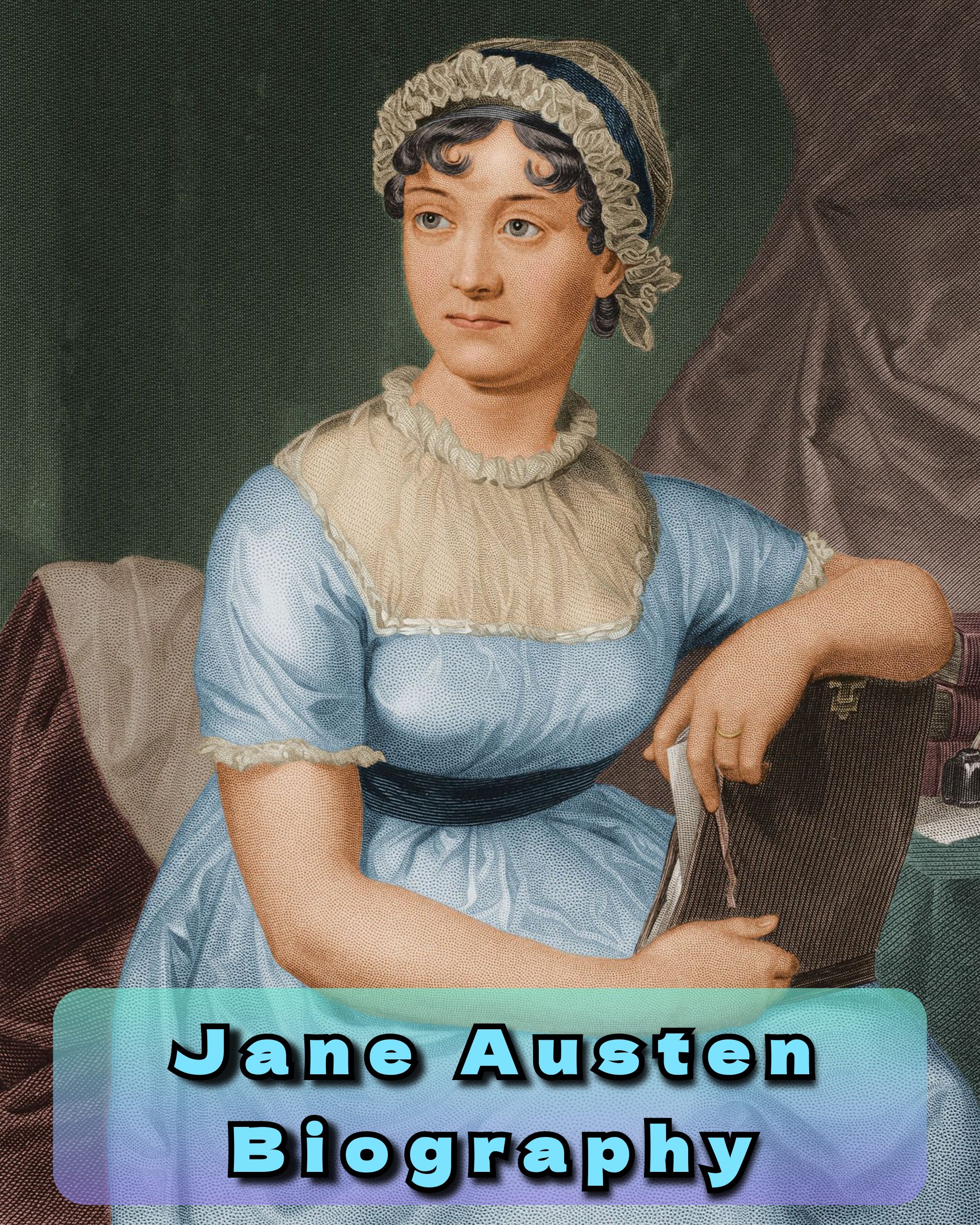
Jane Austen was a renowned English novelist whose literary works transformed the development of romantic fiction and social satire. Born on December 16, 1775, in Steventon, Hampshire, England, she became famous for novels such as Pride and Prejudice, Sense and Sensibility, Emma, Mansfield Park, and Persuasion. Her writing explored love, marriage, family relationships, social class, financial security, and the limited opportunities available to women in eighteenth- and nineteenth-century England. Although she received limited formal education and published her novels anonymously during her lifetime, Austen eventually became one of the most influential writers in English literature. Her books continue to attract readers worldwide, inspiring film adaptations, television productions, stage performances, and modern romantic fiction. As of October 2026, her literary legacy remains prominent, with renewed public interest driven by adaptations of her classic novels and exhibitions celebrating her life and work.
Jane Austen Early Life
Jane Austen was born on December 16, 1775, in Steventon, Hampshire, England. She was the seventh of eight children of George Austen, an Anglican clergyman, and Cassandra Leigh Austen, who came from a family with connections to the English gentry. Her parents encouraged intellectual curiosity and reading within their household, providing an environment in which literature, conversation, and education were valued. Jane developed a particularly close relationship with her older sister, Cassandra Austen, who remained her lifelong confidante and one of the most important people in her personal life.
Growing up in a large family gave Austen opportunities to observe the relationships, personalities, ambitions, and disagreements that later influenced her novels. Her father’s work as a clergyman and educator provided access to books, while her family’s social circumstances exposed her to the customs and expectations of the English middle and upper classes. These experiences helped her understand how inheritance, wealth, marriage, reputation, and social position influenced people’s lives, especially those of women who often depended on advantageous marriages for financial security.
Austen began writing stories, humorous sketches, and dramatic pieces while she was still young. Her early writings, now known collectively as the Juvenilia, demonstrated her imagination, wit, and talent for parody. She experimented with different literary styles and satirized the conventions of popular fiction, gradually developing the distinctive voice that would characterize her mature novels. Although she did not achieve widespread fame during her childhood or early adulthood, these early creative efforts established the foundation for her later success as one of the most celebrated novelists in English literature.
Jane Austen Education
Jane Austen received much of her early education at home under the guidance of her father, George Austen, and her older brothers. Her father was educated at Oxford University and encouraged his children to read widely and develop their intellectual abilities. Jane grew up with access to a substantial family library, where she read novels, poetry, history, and other literary works that influenced her development as a writer. Her early education helped her acquire the language skills and literary knowledge that later distinguished her novels.
During her childhood, Jane attended boarding schools with her sister Cassandra. Around 1783, the sisters received instruction in Oxford and Southampton before attending the Abbey School in Reading in 1785. Their formal schooling was interrupted by financial and practical difficulties, and they eventually returned home. Austen therefore did not receive the extensive formal education that some writers of her period enjoyed, but her family environment continued to encourage reading, writing, and intellectual development.
Despite her limited formal schooling, Austen became an accomplished novelist through independent study, extensive reading, careful observation, and years of writing practice. She developed an exceptional understanding of dialogue, characterization, irony, and narrative structure. Her ability to examine human behavior and social expectations helped her produce works that remain central to English literature courses in schools and universities. Her achievements demonstrate how sustained intellectual curiosity and creative discipline can lead to lasting literary success even without an extensive formal academic background.
Jane Austen Career
Jane Austen’s literary career developed over several decades, beginning with the stories and manuscripts she produced during her youth. Among her early works were drafts that eventually developed into Sense and Sensibility, Pride and Prejudice, and Northanger Abbey. Although she continued revising her manuscripts, finding a publisher was difficult, particularly for a woman writing in a society where literary opportunities and financial independence were limited. Her early experiences helped shape her determination to refine her work and establish herself as a published author.
Austen achieved her first major publishing success with Sense and Sensibility in 1811, followed by Pride and Prejudice in 1813, Mansfield Park in 1814, and Emma in 1815. Her final completed novels, Northanger Abbey and Persuasion, were published posthumously in 1817, although their title pages carried the publication year 1818. Her books initially appeared anonymously, with the author identified as “A Lady” rather than by her full name. This anonymity reflected publishing conventions of the period and the social circumstances faced by women writers.
Austen’s novels became influential because they combined romantic storytelling with sophisticated observations about society. Her characters navigated courtship, inheritance, family obligations, economic insecurity, and social expectations, particularly those affecting women. Pride and Prejudice remains one of her most recognized works, while Emma demonstrates her ability to create complex characters whose assumptions and mistakes drive the narrative. Although her literary reputation grew substantially after her death, her books eventually became international classics and inspired numerous film adaptations, television series, stage productions, and contemporary reinterpretations.
Jane Austen Personal Life and Family
Jane Austen was the daughter of George Austen and Cassandra Leigh Austen, who raised eight children in Steventon, Hampshire. Her father worked as an Anglican clergyman and also helped educate his children, while her mother came from a family with social connections in England. Jane was especially close to her older sister, Cassandra Austen, who shared her interests and remained her most trusted companion. The sisters maintained a strong relationship throughout their lives, and Cassandra played an important role in preserving aspects of Jane’s personal history.
Austen never married and had no children. Her romantic life has attracted considerable interest, particularly her acquaintance with Thomas Lefroy, a young Irishman whom she met in the mid-1790s. Their correspondence and surviving historical accounts suggest that there may have been mutual attraction, but there is insufficient evidence to establish that they became formally engaged or planned a lasting marriage. In December 1802, Austen also accepted a proposal from Harris Bigg-Wither, a family acquaintance, before withdrawing her acceptance the following morning. The precise reasons for her decision remain uncertain, although the episode illustrates the importance of personal choice and financial security in the marriage arrangements of her time.
Following the death of her father in 1805, Austen, Cassandra, and their mother faced greater financial uncertainty and relied partly on assistance from male relatives. In 1809, they settled in Chawton, Hampshire, in a cottage provided by her brother Edward Austen Knight. This period proved especially productive for Jane’s writing, allowing her to revise earlier manuscripts and complete additional novels. Her life was closely connected to her family, and the support she received from Cassandra and other relatives helped her continue writing despite the limited financial independence available to women in her society.
Jane Austen Age, Religion, Nationality, Height and Physical Appearance
Jane Austen was born on December 16, 1775, and died on July 18, 1817, at the age of 41. She was English by nationality and grew up in an Anglican Christian household because her father, George Austen, was a clergyman in the Church of England. Religious morality, social responsibility, and questions of personal conduct formed part of the cultural environment she knew, although her novels are particularly noted for their examination of relationships, manners, and social expectations.
Jane Austen’s exact height has not been reliably established through definitive historical measurements. Descriptions and surviving portraits suggest that she had a relatively slender appearance, dark hair, and delicate facial features, although the available images cannot establish every detail of her physical appearance with certainty. One of the best-known visual representations of Austen is an unfinished watercolor portrait attributed to her sister Cassandra, now held by the National Portrait Gallery in London. Later illustrations and adaptations have offered different interpretations of her appearance.
Austen spent much of her life in Hampshire and later lived in Bath and Chawton before moving to Winchester during her final illness. She died in Winchester on July 18, 1817, after a period of declining health. The exact cause of her illness remains uncertain, and proposed retrospective medical diagnoses cannot be confirmed definitively. She was buried in Winchester Cathedral, where her memorial commemorates her personal qualities and literary achievements. Her relatively short life contrasts with the enduring influence her novels have had on literature and popular culture.
Jane Austen Social Media Presence
Jane Austen lived during the eighteenth and early nineteenth centuries, long before the invention of the internet and social media. Consequently, she did not have personal accounts on Instagram, Facebook, TikTok, X, or other modern platforms. Nevertheless, her name and literary works continue to attract substantial attention online, where readers discuss her novels, share quotations, create fan content, and explore adaptations of her stories.
One prominent online resource is Jane Austen’s House, the museum located in Chawton, Hampshire, where Austen lived during a productive period of her writing career. The museum shares information about her life, manuscripts, exhibitions, and literary heritage through its official digital channels. Its Instagram handle is @janeaustenshouse, where readers can explore museum activities and content related to Austen’s legacy.
Austen’s continued online popularity also reflects the enduring appeal of her characters and themes. Book communities frequently discuss Elizabeth Bennet, Mr. Darcy, Emma Woodhouse, and other characters, while film and television adaptations introduce her stories to new generations. Although she never personally participated in social media, her literary influence continues through digital discussions, educational resources, fan communities, and cultural institutions dedicated to preserving her work.
Jane Austen Net Worth
Jane Austen’s exact net worth is unknown because she lived more than two centuries ago, and surviving financial records do not provide a reliable modern valuation of her personal wealth. Her principal professional income came from publishing her novels, although she also depended on family support during periods of financial difficulty. Unlike many contemporary bestselling authors, she worked in a publishing environment where women had fewer opportunities to earn independent income and often faced significant barriers to literary recognition.
Austen began earning money from her writing when Sense and Sensibility was published in 1811. The novel was issued on commission, meaning that she bore the financial risk of publication and received the profits after the relevant expenses. Her subsequent books also generated income, but the available historical evidence does not establish a complete total of her lifetime earnings. Her financial circumstances improved to some extent as her books found readers, although she did not achieve the extraordinary commercial success associated with her modern reputation during her lifetime.
Today, Jane Austen’s literary estate and cultural legacy have considerable commercial significance through book sales, film and television adaptations, theatrical productions, merchandise, and literary tourism. Her novels continue to be published worldwide, and museums associated with her life attract visitors interested in her history and writing. However, these modern commercial activities do not represent wealth she personally accumulated. No dependable contemporary net worth estimate can be assigned to Austen, and any precise figure would be speculative rather than historically verified.
Jane Austen Legacy
Jane Austen’s legacy is rooted in her ability to combine romantic storytelling with intelligent social commentary. Her novels explore the relationship between money, class, marriage, family obligations, and individual character. Through heroines such as Elizabeth Bennet, Emma Woodhouse, and Anne Elliot, she portrayed women navigating a society in which financial independence and personal freedom were often limited. Her characters make mistakes, challenge assumptions, and learn to recognize their own weaknesses, giving her stories psychological depth that continues to appeal to modern readers.
Austen’s literary reputation expanded significantly after her death. Readers and critics increasingly recognized her precise prose, sophisticated irony, realistic dialogue, and ability to expose social conventions through ordinary interactions. Her novels became established works of English literature and are now studied in schools and universities worldwide. They have inspired countless adaptations, including the widely celebrated screen versions of Pride and Prejudice, Sense and Sensibility, and Emma, as well as modern retellings that reinterpret her characters and themes.
Her influence remains visible in contemporary romance, romantic comedy, historical fiction, and popular culture. Writers continue to draw inspiration from her examination of love, class, family relationships, and personal growth. Museums, literary festivals, academic research, and online communities also help preserve her reputation and introduce her work to new audiences. In 2025, the 250th anniversary of her birth brought renewed attention to her life and achievements, and interest has continued into 2026 through literary exhibitions and new screen adaptations of her novels.
Jane Austen Recent Updates in 2026
Jane Austen’s work continues to receive attention in 2026 through new adaptations and heritage activities. One recent development highlighted in October 2026 is a new film adaptation of Sense and Sensibility, bringing the story of the Dashwood sisters to another generation of viewers. Such adaptations demonstrate how Austen’s exploration of love, family responsibility, and financial security can be reinterpreted for contemporary audiences.
Another continuing attraction is Jane Austen’s House in Chawton, Hampshire, where exhibitions and educational activities explore her writing and historical influence. The exhibition Staging Pride and Prejudice focuses on theatrical interpretations of Austen’s best-known novel and illustrates how her work has moved beyond the printed page into performance and popular culture. These museum activities provide opportunities for visitors to learn about her writing process and the history of her literary reputation.
The continuing interest in Austen following the 250th anniversary of her birth in December 2025 also demonstrates her international cultural significance. Celebrations of her life have encouraged readers to revisit her novels, explore historical accounts of her family, and consider the social circumstances in which she wrote. Together, these developments reinforce her position as an enduring figure in English literature more than two centuries after her death.
Conclusion
Jane Austen remains one of the most influential novelists in English literary history, remembered for her remarkable storytelling, sharp social observations, and enduring exploration of love, marriage, family, and personal independence. Born into a clergyman’s family in Hampshire in 1775, she developed her literary talent through reading, observation, and persistent writing despite limited formal education and the financial restrictions faced by women of her era. Although she never married and died at the age of 41, her novels achieved lasting recognition and continue to influence writers, filmmakers, scholars, and readers around the world. From Pride and Prejudice to Sense and Sensibility, her works remain widely read and adapted, ensuring that her literary achievements continue to attract attention in 2026 and beyond.
Frequently Asked Questions About Jane Austen
1. Who was Jane Austen?
Jane Austen was an English novelist born on December 16, 1775, best known for Pride and Prejudice, Sense and Sensibility, and Emma. She became famous for her romantic storytelling, social satire, and realistic portrayals of family relationships and marriage.
2. How old was Jane Austen when she died?
Jane Austen was 41 years old when she died on July 18, 1817, in Winchester, England.
3. Was Jane Austen married?
No, Jane Austen never married. She was associated with Thomas Lefroy, and she briefly accepted a marriage proposal from Harris Bigg-Wither in 1802 before withdrawing her acceptance.
4. Did Jane Austen have children?
No, Jane Austen had no children. She remained unmarried throughout her life and maintained close relationships with her siblings, particularly her sister Cassandra.
5. Who were Jane Austen’s parents?
Jane Austen’s parents were George Austen, an Anglican clergyman, and Cassandra Leigh Austen. They encouraged reading and education within their family, helping to nurture Jane’s literary interests.
6. What was Jane Austen’s education?
Jane Austen received much of her education at home under the guidance of her father and older brothers. She also attended boarding schools in Oxford, Southampton, and Reading before continuing her literary education through independent reading and writing.
7. What was Jane Austen’s most famous book?
Pride and Prejudice, published in 1813, is widely regarded as Jane Austen’s most famous novel. It follows Elizabeth Bennet and Mr. Darcy as they confront misunderstandings, social expectations, and their own prejudices.
8. What was Jane Austen’s net worth?
Jane Austen’s exact net worth is unknown. She earned money from publishing her novels, but surviving historical records do not support a reliable modern estimate of her personal wealth.
9. What was Jane Austen’s nationality and religion?
Jane Austen was English by nationality and grew up in an Anglican Christian family. Her father served as a clergyman in the Church of England.
10. How tall was Jane Austen?
Jane Austen’s exact height is not reliably documented. Historical portraits provide some information about her appearance, but they do not establish a definitive height measurement.
11. Did Jane Austen have an Instagram account?
No. Jane Austen died in 1817, long before social media existed. However, Jane Austen’s House museum maintains an Instagram account under the handle @janeaustenshouse.
12. What are Jane Austen’s most famous novels?
Her six major completed novels are Sense and Sensibility, Pride and Prejudice, Mansfield Park, Emma, Northanger Abbey, and Persuasion.
13. Where is Jane Austen buried?
Jane Austen is buried in Winchester Cathedral in Hampshire, England. Her grave and memorial remain important sites for readers and literary historians.
14. What is Jane Austen’s legacy?
Jane Austen’s legacy is her lasting contribution to English literature through her exploration of romance, social class, marriage, and human behavior. Her novels remain internationally popular and continue to inspire films, television series, stage productions, and contemporary fiction.
15. What are the latest Jane Austen updates in 2026?
Jane Austen continues to receive attention through new adaptations of her novels, museum exhibitions, and literary events. Recent October 2026 coverage has highlighted a new Sense and Sensibility film adaptation and continuing exhibitions celebrating the history and influence of Pride and Prejudice.
to inspire films, television series, stage productions, and contemporary fiction.
15. What are the latest Jane Austen updates in 2026?
Jane Austen continues to receive attention through new adaptations of her novels, museum exhibitions, and literary events. Recent October 2026 coverage has highlighted a new Sense and Sensibility film adaptation and continuing exhibitions celebrating the history and influence of Pride and Prejudice.