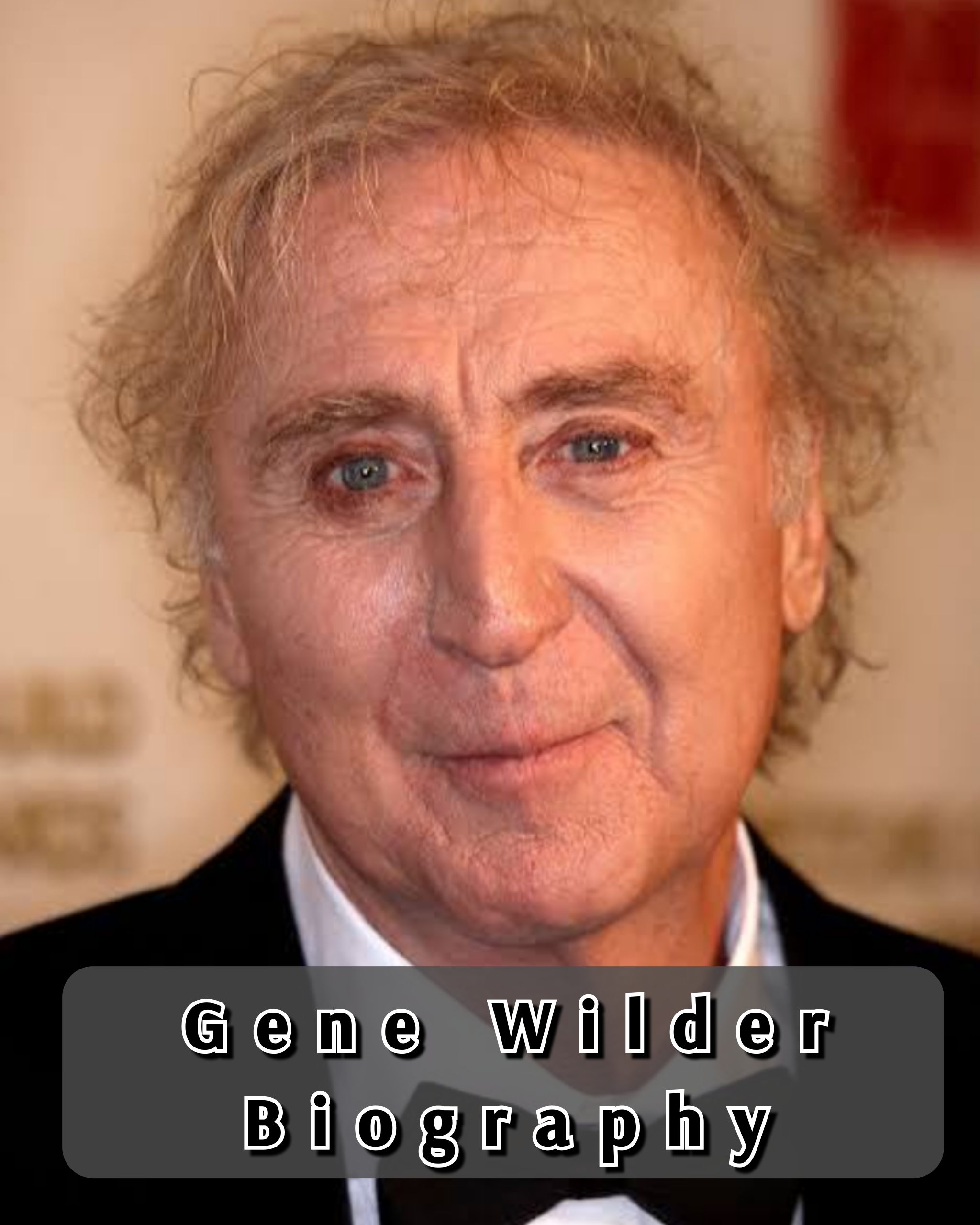
Gene Wilder was an American actor, comedian, screenwriter, director, and author best known for his unforgettable portrayal of Willy Wonka in Willy Wonka & the Chocolate Factory (1971). Born Jerome Silberman on June 11, 1933, in Milwaukee, Wisconsin, he became one of Hollywood’s most celebrated comedy stars through his performances in The Producers, Blazing Saddles, Young Frankenstein, and Stir Crazy. His remarkable ability to combine humor, emotion, and eccentricity made him a distinctive figure in American cinema. Beyond acting, Wilder explored writing, directing, and painting while supporting charitable causes, particularly those connected to cancer awareness. He died on August 29, 2016, at the age of 83, but his films and creative achievements continue to attract audiences worldwide. In 2026, interest in his life and work continues through projects associated with preserving his artistic legacy.
Gene Wilder Biography: Early Life
Gene Wilder was born Jerome Silberman on June 11, 1933, in Milwaukee, Wisconsin, United States. He was the son of William J. Silberman, a manufacturer and salesman, and Jeanne Baer Silberman. His father came from a family with Russian Jewish roots, and Wilder grew up in a Jewish household. His early family experiences helped shape his personality and eventual interest in entertainment. Although he would later become famous for his distinctive comedy, his childhood was not without challenges, particularly because of his mother’s health problems.
One of the most influential experiences of Wilder’s childhood occurred when his mother suffered from rheumatic heart disease. According to biographical accounts, her doctor advised the young Jerome to avoid upsetting her and to try making her laugh. Wilder began experimenting with different voices, expressions, and humorous performances to entertain her. This experience helped nurture his interest in acting and showed him how humor could provide comfort during difficult circumstances. His ability to use comedy to express emotion eventually became one of his defining artistic qualities.
As a teenager, Wilder developed a serious interest in theatre and performance. He participated in acting activities and studied the craft while gradually discovering his talent for portraying unusual and emotionally complex characters. His early experiences in Milwaukee provided the foundation for his ambitions, but he eventually looked beyond his hometown for opportunities to develop professionally. By the time he reached adulthood, he had decided to pursue acting as a career, setting the stage for his later success on Broadway and in Hollywood.
Gene Wilder Biography: Education
Gene Wilder attended Washington High School in Milwaukee, where he completed his secondary education before pursuing further studies. His interest in acting developed during his younger years, and he became increasingly determined to improve his performance skills. Unlike entertainers who enter the industry without formal training, Wilder took an academic and theatrical approach to his ambitions, recognizing the importance of studying acting techniques and stage performance.
After high school, Wilder attended the University of Iowa, where he studied communication and theatre arts. His university education helped him understand dramatic storytelling, character development, and the relationship between performers and audiences. During this period, he continued refining his acting abilities and developing the expressive style that would later distinguish his film performances. His studies also strengthened his interest in serious theatre, even though he would eventually become best known for comedy.
Wilder later studied theatre and fencing at the Bristol Old Vic Theatre School in Bristol, England. He subsequently returned to the United States and continued his acting training in New York, including studies at HB Studio and the Actors Studio, where he learned more about character interpretation and performance. These educational experiences gave him a strong foundation in theatre and helped prepare him for professional stage work. His training became particularly valuable as he transitioned from live performances to film and television.
Gene Wilder Biography: Career and Movies
Gene Wilder began his professional acting career in theatre, performing in stage productions before establishing himself in film and television. His Broadway and off-Broadway experience helped him develop the timing, physical expression, and character-based humor that became central to his screen performances. During the early 1960s, he appeared in theatrical productions, including Mother Courage and Her Children. Through his work in theatre, he became acquainted with actress Anne Bancroft, who introduced him to her partner, filmmaker Mel Brooks. That meeting eventually led to one of the most important professional collaborations of Wilder’s career.
Wilder made his film debut in Bonnie and Clyde (1967), in which he played Eugene Grizzard, a hostage caught up in the criminals’ activities. The same period brought him greater recognition through The Producers (1967), directed by Mel Brooks. Wilder portrayed Leo Bloom, a nervous accountant drawn into an outrageous theatrical scheme. His performance earned him an Academy Award nomination for Best Supporting Actor and established him as a promising comedy performer. His ability to portray anxious, eccentric characters with sincerity made him stand out among his contemporaries.
In 1971, Wilder achieved international recognition when he played Willy Wonka in Willy Wonka & the Chocolate Factory. His mysterious, unpredictable, and occasionally unsettling portrayal transformed the fictional chocolate maker into one of cinema’s most memorable characters. Although the film’s popularity grew over time, Wilder’s performance became a defining part of his career and remains beloved by generations of viewers. His combination of warmth, mischief, and emotional depth helped distinguish his interpretation of the character from later portrayals.
Wilder continued his successful collaboration with Mel Brooks in Blazing Saddles (1974), playing the Waco Kid, and Young Frankenstein (1974), in which he starred as Dr. Frederick Frankenstein. He also co-wrote the screenplay for Young Frankenstein with Brooks, earning an Academy Award nomination for Best Adapted Screenplay. The film became a celebrated parody of classic horror cinema and demonstrated Wilder’s abilities as both an actor and a writer. These projects cemented his position among the leading comedy performers of the 1970s.
Another important part of Wilder’s career was his partnership with comedian Richard Pryor. The two actors appeared together in Silver Streak (1976), Stir Crazy (1980), See No Evil, Hear No Evil (1989), and Another You (1991). Their contrasting personalities created a memorable on-screen chemistry that attracted audiences and helped several of their films achieve commercial success. Wilder also starred in and directed projects such as The Adventure of Sherlock Holmes’ Smarter Brother (1975), The World’s Greatest Lover (1977), and Haunted Honeymoon (1986).
During the later stages of his career, Wilder appeared less frequently in films and increasingly focused on writing. His television appearances included the sitcom Something Wilder and a guest role on Will & Grace. His performance on Will & Grace earned him the Primetime Emmy Award for Outstanding Guest Actor in a Comedy Series in 2003. After stepping away from regular acting, he published a memoir and several works of fiction, demonstrating that his creative interests extended well beyond the screen.
Gene Wilder Biography: Personal Life and Family
Gene Wilder’s personal life included four marriages and several important relationships. He married Mary Mercier in 1960, but their marriage ended in divorce in 1965. In 1967, he married Mary Joan Schutz, who had a daughter named Katharine. Wilder adopted Katharine and became her father figure during their marriage. However, his relationship with his adopted daughter reportedly became strained following his separation from Schutz. Despite the challenges in his personal life, Wilder remained a private individual who preferred to keep many family matters away from public attention.
One of the most significant relationships in Wilder’s life was his marriage to actress and comedian Gilda Radner. The couple met while working together on the film Hanky Panky and developed a close relationship. They married on September 18, 1984, and subsequently appeared together in other projects, including The Woman in Red and Haunted Honeymoon. Their relationship was widely admired for its affection and companionship. However, their happiness was interrupted when Radner was diagnosed with ovarian cancer. She died on May 20, 1989, leaving Wilder devastated by the loss of his wife.
Following Radner’s death, Wilder became an advocate for cancer awareness and helped establish Gilda’s Club, an organization created to provide emotional and social support for people affected by cancer. In 1991, he married Karen Webb, later known as Karen Wilder, who remained his wife until his death in 2016. Their marriage brought him stability and companionship during the later years of his life. Wilder also spent more time writing, painting, and enjoying a quieter lifestyle away from Hollywood’s demands. His family life and personal experiences influenced both his creative work and his charitable activities.
Gene Wilder Age, Religion, Nationality, Height and Physical Appearance
Gene Wilder was born on June 11, 1933, and died on August 29, 2016, at the age of 83. His nationality was American, and he was born in Milwaukee, Wisconsin, United States. Wilder came from a Jewish family, although his personal religious beliefs should not be inferred solely from his family background. He was approximately 6 feet (1.83 metres) tall, according to IMDb’s biographical information. His distinctive physical appearance included expressive blue eyes, curly hair, animated facial expressions, and a gentle but mischievous smile. These features contributed to his recognizable screen presence and helped him portray characters who could appear nervous, eccentric, warm, or mysterious. His appearance and expressive acting style were particularly effective in Willy Wonka & the Chocolate Factory, where his unpredictable mannerisms helped create an unforgettable cinematic character.
Gene Wilder Social Media Presence
Gene Wilder did not maintain a personal Instagram account during his lifetime, as he died in 2016, before Instagram became the central platform for many modern celebrity interactions. However, his legacy continues through online fan communities, film archives, and accounts dedicated to preserving his work. His official legacy website identifies @genewilder_official as an account where followers can find film moments, memories shared by his widow, Karen Wilder, and updates about projects connected to his legacy. Readers can explore the account through Instagram by searching for that handle, while recognizing that it represents the official legacy presence rather than a personal account operated by Wilder himself. His enduring popularity online reflects the continuing appeal of his films and his influence on generations of comedy fans.
Gene Wilder Net Worth
Gene Wilder’s net worth at the time of his death has been estimated by various celebrity-finance websites at approximately $20 million. However, this figure is not supported by a publicly available, independently verified financial statement and should therefore be treated as an estimate rather than a confirmed amount. Wilder worked in the entertainment industry for several decades, earning income from acting, screenwriting, directing, television appearances, and publishing. His long career and participation in commercially successful films contributed to his financial standing.
A significant portion of Wilder’s professional income came from his film career. His appearances in productions such as The Producers, Willy Wonka & the Chocolate Factory, Blazing Saddles, Young Frankenstein, and Stir Crazy established him as a successful performer. His work as a screenwriter and director also provided additional opportunities to earn money beyond acting fees. However, reliable records detailing his individual salaries for most of these productions are not readily available, making it difficult to calculate his lifetime earnings accurately.
Wilder also earned income from his writing career. His memoir, Kiss Me Like a Stranger: My Search for Love and Art, was published in 2005, followed by novels including My French Whore and The Woman Who Wouldn’t, as well as a collection of short stories. Books can generate income through advances, sales, and royalties, although the financial details of Wilder’s publishing agreements have not been fully disclosed. Royalties and other rights associated with his creative work may also contribute to the continuing economic value of his estate. Nevertheless, the widely circulated $20 million estimate should not be interpreted as a verified measure of his estate’s current value.
Gene Wilder Death and Cause of Death
Gene Wilder died on August 29, 2016, at his home in Stamford, Connecticut, United States. He was 83 years old. His death was attributed to complications of Alzheimer’s disease, a progressive condition that affects memory, thinking, and other cognitive functions. According to his family, he had been living with the disease for approximately three years before his death.
Wilder’s family explained that they had kept his diagnosis private because they did not want children who knew him as Willy Wonka to associate the beloved character with illness. The decision reflected the family’s desire to protect the positive memories that audiences had of his performances. His death prompted tributes from fellow actors, filmmakers, and fans who celebrated his contribution to cinema and comedy.
Although Wilder’s death marked the end of his life, it did not diminish the influence of his work. His films continue to be screened, discussed, and rediscovered by new audiences. His portrayal of Willy Wonka remains especially significant, while his collaborations with Mel Brooks and Richard Pryor continue to be celebrated as important achievements in American comedy.
Gene Wilder Legacy
Gene Wilder’s legacy is rooted in his distinctive approach to comedy. Rather than relying solely on loud or exaggerated humor, he often combined physical comedy with vulnerability, emotional sincerity, and subtle expressions. His characters frequently appeared nervous or uncertain, yet they possessed an underlying intelligence and humanity that made them relatable. This balance helped distinguish him from many other comedy performers and contributed to the lasting popularity of his films.
His collaborations with Mel Brooks helped shape modern film satire and parody. The Producers, Blazing Saddles, and Young Frankenstein remain widely recognized for their inventive humor and willingness to challenge conventional storytelling. His partnership with Richard Pryor also produced several memorable comedy films, demonstrating his ability to work effectively with performers whose styles differed considerably from his own. Together, these projects helped establish Wilder as a major figure in twentieth-century American entertainment.
Beyond acting, Wilder left a legacy through his writing, painting, and charitable activities. Following Gilda Radner’s death, he supported cancer awareness and helped establish Gilda’s Club, which became part of a wider network of support for people affected by cancer. He also pursued painting and writing during his later years, revealing a quieter creative side that complemented his public career. His legacy continues through his films, published works, and charitable initiatives, while projects associated with his family help preserve his memory for future generations.
Conclusion
Gene Wilder remains one of the most memorable comedy actors in American film history. From his early theatre training to his celebrated performances in Willy Wonka & the Chocolate Factory, Young Frankenstein, and Blazing Saddles, he built a career defined by originality, emotional depth, and exceptional comic timing. His marriages, especially his relationship with Gilda Radner and later life with Karen Wilder, were important parts of his personal story, while his writing and charitable work revealed interests beyond entertainment. Although he died in 2016 from complications of Alzheimer’s disease, his films continue to inspire audiences and influence modern comedy. His enduring legacy demonstrates how a talented performer can leave a lasting impression through creativity, compassion, and unforgettable storytelling.
Frequently Asked Questions About Gene Wilder
1. Who was Gene Wilder?
Gene Wilder was an American actor, comedian, screenwriter, director, and author best known for playing Willy Wonka in Willy Wonka & the Chocolate Factory (1971). He also starred in The Producers, Blazing Saddles, and Young Frankenstein.
2. How old was Gene Wilder when he died?
Gene Wilder was 83 years old when he died on August 29, 2016. He was born on June 11, 1933, in Milwaukee, Wisconsin.
3. What was Gene Wilder’s real name?
Gene Wilder’s real name was Jerome Silberman. He adopted the professional name Gene Wilder when he began pursuing a career in acting.
4. Who was Gene Wilder’s wife?
Gene Wilder was married four times. His wives were Mary Mercier, Mary Joan Schutz, Gilda Radner, and Karen Webb, later known as Karen Wilder. He married Karen in 1991, and they remained together until his death in 2016.
5. Did Gene Wilder have children?
Gene Wilder adopted Katharine, the daughter of his second wife, Mary Joan Schutz. Public biographies do not identify any biological children.
6. What was Gene Wilder’s net worth?
Gene Wilder’s net worth has been estimated at approximately $20 million, although this figure has not been independently verified. His income came from acting, directing, screenwriting, television, and book publishing.
7. How tall was Gene Wilder?
Gene Wilder was approximately 6 feet (1.83 metres) tall, according to IMDb’s biographical information.
8. What was Gene Wilder’s religion?
Gene Wilder was born into a Jewish family. However, his personal religious beliefs should not be assumed solely from his ancestry.
9. What caused Gene Wilder’s death?
Gene Wilder died from complications of Alzheimer’s disease on August 29, 2016, at his home in Stamford, Connecticut. His family said he had been living with the condition for approximately three years.
10. What was Gene Wilder’s most famous movie?
His most famous movie for many audiences was Willy Wonka & the Chocolate Factory (1971), in which he played the mysterious chocolate maker Willy Wonka. Other celebrated films include Young Frankenstein, Blazing Saddles, and The Producers.
11. Did Gene Wilder win an Emmy Award?
Yes. Gene Wilder won a Primetime Emmy Award in 2003 for Outstanding Guest Actor in a Comedy Series for his appearance on Will & Grace.
12. Did Gene Wilder have an Instagram account?
Gene Wilder did not maintain a personal Instagram account during his lifetime. His official legacy website identifies @genewilder_official as an account sharing film moments, memories, and updates about projects preserving his legacy.
13. What was Gene Wilder’s relationship with Gilda Radner?
Gene Wilder married comedian Gilda Radner on September 18, 1984. They appeared together in films including Hanky Panky and The Woman in Red. Their marriage ended with Radner’s death from ovarian cancer on May 20, 1989.
14. What is Gene Wilder’s legacy?
Gene Wilder is remembered for his distinctive comedic performances, collaborations with Mel Brooks and Richard Pryor, portrayal of Willy Wonka, and contributions as a writer and director. His charitable work supporting cancer awareness also remains an important part of his legacy.