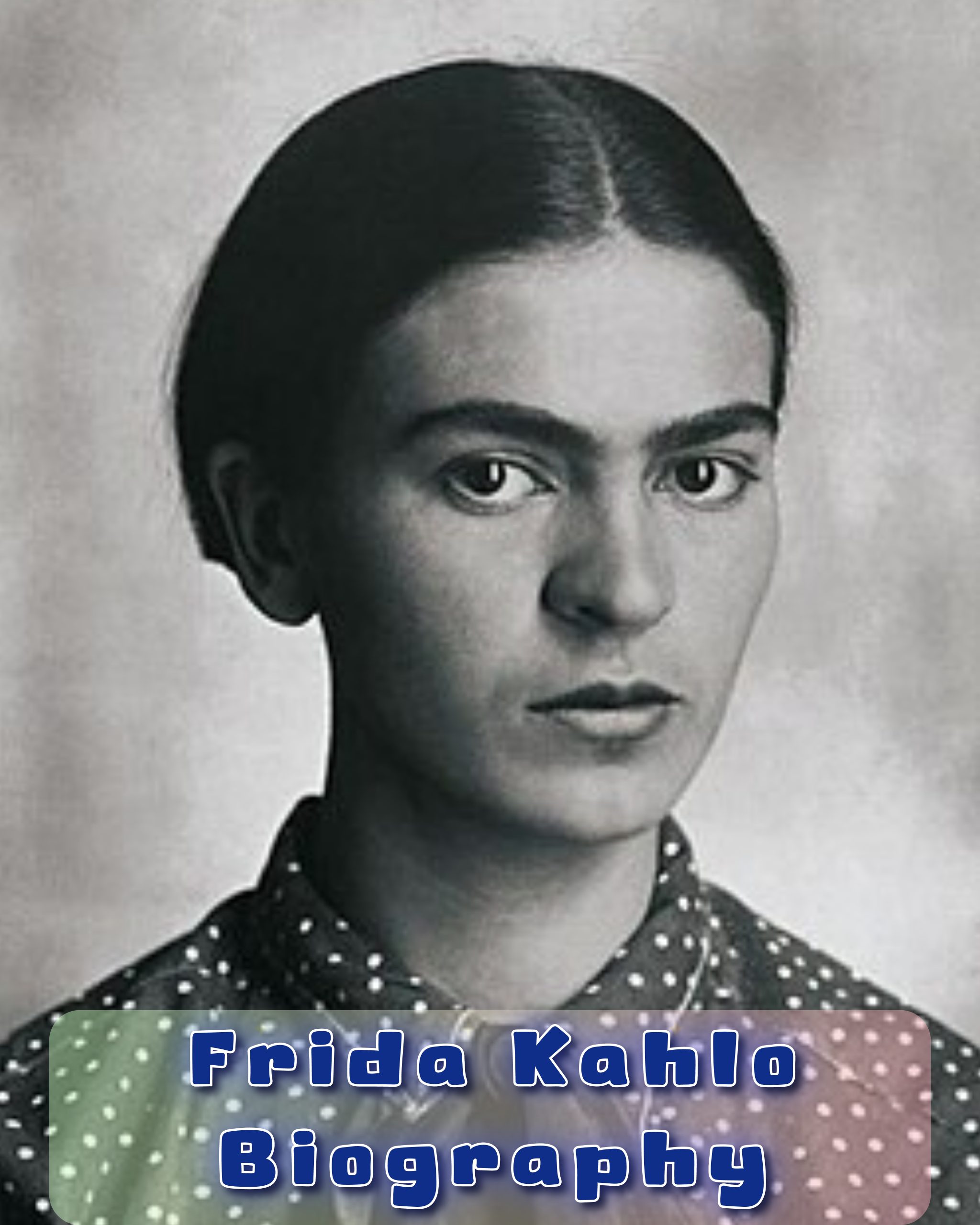
Frida Kahlo was born Magdalena Carmen Frida Kahlo Calderón on July 6, 1907, in Coyoacán, Mexico City, Mexico. She was the third of four daughters born to Wilhelm “Guillermo” Kahlo, a German-born photographer, and Matilde Calderón, a Mexican woman whose family had Indigenous and Spanish ancestry. The family home, known today as the Casa Azul or Blue House, later became closely associated with Frida’s life and legacy.
Frida’s childhood was affected by illness. At the age of six, she contracted polio, which left her right leg shorter and weaker than her left. Despite the physical challenges and bullying she experienced, her father encouraged her to participate in activities such as swimming and sports. Guillermo Kahlo also introduced her to photography, and she learned techniques such as hand-coloring photographs in his studio.
The event that most dramatically changed Frida’s life occurred on September 17, 1925, when she was 18. The bus she was traveling on was involved in a collision with a streetcar, leaving her with severe injuries, including multiple fractures and spinal injuries. During the long period of immobilization and recovery that followed, Frida began painting more seriously. Her physical pain, relationships, identity and experiences would later become central subjects of her art.
Frida Kahlo Education
Frida attended the prestigious Escuela Nacional Preparatoria, or National Preparatory School, in Mexico City beginning in 1922. She was one of only about 35 girls among roughly 2,000 students. At the time, she intended to study medicine rather than become a professional artist. Her education exposed her to science, literature, politics and intellectual debate, all of which influenced her later worldview.
While at the National Preparatory School, Frida became involved with a group of politically and intellectually active students known as “Los Cachuchas.” Among them was Alejandro Gómez Arias, who became her boyfriend. The group shared interests in literature, philosophy and politics, and their activities helped develop Frida’s political consciousness at an early age.
Frida did not complete a conventional university education or receive formal training as a professional painter. Her path toward art developed largely through self-directed practice, her father’s influence and her experiences following the 1925 accident. While recovering, she painted from her bed and gradually transformed painting from a pastime into her life’s work. Her meeting with artists including Diego Rivera further encouraged her artistic development.
Frida Kahlo Career
Frida Kahlo’s professional career developed from deeply personal paintings into an internationally recognized body of work. She became particularly famous for her self-portraits, using her own face and body to explore pain, identity, Mexican culture, relationships, gender and mortality. Rather than separating her personal experiences from her art, Kahlo repeatedly transformed them into visual symbols.
Her career gained increasing recognition during the 1930s and 1940s. She traveled with Diego Rivera in the United States, including periods in San Francisco, New York and Detroit, while continuing to paint. Her work was exhibited internationally, including in Paris, New York and other major artistic centers. In 1938, she had her first major solo exhibition in New York, helping establish her reputation beyond Mexico.
Kahlo’s major works include The Two Fridas, The Broken Column, Self-Portrait with Thorn Necklace and Hummingbird, Henry Ford Hospital, Self-Portrait as a Tehuana and Viva la Vida. Her work combined elements of Mexican folk traditions, symbolism and autobiographical imagery. Although she was sometimes associated with Surrealism, Kahlo resisted being defined simply by that movement, emphasizing that her paintings came from her own reality.
Kahlo also became a teacher. From 1942, she taught at La Esmeralda, Mexico’s national school of painting and sculpture. Because of her declining health, she eventually taught many of her students from her home. Four of her students became known as Los Fridos: Fanny Rabel, Guillermo Monroy, Arturo García Bustos and Arturo Estrada.
Her political beliefs were also an important part of her public identity. Kahlo was associated with Mexican communism and became politically active. Even as her health deteriorated, she continued supporting political causes and attending demonstrations.
Frida Kahlo Personal Life and Family
Frida Kahlo was the daughter of Guillermo Kahlo and Matilde Calderón. She had three sisters: Matilde, Adriana and Cristina Kahlo. Cristina, the youngest, was particularly close to Frida. The Museo Frida Kahlo notes that Cristina’s children, Isolda and Antonio, also maintained a close relationship with the famous painter.
Before her marriage to Diego Rivera, Frida was romantically involved with Alejandro Gómez Arias, whom she met through the Los Cachuchas student group. Her best-known relationship, however, was with Mexican muralist Diego Rivera. The two married on August 21, 1929, when Frida was 22 and Rivera was considerably older. Their relationship became one of the most famous artistic partnerships in Mexican cultural history.
Frida and Diego divorced in 1939 but remarried in 1940. Their relationship was complicated by infidelity, arguments, periods of separation and strong emotional attachment. They did not have children together. Frida’s personal life, including her marriage, friendships, political relationships and physical suffering, became a recurring source of inspiration for her paintings.
Frida Kahlo Age, Religion, Nationality, Height and Physical Appearance
Frida Kahlo was 47 years old when she died in 1954. She was Mexican by nationality and was born in Coyoacán, Mexico City. She was raised in a Catholic cultural environment, although her adult relationship with religion was complex and her artwork frequently incorporated Mexican religious, Indigenous and symbolic imagery. There is no reliable evidence for a simple description of her adult religious identity as belonging exclusively to one denomination. Her exact height is not securely documented in authoritative biographical records, although commonly repeated sources place her at approximately 5 feet 3 inches (160 cm). Physically, Kahlo became recognizable for her distinctive unibrow, dark hair, colorful Tehuana-style clothing, jewelry and strong facial features. Her appearance became an important part of her artistic identity and later cultural image.
Frida Kahlo Death and Cause of Death
Frida Kahlo died on July 13, 1954, at the age of 47, at her home, Casa Azul, in Coyoacán. Her final years were marked by severe health problems, chronic pain and numerous medical procedures. In 1953, part of her right leg was amputated because of complications involving gangrene.
The traditionally reported cause of Frida Kahlo’s death was a pulmonary embolism, although the circumstances surrounding her death have generated speculation about the possibility of an overdose or suicide. Some accounts have pointed to her deteriorating physical and emotional condition, but there is no definitive evidence that conclusively establishes suicide as the cause. The Museo Frida Kahlo confirms that she died on July 13, 1954, but does not present suicide as an established cause.
Days before her death, Kahlo completed Viva la Vida, a painting featuring watermelons and the words “Viva la Vida” (“Long Live Life”). The work has become a powerful symbol of the resilience and determination associated with her final years.
Frida Kahlo Net Worth
There is no reliable historical figure for Frida Kahlo’s personal net worth at the time of her death. Unlike modern celebrities, Kahlo did not leave behind publicly documented financial statements showing a definitive net worth. Her income came primarily from her paintings, exhibitions, commissions and teaching rather than from a modern commercial celebrity business.
Kahlo’s financial circumstances also need to be separated from the extraordinary prices her paintings command today. The huge sums paid for her works decades after her death do not represent money that she personally earned or possessed. Therefore, assigning her a modern net-worth figure based on today’s auction prices would be misleading.
Today, however, Kahlo’s artistic estate has enormous cultural and commercial value. Her paintings, name, image, clothing and personal objects remain the subject of exhibitions, publications, reproductions and licensing. Her global commercial and cultural influence continues to expand, but a precise personal net worth for Frida Kahlo should be described as unknown rather than given an invented dollar estimate.
Legacy
Frida Kahlo’s legacy extends far beyond the world of painting. She became an international symbol of Mexican identity, female creativity, resilience and self-expression. Her willingness to depict physical pain, disability, relationships and personal experiences transformed subjects that were rarely presented so openly into major themes of modern art.
Her home, Casa Azul, was transformed into the Museo Frida Kahlo, preserving important elements of her personal environment and artistic history. Her clothing, photographs, letters and personal possessions have also become important parts of the way historians and audiences understand her life. The museum continues to document and promote her legacy.
Interest in Kahlo remains exceptionally strong in 2026. Tate Modern’s “Frida: The Making of an Icon” exhibition opened on June 25, 2026, and runs until January 3, 2027. The exhibition explores Kahlo as an artist, wife, intellectual, political activist and global cultural icon, demonstrating how her influence has continued long after her death.
Conclusion
Frida Kahlo’s life was shaped by illness, physical pain, love, political conviction, family relationships and an extraordinary determination to create. From a young woman who originally intended to study medicine to one of the world’s most recognizable artists, she turned her experiences into deeply personal works that continue to resonate with millions of people. More than 70 years after her death, Kahlo remains a powerful figure in art and popular culture, with exhibitions such as Tate Modern’s 2026 Frida: The Making of an Icon demonstrating that her story and artistic legacy remain as relevant as ever.
Frequently Asked Questions About Frida Kahlo
Who was Frida Kahlo?
Frida Kahlo was a Mexican painter best known for her autobiographical self-portraits, distinctive artistic style and paintings exploring identity, pain, Mexican culture and personal experiences.
When was Frida Kahlo born?
Frida Kahlo was born on July 6, 1907, in Coyoacán, Mexico City, Mexico.
How old was Frida Kahlo when she died?
Frida Kahlo was 47 years old when she died on July 13, 1954.
Who was Frida Kahlo’s husband?
Frida Kahlo’s husband was Mexican muralist Diego Rivera. They married in 1929, divorced in 1939 and remarried in 1940.
Did Frida Kahlo have children?
No, Frida Kahlo and Diego Rivera did not have children together.
What happened to Frida Kahlo?
Frida Kahlo suffered serious injuries in a 1925 bus accident and lived with chronic pain and health complications for the rest of her life. She continued painting despite numerous medical problems and died in 1954 at age 47.
What was Frida Kahlo’s cause of death?
Frida Kahlo’s traditionally reported cause of death was a pulmonary embolism, although speculation about a possible overdose or suicide has persisted.
What was Frida Kahlo famous for?
Frida Kahlo was famous for her self-portraits and highly personal paintings depicting identity, Mexican culture, physical suffering, relationships and mortality.
What are Frida Kahlo’s most famous paintings?
Some of Frida Kahlo’s most famous paintings include The Two Fridas, The Broken Column, Self-Portrait with Thorn Necklace and Hummingbird, Henry Ford Hospital, Self-Portrait as a Tehuana and Viva la Vida.
What was Frida Kahlo’s religion?
Frida Kahlo was raised in a Catholic cultural environment, but her adult relationship with religion was complex and her work incorporated Catholic, Indigenous Mexican and other symbolic influences.
What was Frida Kahlo’s nationality?
Frida Kahlo was Mexican. She was born and lived primarily in Mexico and became one of the country’s most internationally recognized artists.
What was Frida Kahlo’s net worth?
Frida Kahlo’s exact net worth at the time of her death is unknown. There is no reliable historical financial record supporting a specific modern dollar figure, and today’s multimillion-dollar values of her paintings should not be treated as her personal net worth.
Where did Frida Kahlo live?
Frida Kahlo’s most famous home was Casa Azul, or the Blue House, in Coyoacán, Mexico City. The house is now the Museo Frida Kahlo.
Where can people see Frida Kahlo’s work in 2026?
One major 2026 exhibition is Frida: The Making of an Icon at Tate Modern in London, which runs from June 25, 2026, to January 3, 2027.