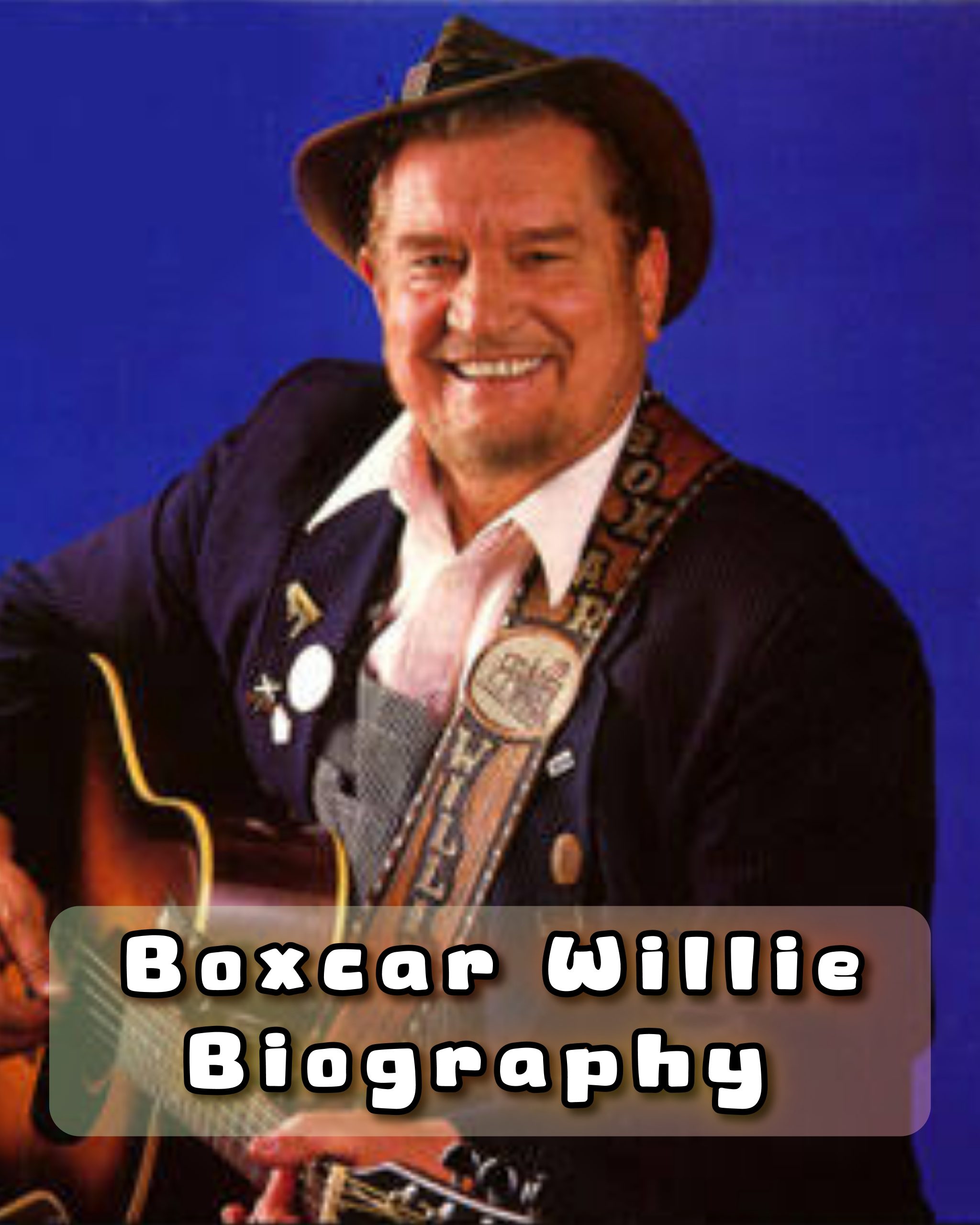
Boxcar Willie was born Lecil Travis Martin on September 1, 1931, in Sterrett, Texas, to Birdie Brown Martin and Edna Jones Martin. He was the eldest son in the family and grew up during the Great Depression in a household closely connected to the railroad. His father worked as a railroad section hand and also played the fiddle, which exposed young Lecil to both railroad life and country music from an early age.
The railroad became an important influence on Martin’s childhood. His family lived near the railroad tracks, and hobos frequently passed through the area looking for food and work. His mother sometimes gave traveling hobos meals in exchange for small jobs around the house. Martin later recalled these experiences as an important source of inspiration for the hobo character that eventually became Boxcar Willie. As a teenager, he even rode freight trains himself.
Music was another major part of his childhood. Martin learned to play guitar and sang with his family and church choir. He listened regularly to the Grand Ole Opry on the radio and began performing at local country music events while still young. By his late teens, he had already appeared on Dallas radio’s Big D Jamboree, giving him some of his earliest experience as a professional performer.
Boxcar Willie Education
There is limited reliable public information about Boxcar Willie’s formal schooling, and no well-documented college or university education is associated with him. His biography is instead dominated by his early musical training, military service and decades of practical experience as an entertainer. His childhood environment, family music and exposure to country radio played a particularly important role in shaping his future career.
His most important musical education came through experience. Martin learned guitar as a child, sang with his family and church choir, listened to traditional country performers and began performing at jamborees and clubs as a teenager. These experiences gave him the skills and stage confidence that would eventually allow him to build a career in country music.
Martin also received extensive professional training through his 22-year career in the U.S. Air Force. He joined the Air Force in 1949 and served as a flight engineer, eventually retiring as a Master Sergeant according to obituary records. While serving, he continued performing music under the name Marty Martin, allowing him to develop his musical abilities alongside his military career.
Boxcar Willie Career
Boxcar Willie’s professional career developed gradually. Before adopting his famous persona, Lecil Martin performed under the name Marty Martin, worked in radio and played country music in Texas and other parts of the United States. He spent more than two decades in the U.S. Air Force while continuing to pursue music on the side. In 1979, he retired from military service so he could concentrate fully on his entertainment career.
During the 1970s, Martin created the Boxcar Willie character, combining traditional country music with the appearance and storytelling style of a railroad hobo. The character was inspired partly by his childhood experiences around railroad workers and hobos. His trademark appearance included bib overalls, a worn hat, beard stubble and an old-fashioned country look. His ability to imitate a train whistle became another defining feature of his performances.
His breakthrough came through performances in Britain. After a promoter discovered him performing in Nashville, Boxcar Willie toured the United Kingdom and developed a substantial following there. His appearance at the 1979 International Country Music Festival at Wembley became an important milestone, helping transform him from a regional performer into an international country music attraction.
Boxcar Willie eventually became successful in the United States as well. He became a member of the Grand Ole Opry in 1981, making him the show’s 60th member according to contemporary and biographical accounts. He also became a regular performer on Hee Haw and appeared on other television programs. His album King of the Road became particularly successful, with millions of copies sold through various channels and especially strong sales in Britain and the United States.
A major chapter of his later career took place in Branson, Missouri. In 1986, Martin and his wife Lloene purchased a theater there, and the Boxcar Willie Theater opened the following year. He eventually expanded his Branson interests to include a train museum and motels. He performed regularly at the theater, sometimes giving six shows a week during the tourist season, and became one of the important early country stars associated with Branson’s development as a major entertainment destination.
Boxcar Willie Personal Life and Family
Boxcar Willie’s personal life included several marriages before he found lasting companionship with Lloene Sue Johnson. The couple met in 1962, and their relationship eventually became his most significant marriage. Contemporary and biographical sources identify Lloene as his wife during the major Branson years and at the time of his death. They shared both family life and business interests, particularly during his successful years in Branson.
Martin had several children, including PaulaKay Lane, Tammy Martin LaCore, Larry Martin and Lorrie Martin Brown. Larry Martin became involved in his father’s entertainment career and performed with him at the Boxcar Willie Theater in Branson. His children therefore became part of the wider Boxcar Willie story, particularly during his later years as a Branson entertainer.
Family remained especially important during Martin’s final years. After being diagnosed with leukemia, he continued working and performing whenever his health allowed. He was surrounded by family when he died at his Branson home in 1999. His surviving family included his wife, children, siblings and grandchildren.
Boxcar Willie Death and Cause of Death
Boxcar Willie was diagnosed with leukemia in 1996 after experiencing increasing fatigue. He underwent treatment and initially experienced a period of remission, allowing him to continue performing. His illness later returned, and he underwent additional chemotherapy while his health deteriorated.
Boxcar Willie died on April 12, 1999, at his home in Branson, Missouri, following his battle with leukemia. He was 67 years old. Contemporary reports stated that he had been battling the disease for approximately three years. He was buried at Ozarks Memorial Park in Branson.
Boxcar Willie Age, Religion, Nationality, Height and Physical Appearance
Boxcar Willie was born on September 1, 1931, and died on April 12, 1999, at the age of 67. If he had lived until 2026, he would have turned 95 on September 1, 2026. He was American by nationality, having been born in Texas and spending most of his life in the United States.
There is no sufficiently reliable evidence establishing Boxcar Willie’s specific religious denomination. However, Christian gospel music was part of his early musical upbringing, and biographical accounts state that he sang in a church choir as a child. For that reason, it is safer to describe gospel music as an important influence on his musical background rather than assign him a particular denomination without evidence.
A reliable published height measurement for Boxcar Willie is not readily documented, so his exact height should not be stated as a confirmed fact. He was nevertheless instantly recognizable because of his trademark appearance: bib overalls, a worn or battered hat, beard stubble, old shoes and a guitar. His deliberately rugged appearance was an essential part of the Boxcar Willie persona and helped distinguish him from mainstream country performers of his era.
Boxcar Willie Net Worth
There is no verified public record establishing Boxcar Willie’s exact net worth at the time of his death. Therefore, figures sometimes published online should be treated as estimates rather than confirmed estate values. His income came from several sources, including record sales, touring, television appearances, personal appearances and his Branson entertainment businesses.
His commercial career was nevertheless substantial. Contemporary reports state that he recorded numerous successful albums, including King of the Road, and that his records generated significant sales. The Washington Post reported that he had at least 15 gold albums and four platinum albums, while other contemporary reports described millions of records sold.
His Branson businesses also represented an important source of potential wealth. He and Lloene owned the Boxcar Willie Theater, while Martin later expanded into a train museum and motels. The theater reportedly attracted strong audiences and allowed him to perform regularly for much of the year. Based on his long entertainment career, substantial record sales and ownership interests, a multi-million-dollar net worth estimate is more reasonable than claims of a specific fortune; however, without verified estate documents, an exact figure cannot responsibly be given.
Legacy
Boxcar Willie’s greatest legacy is the distinctive character he created by combining traditional country music with the imagery of the American railroad hobo. At a time when country entertainment was becoming increasingly polished and commercial, he stood out through his overalls, battered hat, train songs, storytelling and realistic train-whistle imitation. His unusual approach helped him build an audience without depending on conventional country-star imagery.
He also left an important mark on Branson, Missouri. His theater was among the major country-music attractions that helped establish Branson as a destination for live entertainment. His performances, museum and other businesses connected his personal brand with the town’s emerging country-music tourism industry. He also participated in charitable activities, particularly those benefiting children.
Today, Boxcar Willie remains remembered as an unconventional but influential figure in traditional country music. His membership in the Grand Ole Opry, international popularity, successful recordings and role in Branson history continue to define his place in American entertainment. Although he never became a conventional chart-topping country star, his unique identity made him highly recognizable and gave him a lasting legacy among fans of classic country, railroad songs and old-fashioned American storytelling.
Conclusion
Boxcar Willie, born Lecil Travis Martin, built an extraordinary career from humble beginnings in Depression-era Texas to international country-music fame. His railroad childhood, military service, musical talent and unforgettable hobo persona eventually made him a member of the Grand Ole Opry and an important early figure in Branson’s entertainment industry. Although he died from leukemia at 67 in 1999, his recordings, distinctive stage character and contribution to traditional country music continue to keep his name alive.
Frequently Asked Questions About Boxcar Willie
Who was Boxcar Willie?
Boxcar Willie was an American country singer and entertainer whose real name was Lecil Travis Martin. He became famous for his railroad-hobo persona, traditional country songs and realistic train-whistle imitation.
What was Boxcar Willie’s real name?
Boxcar Willie’s real name was Lecil Travis Martin. He was born on September 1, 1931, in Sterrett, Texas.
When was Boxcar Willie born?
Boxcar Willie was born on September 1, 1931, in Sterrett, Texas, USA.
How old was Boxcar Willie when he died?
Boxcar Willie was 67 years old when he died on April 12, 1999.
What was Boxcar Willie’s cause of death?
Boxcar Willie died from leukemia on April 12, 1999, at his home in Branson, Missouri. He had been diagnosed with the disease in 1996.
Who was Boxcar Willie’s wife?
Boxcar Willie’s wife was Lloene Sue Johnson, whom he met in 1962. She remained his wife during his successful later career and until his death in 1999.
Did Boxcar Willie have children?
Yes. Boxcar Willie had four children: PaulaKay Lane, Tammy Martin LaCore, Larry Martin and Lorrie Martin Brown. His son Larry also performed with him at his Branson theater.
Was Boxcar Willie a member of the Grand Ole Opry?
Yes. Boxcar Willie became a member of the Grand Ole Opry in 1981 and was recognized as the show’s 60th member.
What was Boxcar Willie famous for?
Boxcar Willie was famous for his singing-hobo character, railroad-themed country songs, distinctive overalls and battered hat, and realistic train-whistle imitation.
What was Boxcar Willie’s net worth?
Boxcar Willie’s exact net worth is not publicly verified. His wealth came from record sales, touring, television appearances, personal appearances and Branson businesses, including his theater, museum and motels. A multi-million-dollar estimate is possible, but a precise figure should not be presented as confirmed.
Did Boxcar Willie serve in the military?
Yes. Boxcar Willie served in the U.S. Air Force for approximately 22 years and retired as a Master Sergeant. During his military years, he continued performing music under the name Marty Martin.
Where did Boxcar Willie live?
Boxcar Willie spent his later years in Branson, Missouri, where he operated the Boxcar Willie Theater and other entertainment-related businesses. Branson became an important part of his legacy.
How tall was Boxcar Willie?
Boxcar Willie’s exact height is not reliably documented in authoritative biographical sources. His distinctive appearance—including overalls, a battered hat and beard stubble—was much more important to his public image than his physical measurements.
What is Boxcar Willie’s legacy?
Boxcar Willie’s legacy is his unique contribution to traditional country music and his pioneering role in Branson’s country-entertainment scene. His railroad-hobo persona, Grand Ole Opry membership, recordings and live performances made him one of country music’s most recognizable unconventional entertainers.