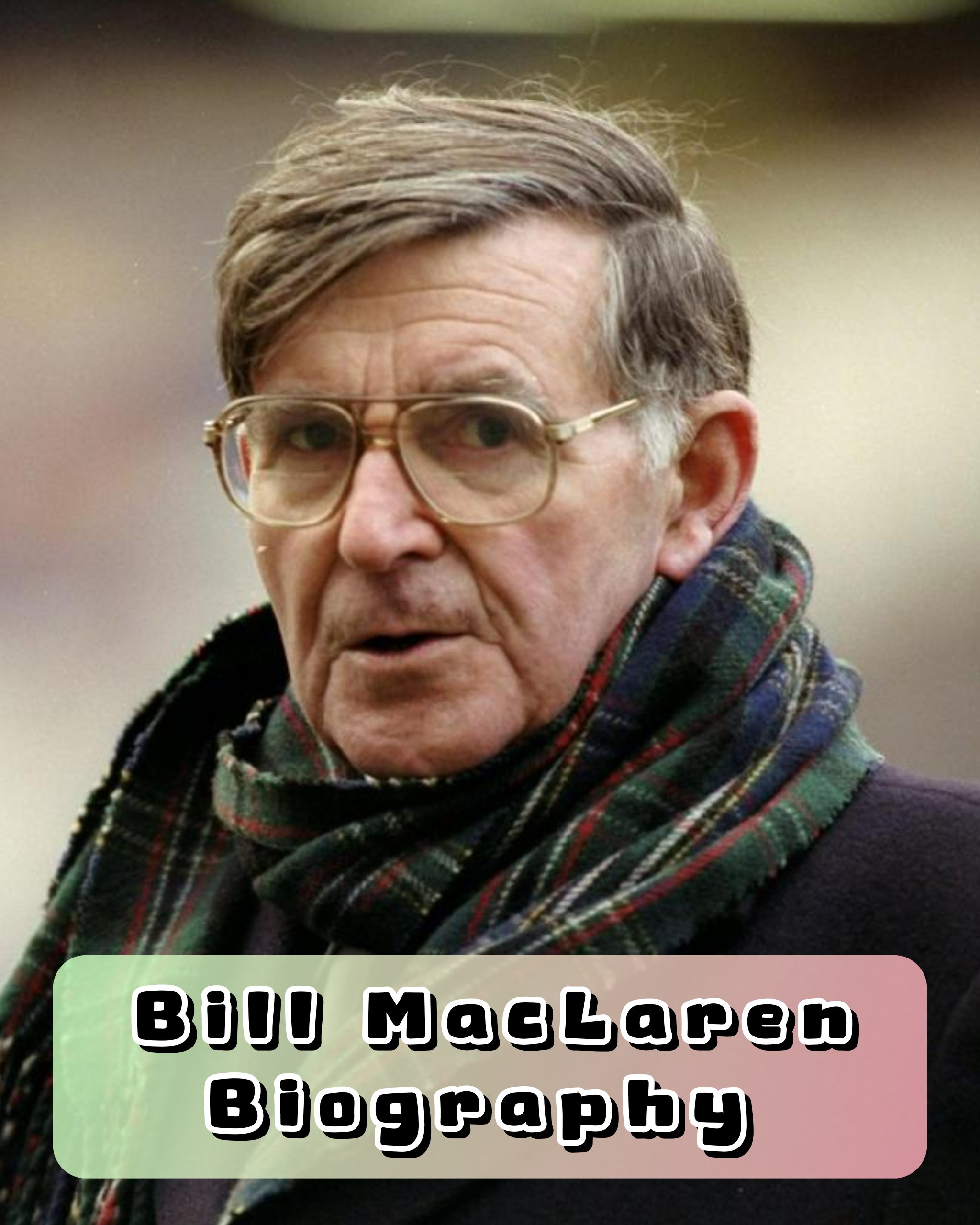
Bill McLaren was a legendary Scottish rugby union commentator, journalist, teacher and former rugby player who became widely known as “The Voice of Rugby.” Born William Pollock McLaren on October 16, 1923, in Hawick, Scotland, he earned a special place in sporting history through his distinctive Borders accent, encyclopaedic knowledge of rugby and unforgettable descriptions of matches. His broadcasting career with the BBC spanned almost five decades, during which he became one of the most respected voices in international rugby. Although tuberculosis ended his hopes of representing Scotland as a player, his passion for the sport led him to a successful career behind the microphone. McLaren died on January 19, 2010, aged 86, but his influence continues through rugby history, his family and the charitable work of the Bill McLaren Foundation.
Early Life of Bill McLaren
Bill McLaren was born on October 16, 1923, in Hawick, a historic town in the Scottish Borders renowned for its strong rugby tradition. His father worked in the knitwear industry, and McLaren grew up in a community where rugby union was an important part of local identity. From childhood, he developed a deep affection for the sport by listening to stories about famous players and attending matches with his father. These early experiences helped shape his ambitions and laid the foundation for his lifelong relationship with rugby.
As a young boy, McLaren became fascinated by Hawick Rugby Football Club and the legendary players who represented the town. He dreamed of wearing Scotland’s national rugby jersey and developed his own playing abilities while attending school. He eventually played as a flanker for Hawick, earning a reputation as a committed and enthusiastic forward. His early involvement in the game gave him practical knowledge of rugby tactics, player responsibilities and the physical demands of competition, all of which later strengthened his credibility as a commentator.
McLaren’s early adulthood was shaped by the Second World War, during which he served with the Royal Artillery in Italy. He witnessed the devastating consequences of the conflict, including the horrors associated with the Battle of Monte Cassino. After the war, he returned to rugby and pursued his ambition of playing for Scotland. However, in 1947, he contracted tuberculosis, a serious illness that forced him to abandon his hopes of becoming an international rugby player. His recovery included a lengthy stay in a sanatorium, where he encountered the circumstances that would unexpectedly introduce him to broadcasting. [1][2]
Bill McLaren Education
Bill McLaren received his early education in Hawick, where he developed an interest in sport, physical activity and the rugby culture that surrounded him. His school years helped establish the discipline and curiosity that later characterised both his teaching and broadcasting careers. Although detailed public records of every stage of his early schooling are limited, his association with Hawick’s sporting community is well documented, and rugby remained central to his development.
After his school education, McLaren pursued professional training that enabled him to become a physical education teacher. Teaching was an important part of his working life and gave him opportunities to encourage young people to participate in sport. His knowledge extended beyond rugby, as he taught physical education and worked with pupils in different sporting activities. His professional training and experience as an educator also helped him explain complicated sporting situations in language that audiences could understand.
McLaren’s education continued throughout his life through practical experience, reading, observation and detailed research. He studied teams and players, attended training sessions and developed a remarkable ability to remember names, statistics and match histories. Rather than relying solely on formal qualifications, he combined his teaching background with years of direct involvement in rugby. This continuous learning became one of the defining strengths of his broadcasting career and contributed to his reputation as one of the best-prepared commentators in the sport. [1][3]
Bill McLaren Career
Bill McLaren’s career combined teaching, journalism and broadcasting, with rugby remaining the central passion throughout his professional life. Before becoming a nationally recognised commentator, he worked as a physical education teacher and contributed rugby reports to the Hawick Express. His knowledge of local rugby and ability to communicate clearly helped establish his reputation. After his illness ended his playing ambitions, broadcasting offered him another way to remain involved in the game he loved.
McLaren made his BBC radio commentary debut in 1953 during a Scotland versus Wales international, which Scotland lost 12–0. He later became a familiar voice on television, with his coverage bringing rugby union to audiences throughout Britain and beyond. His commentary was distinguished by a rich Scottish Borders accent, colourful expressions, enthusiasm and a remarkable understanding of the game. He was also famous for preparing extensive notes about players and teams, allowing him to provide detailed background information while following the action. His style was knowledgeable without being unnecessarily harsh, and he became admired by players, coaches and supporters across national boundaries.
Over the decades, McLaren commentated on numerous memorable international matches and major rugby competitions. He continued teaching alongside broadcasting for many years before ending his teaching career in 1987. His final international commentary came in 2002, almost 50 years after his BBC debut. He received several honours for his services to sport, including an MBE, OBE and CBE. His contributions also earned him induction into the International Rugby Hall of Fame in 2001 and the World Rugby Hall of Fame in 2015, recognising the lasting influence of his work. [1][2][4]
Bill McLaren Personal Life and Family
Bill McLaren was married to Bette McLaren, née Hill, whom he met at a dance at Hawick Town Hall in 1947. Their relationship became one of the most important parts of his personal life, and they married in 1951. McLaren frequently expressed his affection for his wife and valued the time they spent together away from rugby. The couple shared interests that included golf, and Bette remained a central source of companionship throughout their marriage. His family life was especially important to him despite the demanding schedule associated with broadcasting.
Bill and Bette had two daughters, Linda Lawson and Janie Thompson. Linda married Alan Lawson, a former Scotland international rugby scrum-half who later became associated with rugby administration and the Bill McLaren Foundation. Janie married horse-racing commentator Derek Thompson. McLaren was devoted to his daughters and took great pride in their lives and families. Janie died in 2000 after an illness, a loss that deeply affected him. Despite his grief, he continued working and remained committed to the sport that had shaped much of his life.
McLaren also enjoyed a close relationship with his grandchildren, several of whom developed their own sporting interests. His grandson Rory Lawson became a Scotland international rugby scrum-half, while Jim Thompson also pursued rugby at a competitive level. McLaren took pride in seeing younger generations participate in the sport he had spent a lifetime promoting. His son-in-law Alan Lawson has also helped sustain his legacy through the Bill McLaren Foundation, connecting the family’s history with charitable initiatives that encourage participation in rugby and support emerging talent. [2][5]
Bill McLaren Age, Religion, Nationality, Height and Physical Appearance
Bill McLaren was born on October 16, 1923, and died on January 19, 2010, at the age of 86. He was Scottish by nationality and was born and raised in Hawick, in the Scottish Borders. His religious beliefs are not clearly documented in reliable public biographical sources, so a specific religion cannot be confidently attributed to him. His exact height has also not been reliably established in the sources consulted. In photographs and television appearances, McLaren was recognisable by his mature appearance, glasses, expressive face and distinctive Scottish Borders accent. His warm manner and familiar presence became as recognisable to rugby supporters as his commentary itself.
Bill McLaren Social Media Presence
Bill McLaren lived before social media became a major part of public life, and there is no verified personal Instagram account that can confidently be attributed to him. His public profile was built through BBC radio and television broadcasts, newspaper articles, interviews and books rather than online platforms. Today, supporters can learn about his life and continuing influence through the Bill McLaren Foundation, which shares information about its activities and the work being done in his name. Readers looking for updates should consult the foundation’s official website and its verified social media channels rather than assuming that an account using his name is personally operated by him.
Bill McLaren Net Worth
Bill McLaren’s exact net worth at the time of his death has not been reliably disclosed in public records. Although he enjoyed a long career with the BBC and worked as a physical education teacher, there is insufficient verified financial information to calculate his accumulated wealth accurately. Figures published online without supporting documentation should therefore be treated cautiously. His financial circumstances were associated primarily with his professional employment, broadcasting work and published writing rather than a publicly documented business empire.
McLaren’s earnings came from several professional activities over the course of his life. He worked as a teacher for decades, contributed to BBC radio and television coverage, and wrote books about rugby and its leading personalities. His publications included The History of Scottish Rugby, written with Sandy Thorburn, Talking of Rugby, Bill McLaren’s Dream Lions and his autobiography, The Voice of Rugby: My Autobiography. However, reliable historical salary records and comprehensive information about his book royalties are not readily available, making a precise income-based calculation impossible.
As a result, no defensible numerical estimate of Bill McLaren’s net worth can be provided from the available evidence. His long broadcasting career and other professional activities suggest that he earned a living through established employment and publishing, but they do not establish a specific fortune. His enduring value is more clearly reflected in his contribution to rugby, the affection of generations of supporters and the charitable foundation that continues to carry his name. Any claimed net-worth figure should be considered unverified unless it can be supported by credible financial documentation.
Bill McLaren Legacy
Bill McLaren’s legacy rests primarily on his extraordinary contribution to rugby broadcasting. For nearly 50 years, his voice helped audiences understand and appreciate rugby union, from international contests to the memorable performances of individual players. His distinctive accent, enthusiasm, extensive preparation and ability to describe complex moments in engaging language made him a defining figure in sports commentary. His nickname, “The Voice of Rugby,” captured the relationship he built with audiences who came to associate his voice with some of the sport’s most significant moments.
His influence extended beyond broadcasting into education and grassroots sport. As a physical education teacher, he encouraged young people to participate in sporting activities and helped develop an appreciation for teamwork, discipline and fair play. His deep knowledge of players and rugby history also made him a valuable source of information for journalists, supporters and future commentators. His induction into the International Rugby Hall of Fame and the World Rugby Hall of Fame recognised the unusual significance of a broadcaster whose impact reached far beyond the commentary box.
The Bill McLaren Foundation continues to preserve his memory by encouraging sporting opportunities and supporting young people. In the 2025–26 season, its bursary programme, launched in partnership with Scottish Rugby, awarded a total of £30,000 to ten young players, five female and five male, to help them balance rugby development with work, study and other responsibilities. The foundation also supports community initiatives and promotes the values McLaren represented. These efforts ensure that his name remains connected not only with historic rugby broadcasts but also with practical opportunities for future generations.
Conclusion
Bill McLaren remains one of the most influential rugby commentators in sporting history. From his early life in Hawick and his interrupted playing ambitions to his celebrated BBC broadcasting career, he demonstrated how knowledge, dedication and a genuine love of sport can create a lasting legacy. His marriage to Bette McLaren, his daughters and grandchildren, his work as a teacher and his memorable commentary all contributed to the person supporters came to admire. Although he died in 2010 at the age of 86, his influence continues through rugby history, the World Rugby Hall of Fame and the work of the Bill McLaren Foundation, which supports young players and preserves his contribution to the game.
Frequently Asked Questions About Bill McLaren
1. Who was Bill McLaren?
Bill McLaren was a Scottish rugby union commentator, journalist and physical education teacher best known as “The Voice of Rugby.” He worked with the BBC from 1953 until his retirement from international commentary in 2002.
2. How old was Bill McLaren when he died?
Bill McLaren was 86 years old when he died on January 19, 2010. He was born on October 16, 1923, in Hawick, Scotland.
3. Who was Bill McLaren’s wife?
Bill McLaren’s wife was Bette McLaren, née Hill. They met in Hawick in 1947 and married in 1951, remaining together for nearly six decades.
4. How many children did Bill McLaren have?
Bill McLaren had two daughters, Linda Lawson and Janie Thompson. Janie died in 2000, while Linda was among the family members who survived him.
5. What was Bill McLaren’s nationality?
Bill McLaren was Scottish. He was born in Hawick in the Scottish Borders and became one of Scotland’s most recognisable sporting broadcasters.
6. What was Bill McLaren’s religion?
Bill McLaren’s religious beliefs are not clearly established in reliable public biographical sources. It is therefore not possible to confirm his religion with confidence.
7. What was Bill McLaren’s height?
Bill McLaren’s exact height is not reliably documented in the biographical sources consulted. Claims giving a specific measurement should be treated as unverified.
8. What was Bill McLaren’s net worth?
Bill McLaren’s net worth was not publicly established through reliable financial records. He earned income as a BBC rugby commentator, teacher and author, but there is insufficient evidence to provide a trustworthy numerical estimate.
9. Why was Bill McLaren called the Voice of Rugby?
Bill McLaren was called “The Voice of Rugby” because of his distinctive Scottish Borders accent, memorable descriptions, extensive knowledge of players and ability to communicate the excitement of rugby matches to millions of listeners and viewers.
10. Why did Bill McLaren stop playing rugby?
Bill McLaren’s ambition to play international rugby for Scotland was ended by tuberculosis, which he contracted in 1947. After recovering, he developed a successful career in teaching and broadcasting.
11. When did Bill McLaren retire from commentary?
Bill McLaren’s final international rugby commentary took place in 2002, after almost 50 years with the BBC.
12. Did Bill McLaren have an Instagram account?
There is no verified personal Instagram account for Bill McLaren. He died in 2010, before Instagram was launched, and his legacy is now promoted through the Bill McLaren Foundation and rugby history resources.
13. What awards did Bill McLaren receive?
Bill McLaren received an MBE, OBE and CBE for his services to sport. He was inducted into the International Rugby Hall of Fame in 2001 and the World Rugby Hall of Fame in 2015.
14. What is the Bill McLaren Foundation?
The Bill McLaren Foundation is a charitable organisation that honours his legacy by encouraging sporting opportunities, supporting young people and promoting rugby at grassroots level. Its bursary programme has also provided financial support to emerging rugby players.
15. When did Bill McLaren die?
Bill McLaren died on January 19, 2010, aged 86, in his hometown of Hawick, Scotland.