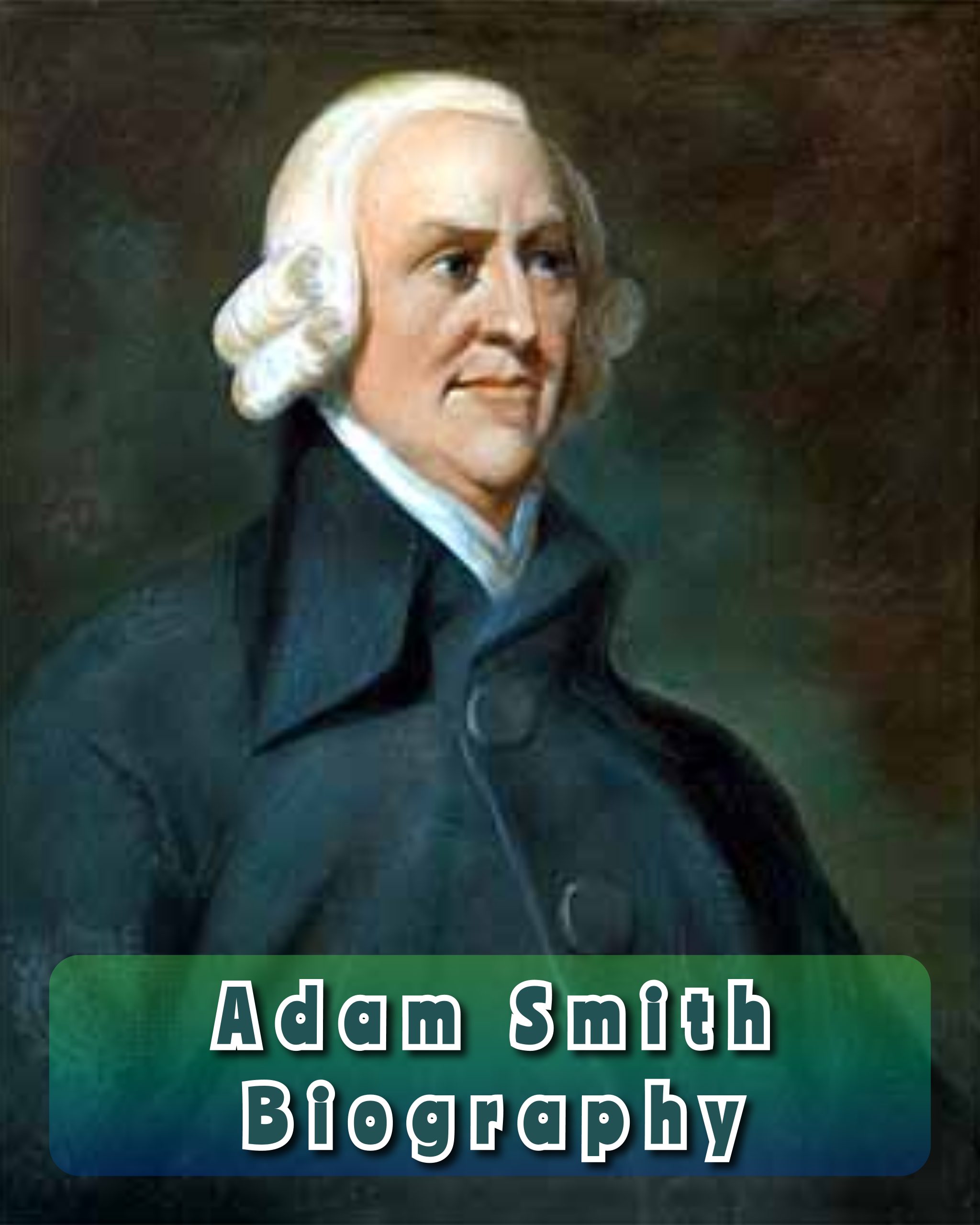
Adam Smith was born in 1723 in Kirkcaldy, Fife, Scotland, a small coastal town known for its trading and manufacturing activities. His exact date of birth is unknown, but he was baptized on June 5, 1723. His father, also named Adam Smith, had worked as a lawyer and customs official but died several months before Smith was born. He was raised by his mother, Margaret Douglas, who played an important role in his upbringing. Smith remained particularly close to her throughout his life.
As a child, Smith developed a strong interest in reading, learning and intellectual subjects. He attended the local school in Kirkcaldy, where he received an education that prepared him for further study. Contemporary accounts describe him as a quiet and deeply thoughtful child who was especially interested in books and ideas. His early exposure to the commercial life of Kirkcaldy may also have contributed to his later interest in trade, markets and the way economic activity shaped society.
At the age of about 14, Smith entered the University of Glasgow, where he studied from 1737 to 1740. There, he was strongly influenced by the philosopher Francis Hutcheson, whose teachings on moral philosophy, liberty and human society helped shape Smith’s intellectual development. He later attended Balliol College, Oxford, from 1740, where he continued studying philosophy and literature. Although his time at Oxford was not as academically stimulating as his years at Glasgow, these early educational experiences laid the foundation for the philosophical and economic ideas that would eventually make Smith one of the most influential thinkers of the 18th century.
Adam Smith Education
Adam Smith began his formal education at a local school in Kirkcaldy, Scotland, where he developed an early interest in reading, writing and academic study. He was considered an intelligent and highly curious student, with a particular fascination for books and intellectual subjects. His early education provided the foundation for his later studies and helped prepare him for university at a relatively young age.
In 1737, at about 14 years old, Smith entered the University of Glasgow, where he studied for three years. Glasgow was an important stage in his intellectual development, particularly because of the influence of Francis Hutcheson, a prominent professor of moral philosophy. Hutcheson’s teachings on morality, liberty, human behavior and society had a lasting influence on Smith’s thinking. Smith graduated from Glasgow in 1740 and subsequently received a scholarship known as the Snell Exhibition, which enabled him to continue his education at Oxford.
Smith entered Balliol College, Oxford, in 1740 and remained there until 1746. He studied subjects including philosophy, classical literature and related fields, although he later expressed criticism of aspects of the Oxford academic system. Despite this, his years at Oxford gave him considerable time for independent reading and intellectual development. His education at Glasgow and Oxford ultimately helped establish the philosophical foundation for his later works, including The Theory of Moral Sentiments and The Wealth of Nations.
Adam Smith Career
Adam Smith began his professional career as a lecturer in Edinburgh during the 1740s, teaching subjects connected to English literature, rhetoric and philosophy. In 1751, he was appointed Professor of Logic at the University of Glasgow, and the following year he became Professor of Moral Philosophy. At Glasgow, Smith taught ethics, jurisprudence, political economy and related subjects, developing many of the ideas that would later appear in his major books. His lectures established him as an important Scottish Enlightenment thinker and earned him a strong reputation among students and fellow scholars.
In 1759, Smith published The Theory of Moral Sentiments, a work that examined human morality, sympathy and the ways people judge their own behavior and the actions of others. The book brought him considerable recognition and helped establish his reputation beyond the university. Smith later left academic teaching in 1764 after accepting a position as tutor to the young Duke of Buccleuch. He accompanied his pupil on a tour of Europe, where he met several leading intellectuals, including the French economic thinkers François Quesnay and Anne Robert Jacques Turgot. These encounters broadened Smith’s understanding of economics, trade and government.
After returning to Britain, Smith settled in Kirkcaldy and devoted much of his time to writing what became his most famous work, An Inquiry into the Nature and Causes of the Wealth of Nations, published in 1776. The book transformed the study of political economy through its discussion of the division of labour, productivity, trade, markets and economic growth. In 1778, Smith was appointed Commissioner of Customs in Edinburgh, a position he held until his death in 1790. Although he became internationally famous for his economic writings, Smith continued to see economics as part of a broader study of human society, morality and political institutions.
Adam Smith Personal Life and Family
Adam Smith was born in Kirkcaldy, Scotland, to Adam Smith Sr. and Margaret Douglas. His father was a lawyer, writer to the signet and customs official, but he died several months before Smith was born. Smith was therefore raised primarily by his mother, Margaret, with whom he remained exceptionally close throughout his life. He never married and had no known children, and there is no reliable evidence that he had a wife or formally documented fiancée.
Smith’s private life was generally quiet and largely devoted to scholarship, writing and intellectual pursuits. He maintained close relationships with friends and fellow scholars, particularly during his years in the Scottish Enlightenment intellectual circle. Among the people who influenced his professional and intellectual life were David Hume, the Scottish philosopher and historian, and Francis Hutcheson, his former professor at the University of Glasgow. Smith and Hume became close friends, and their correspondence and relationship were significant parts of Smith’s personal and intellectual world.
Smith spent his later years in Edinburgh, where he lived with his mother until her death in 1784 and was also assisted by his cousin Janet Douglas, who kept house for him during his final years. Smith died on July 17, 1790, at the age of 67. He was buried in the Canongate Kirkyard in Edinburgh, and because he left no wife or children, much of his personal legacy passed through his writings and the intellectual influence he had on later generations.
Adam Smith Death and Cause of Death
Adam Smith died on July 17, 1790, in Edinburgh, Scotland, at the age of 67. He had spent the final years of his life in Edinburgh while serving as a Commissioner of Customs. Although Smith had achieved international recognition for The Wealth of Nations, he remained a relatively private man and continued working and studying until his health began to decline.
The exact cause of Adam Smith’s death is not definitively known. Historical accounts indicate that he suffered from a prolonged illness before his death, but there is no reliable modern medical diagnosis that can establish precisely what condition caused it. Claims sometimes made about a specific disease or medical condition should therefore be treated cautiously rather than presented as fact.
Shortly before his death, Smith reportedly asked his friends to destroy some of his unpublished manuscripts because he did not consider them ready for publication. He was buried at Canongate Kirkyard in Edinburgh, where his grave remains associated with his enduring legacy as one of the most influential thinkers in the history of economics and moral philosophy.
Adam Smith Age, Religion, Nationality, Height and Physical Appearance
Adam Smith was 67 years old when he died on July 17, 1790. He was Scottish by nationality, having been born in Kirkcaldy, Fife, Scotland, and spending most of his life in Scotland. Smith was raised within the Christian tradition, particularly the Presbyterian religious environment of 18th-century Scotland, although his personal religious beliefs have been the subject of scholarly discussion and cannot always be stated with certainty.
There is no reliable historical record of Adam Smith’s exact height, so a specific measurement should not be presented as fact. Contemporary descriptions and surviving portraits generally depict him as a somewhat heavyset man with a prominent nose, full face and distinctive facial features. He was also known for his formal 18th-century clothing and, in later life, often appeared with a wig, reflecting the fashion of his period.
Smith’s appearance is best understood through contemporary descriptions and portraits, since photography did not yet exist during his lifetime. Accounts portray him as an intellectual and somewhat absent-minded scholar who was more concerned with reading, teaching and philosophical discussion than with personal appearance. His physical characteristics are less documented than his intellectual life, and many details commonly repeated online about his height or appearance are not historically verifiable.
Adam Smith Net Worth
Adam Smith’s exact net worth at the time of his death in 1790 is not known, and it would be misleading to give a modern-style figure as though a documented estate valuation survives. Smith earned income from several respectable positions, including university teaching, private tutoring and his later government appointment as a Commissioner of Customs. His financial position appears to have been comfortable, although he was not known to have accumulated extraordinary wealth.
Smith’s university career provided him with a steady income. As a professor at the University of Glasgow, he received a salary from his academic position and also earned money from student fees and other teaching-related arrangements. Later, his position as tutor to the Duke of Buccleuch provided additional financial security. In 1778, he became a Commissioner of Customs in Edinburgh, a well-paid government position that gave him a more stable income during the final 12 years of his life. His books, particularly The Wealth of Nations, also brought him fame and some financial returns, although book royalties in the 18th century were very different from those received by bestselling authors today.
Based on the available historical evidence about his professorial income, private tutoring, government salary and literary earnings, Smith can reasonably be described as financially comfortable or upper-middle-class by the standards of 18th-century Scotland, rather than exceptionally wealthy. However, there is insufficient evidence to calculate a credible exact figure for his estate or convert it into a modern net-worth estimate. For an accurate biography, it is therefore better to state that Adam Smith’s net worth is unknown, rather than attach an unsupported dollar amount to him.
Legacy
Adam Smith’s legacy is closely connected to the development of modern economics and political economy. His 1776 book, An Inquiry into the Nature and Causes of the Wealth of Nations, became one of the most influential works in economic thought. Smith examined how the division of labour, specialization, competition, trade and individual economic decisions could contribute to greater productivity and national prosperity. His famous discussion of the “invisible hand” became one of the most widely recognized ideas associated with economics, although the concept is often simplified or taken out of the broader context of his writings.
Smith’s influence extends beyond economics because he also explored morality, human behavior and social relationships. His earlier work, The Theory of Moral Sentiments, argued that people possess a capacity for sympathy and that moral judgment plays an important role in society. Together, his major works demonstrate that Smith was interested not only in markets and wealth but also in the ethical and social conditions under which people live. Modern scholars therefore often present him as a broader moral philosopher and social thinker, rather than simply as the founder of free-market economics.
Today, Adam Smith remains one of the most influential figures in the history of economic thought. His ideas have shaped debates about free markets, government, taxation, international trade, economic freedom and capitalism, while economists and historians continue to debate how his arguments should be interpreted in the modern world. Universities, research institutions and organizations around the world continue to study his writings, and the Adam Smith Prize and Adam Smith Lecture are among the many honors and academic initiatives that reflect his continuing influence. His name remains synonymous with the emergence of modern economic thought and his intellectual legacy continues to shape discussions about how economies and societies should function.
Conclusion
Adam Smith remains one of the most influential thinkers in the history of economics and philosophy. From his early education in Scotland to his academic career at the University of Glasgow and his government service in Edinburgh, his life was shaped by a deep interest in human behavior, morality, trade and society. Through The Theory of Moral Sentiments and The Wealth of Nations, Smith developed ideas that continue to influence discussions about markets, economic freedom, competition, government and social responsibility. Although many details of his private life and finances remain uncertain, his intellectual contributions have given him a lasting place in history as one of the key figures behind the development of modern economics.
Frequently Asked Questions About Adam Smith
Who was Adam Smith?
Adam Smith was a Scottish economist, philosopher and author best known for The Wealth of Nations (1776) and The Theory of Moral Sentiments (1759). He is widely regarded as one of the founding figures of modern economics.
When was Adam Smith born?
Adam Smith was born in 1723 in Kirkcaldy, Fife, Scotland. His exact birth date is uncertain, but his baptism was recorded on June 5, 1723.
How old was Adam Smith when he died?
Adam Smith was 67 years old when he died on July 17, 1790, in Edinburgh, Scotland.
Was Adam Smith married?
No. Adam Smith never married and there is no reliable historical evidence that he had a wife or formally documented fiancée.
Did Adam Smith have children?
No. Adam Smith had no known children. He remained unmarried throughout his life.
What was Adam Smith’s religion?
Adam Smith was raised in the Christian and Presbyterian environment of 18th-century Scotland. However, his personal religious beliefs are debated by historians, so it is difficult to assign him a precise religious identity with certainty.
What was Adam Smith’s nationality?
Adam Smith was Scottish. He was born in Kirkcaldy, Fife, and spent most of his life in Scotland.
What was Adam Smith’s most famous book?
Adam Smith’s most famous book was The Wealth of Nations, published in 1776. Its full title is An Inquiry into the Nature and Causes of the Wealth of Nations.
What did Adam Smith believe?
Adam Smith believed that specialization, division of labour, voluntary exchange and competition could increase productivity and contribute to economic prosperity. His ideas also emphasized morality, social cooperation and the importance of institutions.
What is Adam Smith’s invisible hand?
The invisible hand is a phrase associated with Adam Smith’s explanation of how individuals pursuing their own interests can, under certain conditions, unintentionally contribute to broader economic outcomes. It is often used to describe the coordinating effects of markets.
What was Adam Smith’s occupation?
Adam Smith was a philosopher, economist, professor, lecturer, author and government official. He taught at the University of Glasgow and later served as a Commissioner of Customs in Edinburgh.
Where did Adam Smith study?
Adam Smith studied at the University of Glasgow and later attended Balliol College, Oxford. His education in philosophy strongly influenced his later economic and moral writings.
What was Adam Smith’s net worth?
Adam Smith’s exact net worth is unknown. He earned income from university teaching, private tutoring, writing and government service, and appears to have lived comfortably by the standards of his time, but no reliable modern net-worth figure exists.
How tall was Adam Smith?
Adam Smith’s exact height is not known. There is no reliable historical record providing a precise measurement of his height.
How did Adam Smith die?
Adam Smith died on July 17, 1790, in Edinburgh at the age of 67. The exact medical cause of his death is unknown, although historical accounts indicate that he had suffered from a prolonged illness.
Why is Adam Smith important?
Adam Smith is important because his writings helped establish the foundations of modern economics and political economy. His ideas about division of labour, markets, trade, productivity and economic behavior continue to influence economic thought today.
Where is Adam Smith buried?
Adam Smith is buried at Canongate Kirkyard in Edinburgh, Scotland. His grave remains an important site associated with his historical legacy.