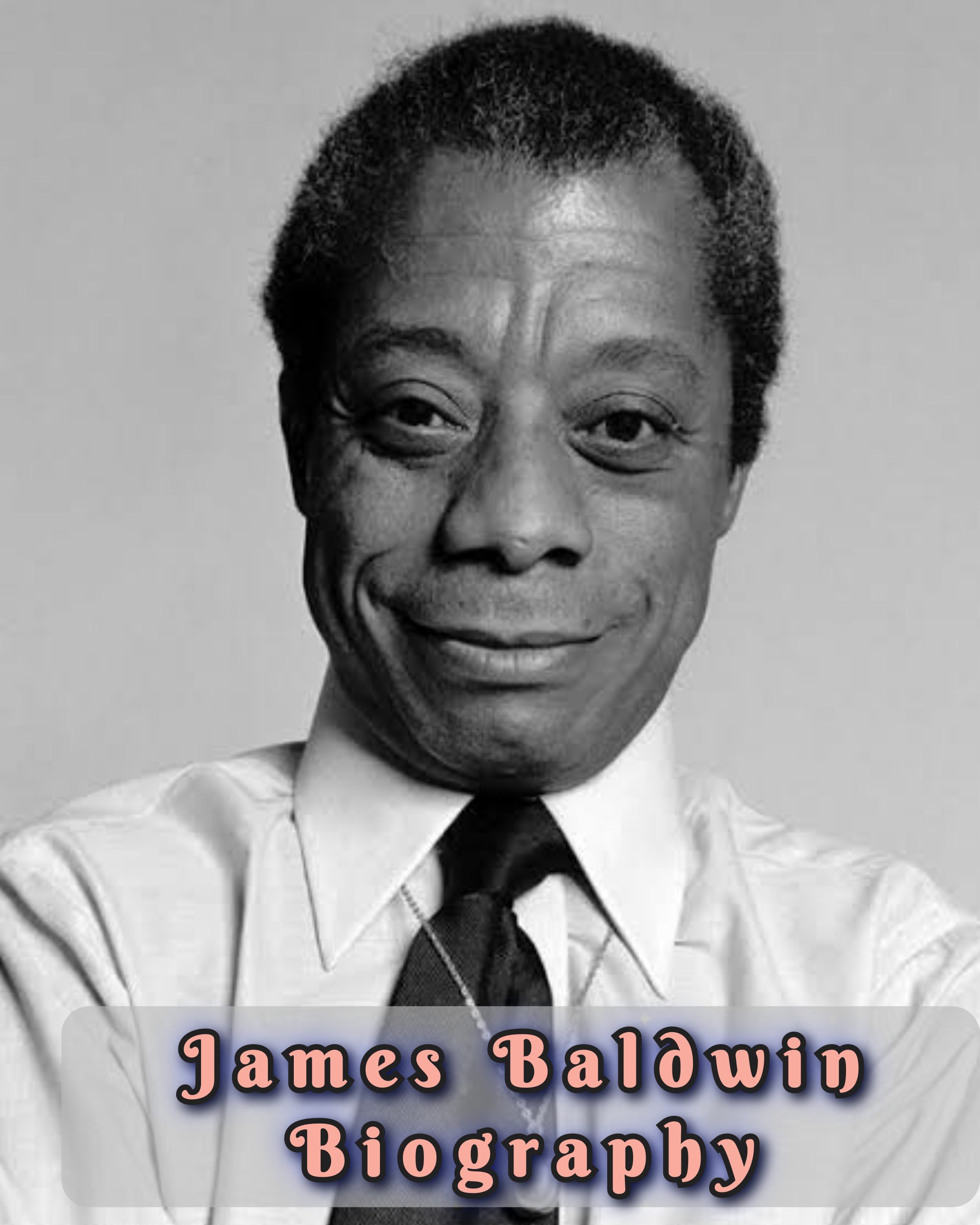
James Arthur Baldwin was born on August 2, 1924, in Harlem, New York City, during the Harlem Renaissance, a period of extraordinary cultural and intellectual growth among African Americans. He was raised in a large family by his mother, Emma Berdis Jones, and his stepfather, David Baldwin, a strict Pentecostal preacher. Baldwin grew up in poverty and faced the realities of racial discrimination from an early age, experiences that would later become central themes in his writing.
Religion played a major role in Baldwin’s childhood. As a teenager, he followed his stepfather into the church and became a preacher at the age of 14. His years in the Pentecostal church exposed him to powerful preaching, music and biblical language, which later influenced the rhythm and style of his literary work. However, his growing doubts about religion and the conflict between his personal identity and the expectations placed upon him eventually led him to leave the church.
Baldwin attended DeWitt Clinton High School in the Bronx, where he developed a strong interest in literature and writing. He worked on the school newspaper and literary magazine and began forming friendships with other young writers and artists. His experiences growing up as a Black teenager in Harlem and the Bronx, combined with his early religious life and exposure to racial inequality, shaped the ideas about identity, race, faith, sexuality and social injustice that would define his later career as one of America’s most influential writers.
James Baldwin Education
James Baldwin received his early education in New York City and attended DeWitt Clinton High School in the Bronx. At school, he developed a deep interest in literature and writing, becoming involved with the school newspaper and literary magazine. His teachers and early exposure to books encouraged him to take writing seriously and helped lay the foundation for his future career as a literary figure.
Although Baldwin was an intelligent and gifted student, he did not attend college. Instead, after graduating from high school, he focused on supporting himself through various jobs while continuing to write. During this period, he read extensively and studied the works of major writers, developing his own literary voice outside the traditional university system.
Baldwin’s education was therefore shaped as much by self-study and life experience as by formal schooling. His childhood in Harlem, years as a teenage preacher, encounters with racial discrimination, and growing involvement with New York’s literary community provided him with experiences that became central to his writing. His intellectual development eventually led him to become a powerful essayist, novelist and social critic whose works examined race, religion, identity and American society.
James Baldwin Career
James Baldwin began his professional writing career in New York City during the 1940s, initially working as a reviewer and contributing essays, reviews and short stories to literary publications. He received important encouragement from writer Richard Wright, who helped Baldwin obtain a fellowship that allowed him to devote more time to writing. In 1948, Baldwin moved to Paris, France, seeking distance from the racial pressures of America and greater freedom to develop his literary voice.
Baldwin achieved major recognition with his first novel, Go Tell It on the Mountain, published in 1953. The semi-autobiographical novel drew heavily on his childhood experiences in a strict Pentecostal household and explored themes of faith, family, sexuality and identity. He followed it with influential works including Notes of a Native Son (1955), Giovanni’s Room (1956), Another Country (1962) and The Fire Next Time (1963). His writing increasingly addressed racism, sexuality, religion and the complex realities of American society.
During the Civil Rights Movement, Baldwin became one of America’s most prominent literary and social commentators. He wrote extensively about racial inequality and participated in public debates and discussions alongside figures such as Martin Luther King Jr., Malcolm X and Medgar Evers. His later works included If Beale Street Could Talk (1974), Just Above My Head (1979) and The Evidence of Things Not Seen (1985). Baldwin spent much of his later life between France and the United States and continued writing and speaking about racial justice, human rights and personal identity until his death in 1987.
James Baldwin Death and Cause of Death
James Baldwin died on December 1, 1987, at the age of 63, at his home in Saint-Paul-de-Vence, France. He had spent much of his later life in France while continuing to write, teach and speak about literature, race, identity and social justice. The Library of Congress confirms his death in 1987, while its archival material records that he was still working on an unpublished poetry project at the time of his death.
Baldwin died after a battle with stomach cancer. His illness occurred during the final period of his life, when he continued working despite declining health. His death was widely regarded as a significant loss to American literature and the broader civil-rights and cultural movements with which he had been associated.
Baldwin was buried at Ferncliff Cemetery in Hartsdale, New York. Although he died decades ago, his books and essays remain influential, particularly his writings on racism, religion, sexuality, identity and the American experience. His literary legacy continues to be preserved and studied by institutions including the Library of Congress and major universities and museums.
James Baldwin Personal Life and Family
James Baldwin was born to Emma Berdis Jones, his mother, and was raised by his stepfather, David Baldwin, a strict Pentecostal preacher. Baldwin was the eldest of his mother’s children and grew up in a large family in Harlem. His complicated relationship with his stepfather, combined with his experiences in the church, strongly influenced his writing, particularly his exploration of family, religion, identity and sexuality. His childhood experiences later inspired parts of his semi-autobiographical novel Go Tell It on the Mountain.
Baldwin never married and had no children. He was openly gay and had romantic relationships with men throughout his adult life. Among the people associated with his personal life was Lucien Happersberger, a Swiss artist whom Baldwin met as a young man and with whom he shared a close and complicated relationship. Baldwin also had relationships with other men, but he generally kept many intimate details of his private life away from the public. There is no reliable evidence that Baldwin was ever formally engaged to a fiancée.
Family remained an important part of Baldwin’s identity even as he spent long periods living abroad, particularly in France. He maintained connections with his siblings and extended family while building a life within literary and artistic communities in the United States and Europe. His experiences with family, faith, race and sexuality became deeply intertwined with his work, making his personal history an important key to understanding his novels, essays and social commentary.
James Baldwin Age, Religion, Nationality, Height and Physical Appearance
James Baldwin was born on August 2, 1924, and died on December 1, 1987, at the age of 63. He was American by nationality and was born in Harlem, New York City. Baldwin was raised in a strict Pentecostal Christian household and became a teenage preacher before eventually leaving the church. Although his relationship with organized religion became increasingly complicated, Christian theology, biblical language and spiritual questions remained important influences throughout his writing.
Baldwin’s exact height is not reliably documented in authoritative biographical sources, so commonly published figures should be treated with caution. He was known for his distinctive appearance, with a slim build, dark complexion, short dark hair and expressive facial features. Photographs from different periods of his life frequently show him wearing suits, jackets or simple shirts, reflecting the understated but recognizable style associated with him.
In his later years, Baldwin’s appearance changed naturally with age and declining health, but he remained a recognizable public intellectual whose photographs often captured his thoughtful and serious expression. His physical appearance is generally less documented than his literary achievements, and there is no need to state an exact height unless a reliable source confirms it.
James Baldwin Net Worth
James Baldwin’s exact net worth at the time of his death is not publicly documented, so figures circulating online should be treated as estimates rather than confirmed financial records. One widely cited estimate places his net worth at approximately $100,000 in 1987, the year he died.
Baldwin earned money primarily through his work as a novelist, essayist, playwright, lecturer and literary commentator. His income came from book advances, publishing royalties, magazine contributions, speaking engagements and other literary work. He became particularly successful in the 1950s and 1960s, when books such as Go Tell It on the Mountain, Notes of a Native Son and The Fire Next Time established him as a major American writer. His financial situation, however, varied throughout his career, and there is no reliable public record showing a consistent annual salary.
Baldwin’s literary estate continued to have value after his death. For example, shortly before his death, he had received a $200,000 advance from McGraw-Hill for his unfinished book Remember This House; the publisher later sued his estate to recover the advance, although the lawsuit was eventually dropped. Therefore, for an SEO biography, it is safest to state that James Baldwin’s estimated net worth was around $100,000 at the time of his death in 1987, while noting that this is an estimate rather than an officially verified figure.
Legacy
James Baldwin left an enduring legacy as one of the most influential American writers and social critics of the 20th century. Through novels, essays, plays and public commentary, he examined racism, religion, sexuality, identity, poverty and the American experience with unusual honesty and emotional depth. Works such as Go Tell It on the Mountain, Giovanni’s Room, Notes of a Native Son and The Fire Next Time established him as a major literary voice whose work continues to be widely read and studied.
Baldwin also became an important voice during the American Civil Rights Movement. His essays and public appearances challenged racial injustice and forced readers to confront the contradictions between America’s democratic ideals and the realities experienced by Black Americans. At the same time, his willingness to write openly about homosexuality and personal identity made him an important figure in the history of LGBTQ+ literature. His work connected struggles over race, sexuality, religion and freedom in ways that were groundbreaking for his time.
More than three decades after his death, Baldwin’s influence remains visible in literature, film, academia and social-justice discussions. His writings continue to inspire new generations of authors, activists, filmmakers and scholars, while works such as If Beale Street Could Talk have reached new audiences through film adaptations. Baldwin’s ability to combine personal experience with powerful social criticism has ensured that his voice remains relevant, making him an enduring figure in American literature and cultural history.
Conclusion
James Baldwin remains one of the most important literary and cultural voices of the 20th century. From his difficult childhood in Harlem and early life in the church to his groundbreaking career as a novelist, essayist and social critic, Baldwin used his experiences to examine race, religion, sexuality, identity and human freedom. Although he died in 1987 at the age of 63, his books and ideas continue to influence readers, writers, scholars and activists around the world. His enduring legacy lies in his courage to confront difficult truths and his ability to turn personal experience into powerful writing that continues to speak to new generations.
Frequently Asked Questions About James Baldwin
Who was James Baldwin?
James Baldwin was an American novelist, essayist, playwright, poet and social critic best known for writing about race, religion, sexuality, identity and social injustice. His major works include Go Tell It on the Mountain, Giovanni’s Room, Notes of a Native Son and The Fire Next Time.
When was James Baldwin born?
James Baldwin was born on August 2, 1924, in Harlem, New York City, United States.
How old was James Baldwin when he died?
James Baldwin was 63 years old when he died on December 1, 1987.
What was James Baldwin’s cause of death?
James Baldwin died from stomach cancer on December 1, 1987, at his home in Saint-Paul-de-Vence, France.
Was James Baldwin married?
No. James Baldwin was never married and did not have a wife or children.
Did James Baldwin have children?
No. James Baldwin did not have any children.
Was James Baldwin gay?
Yes. James Baldwin was openly gay and wrote extensively about sexuality, identity and relationships. His openness about his sexuality made him an important figure in LGBTQ+ literature.
Who was James Baldwin’s partner?
One of Baldwin’s best-known long-term relationships was with Lucien Happersberger, a Swiss artist whom he met when Baldwin was a young man. Their relationship was complex and remained significant in Baldwin’s personal life.
What religion was James Baldwin?
James Baldwin was raised in a strict Pentecostal Christian family. He became a teenage preacher but later left the church. Christianity, faith and spiritual conflict remained important themes throughout his writing.
Where did James Baldwin live?
Baldwin lived in several places during his life, including New York City and France. He moved to Paris in 1948 and spent much of his later life in France, where he died in Saint-Paul-de-Vence.
What was James Baldwin’s most famous book?
One of Baldwin’s most famous books is The Fire Next Time, published in 1963. The influential work examines race, religion and racial inequality in America and became an important text associated with the Civil Rights era.
What are James Baldwin’s most famous books?
Some of James Baldwin’s best-known books include Go Tell It on the Mountain, Notes of a Native Son, Giovanni’s Room, Another Country, The Fire Next Time, If Beale Street Could Talk and Just Above My Head.
Did James Baldwin have a college degree?
No. Baldwin did not attend college. He attended DeWitt Clinton High School in the Bronx and continued his education largely through reading, writing and personal experience.
What was James Baldwin’s net worth?
James Baldwin’s exact net worth is not publicly verified. Some sources estimate that he had approximately $100,000 at the time of his death in 1987, but this figure should be regarded as an estimate rather than an official financial record.
What was James Baldwin’s nationality?
James Baldwin was American. He was born in Harlem, New York City, and spent significant periods of his adult life living in France.
How tall was James Baldwin?
James Baldwin’s exact height is not reliably documented by authoritative biographical sources. Online figures vary, so a specific height should not be presented as confirmed fact.
Where is James Baldwin buried?
James Baldwin is buried at Ferncliff Cemetery in Hartsdale, New York, United States.
Why is James Baldwin important?
James Baldwin is important because he used literature and public commentary to challenge racism, religious intolerance, homophobia and social inequality. His writing helped shape American literature and continues to influence discussions about race, sexuality, identity and justice.