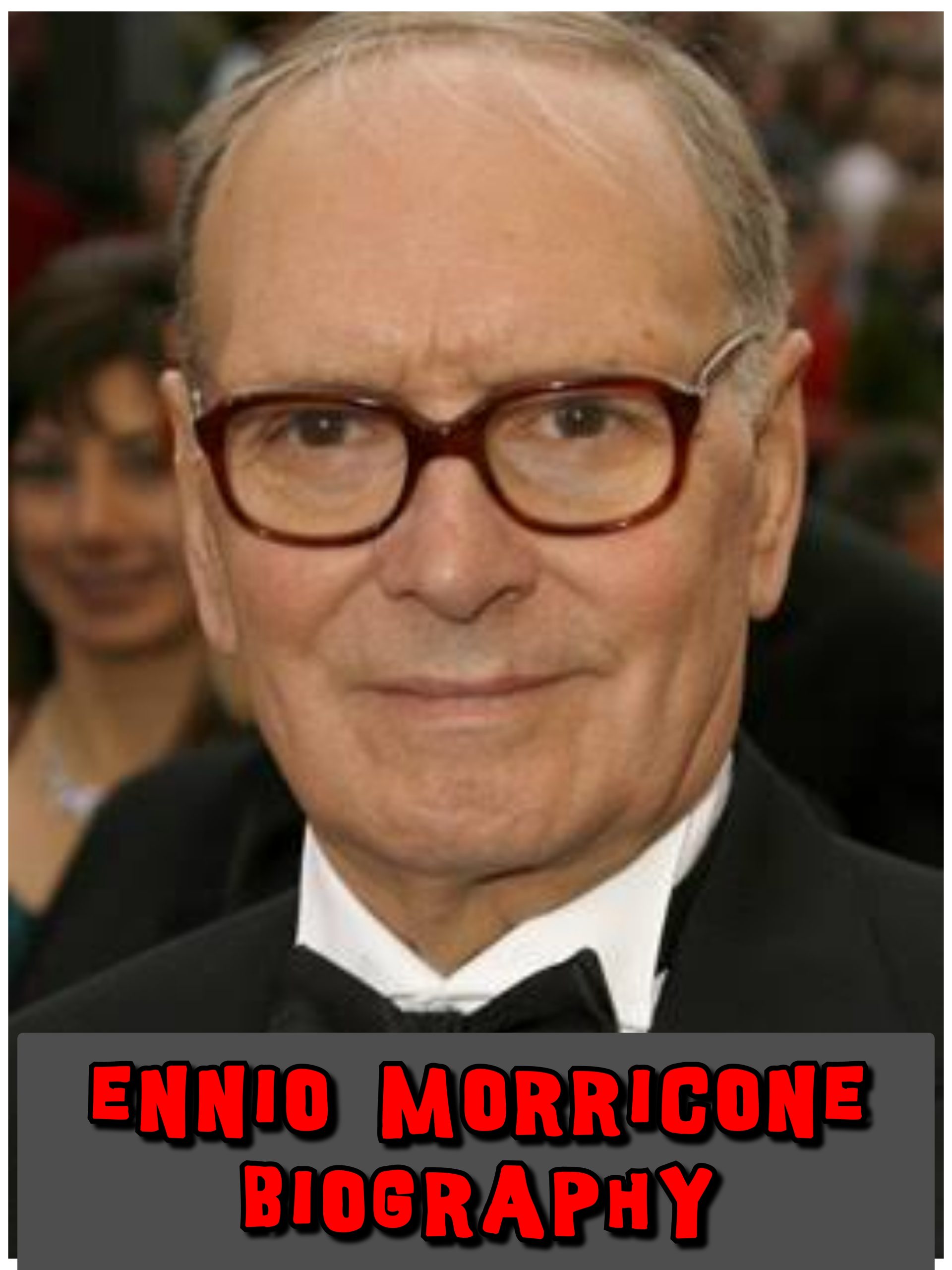
Ennio Morricone was born on November 10, 1928, in Rome, Italy, to Libera Ridolfi and Mario Morricone. His father was a professional trumpeter who performed with orchestras, while his mother managed the family. Growing up in a musical household, Morricone was introduced to music from an early age, and his father’s work strongly influenced his decision to pursue a career in music.
Morricone showed remarkable musical ability as a child and began studying the trumpet before developing a deeper interest in composition and arrangement. He attended the Conservatorio di Santa Cecilia in Rome, one of Italy’s most prestigious music institutions, where he studied trumpet, orchestration and composition. His education gave him a strong classical foundation that would later become an important part of his distinctive approach to film scoring.
As a young musician, Morricone began working professionally as an arranger and composer while continuing to develop his skills. He initially wrote and arranged music for Italian radio, television and popular recordings before moving increasingly toward film and television scores. These early experiences allowed him to experiment with unusual sounds and musical combinations, laying the foundation for the innovative style that would eventually make him one of the most celebrated film composers of the 20th century.
Ennio Morricone’s Education
Ennio Morricone received his formal musical education at the Conservatorio di Santa Cecilia in Rome, one of Italy’s most respected institutions for classical music. He enrolled at the conservatory as a young musician and studied the trumpet, developing the technical skills that would become an important part of his early professional career. His training also exposed him to the traditions of classical composition and orchestration.
During his studies, Morricone expanded his musical abilities beyond performance and concentrated increasingly on composition and orchestration. He studied under established Italian musicians, including composer Goffredo Petrassi, whose influence was particularly important in shaping Morricone’s understanding of modern composition. Morricone completed his studies in trumpet and later obtained qualifications in orchestral and choral composition and instrumentation.
His education at Santa Cecilia provided the classical foundation that distinguished his later film music. Although he eventually became famous for creating innovative soundtracks that blended orchestral music with unusual instruments and contemporary sounds, Morricone retained the discipline and compositional techniques he developed during his conservatory years. This combination of formal classical training and experimentation became a defining feature of his career.
Ennio Morricone’s Career
Ennio Morricone began his professional career as a musician, arranger and orchestrator before becoming one of the most celebrated film composers in history. After completing his studies at the Conservatorio di Santa Cecilia in Rome, he worked on arrangements for Italian popular music and for organizations including RAI and RCA Italy. He officially entered the film-composition world in 1961 with Il Federale, directed by Luciano Salce. His early work demonstrated the combination of classical training and experimentation that would later become his signature style.
Morricone achieved international fame through his collaboration with director Sergio Leone, beginning with A Fistful of Dollars in 1964. He went on to score For a Few Dollars More, The Good, the Bad and the Ugly, Once Upon a Time in the West and Once Upon a Time in America. His distinctive use of whistles, electric guitar, percussion, voices, unusual sound effects and orchestral arrangements transformed the sound of the Western and made his compositions instantly recognizable. However, Westerns represented only a small portion of his overall output; the Morricone Foundation records more than 450 film scores and highlights his work across numerous genres and collaborations with filmmakers around the world.
Beyond the Western genre, Morricone composed acclaimed scores for films including The Battle of Algiers, The Mission, The Untouchables, Cinema Paradiso, The Untouchables, Malèna and The Hateful Eight. He also continued composing concert and absolute music throughout his life and later conducted his works in major concerts around Europe, Asia and the Americas. In 2016, he won the Academy Award for Best Original Score for The Hateful Eight, following his earlier Honorary Academy Award in 2007 for his outstanding contribution to film music. His career established him as not merely a film composer but as one of the most influential composers of the modern era.
Ennio Morricone’s Personal Life and Family
Ennio Morricone married Maria Travia on October 13, 1956, after the couple had met in Rome in 1950. Maria, who was born in Sicily and raised in Rome, became his lifelong partner and an important supporter of his musical career. She also contributed lyrics to some of Morricone’s works, including the Latin texts for The Mission. Their marriage lasted for 63 years, until Morricone’s death in July 2020.
Morricone and Maria Travia had four children: Marco, Alessandra, Andrea and Giovanni. Their eldest son, Marco Morricone, was born in 1957, followed by Alessandra in 1961, Andrea Morricone in 1964, and Giovanni Morricone in 1966. Andrea followed his father into music as a composer and conductor, while Giovanni pursued filmmaking and screenwriting. Alessandra became a medical doctor, and Marco went into business.
Despite his international fame, Morricone remained closely connected to his family and his native Rome throughout his life. He chose not to relocate permanently to Hollywood, preferring to build his career from Italy. His relationship with Maria remained central to his personal life, and she was among the people closest to his creative process. Morricone died in Rome on July 6, 2020, aged 91, and was survived by Maria and their four children.
Ennio Morricone’s Age, Religion, Nationality, Height and Physical Appearance
Ennio Morricone was born on November 10, 1928, in Rome, Italy, and died on July 6, 2020, at the age of 91. He was Italian by nationality and spent most of his life closely connected to Rome and Italian culture. Morricone was also known for his Catholic faith, which influenced aspects of his personal life and was reflected in some of his compositions, particularly his work on The Mission.
Morricone was commonly reported to have been around 5 feet 6 inches (168 cm) tall, although his exact height was not consistently documented in authoritative biographical sources. In appearance, he had a slender build, light skin, gray-to-white hair in his later years and distinctive facial features. He frequently appeared in public wearing formal suits, reflecting the reserved and professional image associated with his long career as a composer and conductor.
During his later years, Morricone’s white hair and glasses became recognizable features of his appearance. Photographs of him conducting orchestras often showed him holding a baton and concentrating intensely on the performers. His understated appearance contrasted with the highly innovative and dramatic character of the music that made him internationally famous.
Ennio Morricone’s Social Media Presence
Ennio Morricone remains highly visible on social media through accounts and pages dedicated to preserving and celebrating his music and legacy. Because Morricone died in 2020, accounts using his name should not automatically be assumed to be personally operated by him. One Instagram account associated with his legacy is @morricone.official, which shares content connected with his music, productions and continuing artistic legacy.
Another Instagram account using Morricone’s name is @maestro_ennio_morricone, which has shared photographs and posts celebrating the composer and his work. There is also an account under @ennio___morricone, whose profile identifies Morricone as an Italian composer and gives his dates as 1928–2020. These accounts help keep his music and image visible to audiences around the world.
Morricone’s influence also continues through musicians, orchestras, filmmakers and fans who regularly share performances, tributes and interpretations of his compositions on social media. His most recognizable works, including music from The Good, the Bad and the Ugly, Cinema Paradiso and The Mission, continue to generate substantial online interest, ensuring that his artistic legacy remains relevant to new generations.
Ennio Morricone’s Net Worth
Ennio Morricone had an estimated net worth of about $50 million at the time of his death in 2020, according to Celebrity Net Worth. However, this figure should be treated as an estimate rather than an officially confirmed amount because Morricone did not publicly disclose his complete financial records. His wealth was accumulated over a career spanning nearly six decades as a film composer, conductor, orchestrator, arranger and recording artist.
A precise salary per movie or annual income for Morricone has not been reliably documented in authoritative public sources. His earnings would have come from multiple sources, including film-composition fees, music publishing and royalties, record sales, concert performances, television projects and licensing of his compositions. His exceptionally large catalogue—covering hundreds of film and television projects—provided numerous opportunities for continuing royalties and licensing income. Contemporary reporting also noted that Morricone initially turned to arranging popular music because composing contemporary classical music alone provided a very modest income, before his career expanded substantially.
Morricone’s financial legacy has continued beyond his death because his compositions remain commercially valuable and widely performed, recorded and licensed. A 2026 estimate from MoneySnoop also places his wealth at approximately $50 million, although the site explicitly describes its figure as a hypothetical estimate rather than verified estate information. Therefore, $50 million is a reasonable published estimate for Ennio Morricone’s net worth, but it should not be presented as an officially confirmed value.
Legacy
Ennio Morricone left an extraordinary legacy as one of the most influential film composers of the 20th and early 21st centuries. His music transformed the relationship between cinema and sound, demonstrating that a film score could become as memorable and emotionally powerful as the images on screen. His collaborations with Sergio Leone, particularly The Good, the Bad and the Ugly and Once Upon a Time in the West, helped redefine the sound of the Western and established musical themes that remain instantly recognizable around the world.
Morricone’s influence extended far beyond Westerns. Throughout his career, he composed music for hundreds of films across different genres, including The Mission, Cinema Paradiso, The Untouchables, Once Upon a Time in America and The Hateful Eight. His willingness to combine traditional orchestration with electric instruments, unconventional percussion, human voices, whistles and other unexpected sounds made his work distinctive. His influence can still be heard in contemporary film scoring, popular music and concert performances, while his compositions continue to introduce new generations to his remarkable musical language.
His achievements were formally recognized through numerous international awards, including an Honorary Academy Award in 2007 and the Academy Award for Best Original Score for The Hateful Eight in 2016. After his death in Rome on July 6, 2020, at the age of 91, his music continued to be performed and celebrated worldwide. Today, Morricone is remembered not only as a master of film music but also as a composer whose creativity, experimentation and emotional depth permanently changed the history of cinema.
Conclusion
Ennio Morricone’s life and career represent an extraordinary chapter in the history of music and cinema. From his early musical education in Rome to his rise as an internationally acclaimed composer, he created hundreds of scores that gave unforgettable emotional depth to films across generations. His collaborations with Sergio Leone, his Academy Award-winning work on The Hateful Eight, and timeless compositions from films such as The Mission and Cinema Paradiso secured his place among the greatest film composers of all time. Although he died in 2020 at the age of 91, Morricone’s music continues to be performed, recorded and discovered by new audiences, ensuring that his artistic legacy remains powerful and enduring.
Frequently Asked Questions About Ennio Morricone
Who was Ennio Morricone?
Ennio Morricone was an Italian composer, conductor, orchestrator and musician best known for creating some of the most influential film scores in cinema history. He worked on hundreds of films and became internationally famous for his collaborations with director Sergio Leone.
How old was Ennio Morricone when he died?
Ennio Morricone was 91 years old when he died on July 6, 2020. He was born on November 10, 1928, in Rome, Italy.
What was Ennio Morricone famous for?
Ennio Morricone was famous for composing iconic film scores, particularly for Westerns such as The Good, the Bad and the Ugly and Once Upon a Time in the West. He also composed acclaimed scores for The Mission, Cinema Paradiso, The Untouchables and The Hateful Eight.
Who was Ennio Morricone’s wife?
Ennio Morricone’s wife was Maria Travia. They married in 1956 and remained together until his death in 2020. They had four children.
How many children did Ennio Morricone have?
Ennio Morricone had four children with Maria Travia: Marco, Alessandra, Andrea and Giovanni Morricone. His son Andrea also became a composer and conductor.
What was Ennio Morricone’s net worth?
Ennio Morricone’s net worth was estimated at around $50 million at the time of his death, although no official public record confirms the exact value of his estate.
Did Ennio Morricone win an Oscar?
Yes. Ennio Morricone won the Academy Award for Best Original Score in 2016 for Quentin Tarantino’s The Hateful Eight. He had previously received an Honorary Academy Award in 2007 for his outstanding contribution to film music.
What is Ennio Morricone’s most famous song?
One of Morricone’s most recognizable compositions is “The Ecstasy of Gold” from The Good, the Bad and the Ugly. His themes from Once Upon a Time in the West, Cinema Paradiso and The Mission are also among his most celebrated works.
Where was Ennio Morricone born?
Ennio Morricone was born in Rome, Italy, on November 10, 1928. He spent much of his life living and working in Rome.
What religion was Ennio Morricone?
Ennio Morricone was Roman Catholic. His religious background was particularly relevant to some of his work, including his acclaimed score for The Mission.
How tall was Ennio Morricone?
Ennio Morricone was commonly reported to have been approximately 5 feet 6 inches (168 cm) tall. However, his exact height is not consistently documented by authoritative biographical sources.
When did Ennio Morricone die?
Ennio Morricone died on July 6, 2020, in Rome, Italy, at the age of 91. His death followed complications from injuries sustained in a fall.
What was Ennio Morricone’s relationship with Sergio Leone?
Ennio Morricone and Sergio Leone had one of the most important composer-director partnerships in film history. Morricone scored several of Leone’s major films, including A Fistful of Dollars, For a Few Dollars More, The Good, the Bad and the Ugly, Once Upon a Time in the West and Once Upon a Time in America.
How many movies did Ennio Morricone score?
Morricone composed music for hundreds of films and television productions during his career. Estimates vary depending on whether television projects, short films and other screen works are included, but his body of work spans more than 450 screen projects.
Is Ennio Morricone still alive?
No. Ennio Morricone died on July 6, 2020, aged 91. His music and influence, however, continue to be celebrated internationally.
What is Ennio Morricone’s legacy?
Ennio Morricone is remembered as one of the greatest and most innovative film composers in history. His distinctive combination of orchestral music, unusual instruments, vocals and experimental sounds changed the way film scores were created and continues to influence composers and filmmakers worldwide.