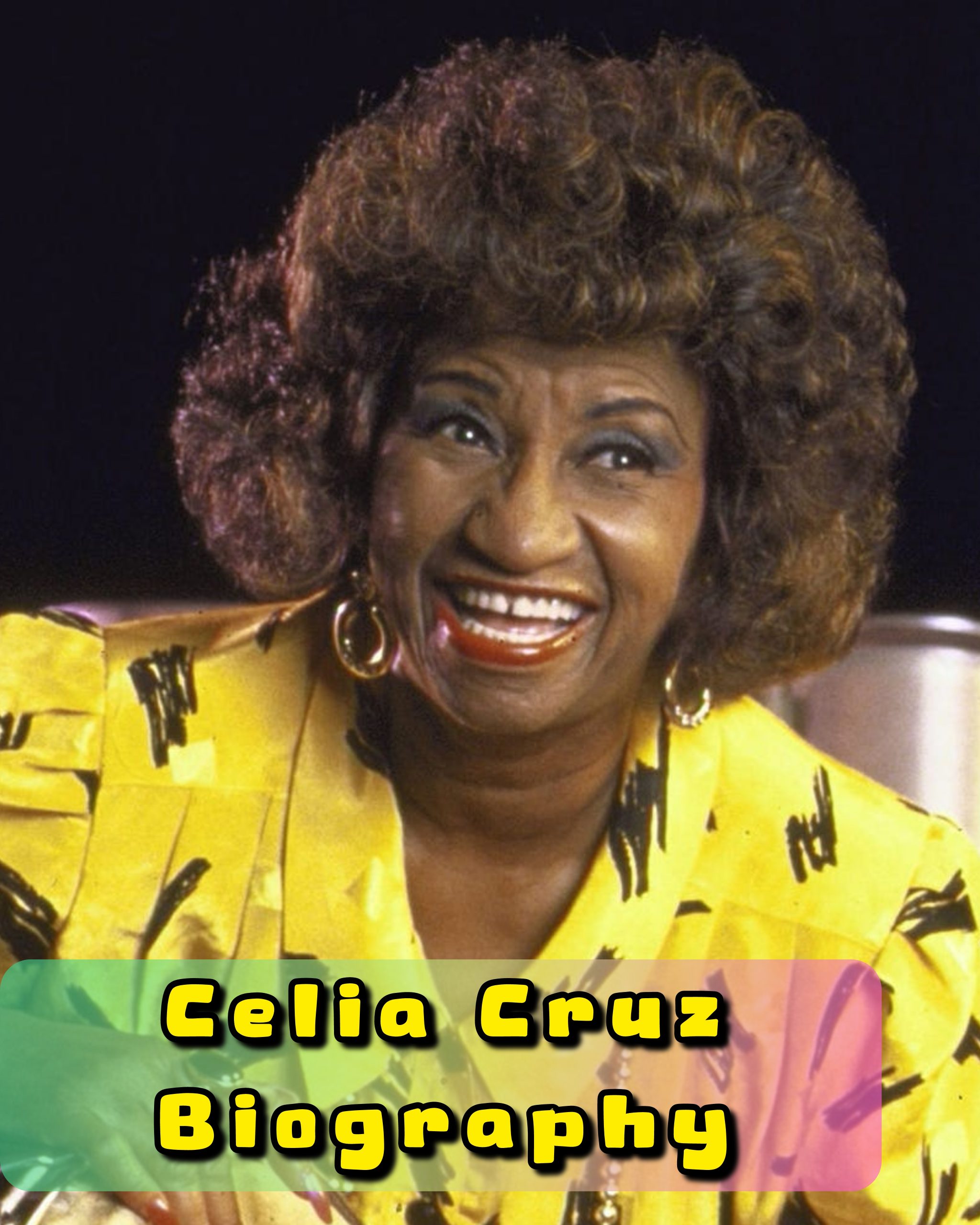
Celia Caridad Cruz Alfonso was born on October 21, 1925, in the Santos Suárez neighborhood of Havana, Cuba. She grew up in a working-class family and was one of the children in a large extended household. Her father, Simón Cruz, worked as a railway stoker, while her mother, Catalina Alfonso, was a homemaker who cared for the family. From a remarkably young age, Celia showed an attraction to music and singing. She reportedly sang lullabies to younger children in her family and performed in school and community activities.
Music quickly became an important part of Cruz’s childhood. Growing up in Havana during a vibrant period of Cuban musical development, she encountered numerous styles and performers that would later influence her distinctive sound. She listened to musicians including Fernando Collazo, Abelardo Barroso, Antonio Arcaño and Arsenio Rodríguez, while also developing an appreciation for Afro-Cuban musical traditions. Her powerful voice and natural stage presence eventually encouraged her to pursue opportunities beyond school and neighborhood performances.
Cruz’s decision to pursue music was not initially welcomed by her father, who hoped she would become a teacher. At the time, professional singing was not always regarded as a respectable career for a young Cuban woman. Nevertheless, her talent became increasingly difficult to ignore. As a teenager, she performed in cabarets and on radio programs, and she eventually entered amateur singing competitions. Her success on radio helped introduce her to professional musicians and producers and set the foundation for the extraordinary career that followed.
Celia Cruz Education
Celia Cruz initially pursued education with the intention of becoming a teacher. She attended Havana’s Normal School for Teachers because her father wanted her to have a stable and respectable profession. Her academic interests included literature, and for a time she seriously considered becoming a literature teacher rather than a professional entertainer.
Her growing success as a performer, however, gradually changed her career direction. Cruz continued singing while studying and became increasingly convinced that music was her calling. After completing her teacher-training studies, she enrolled at Havana’s National Conservatory of Music, where she studied music theory, voice and piano. Her formal musical training gave her a stronger technical foundation and helped develop the commanding vocal abilities that later became her trademark.
Cruz’s education therefore extended beyond formal classrooms. Her years performing on Cuban radio, in local ensembles and with professional musicians became an important part of her practical musical education. She learned different Cuban rhythms and performance styles and developed the versatility that allowed her to move between guaracha, rumba, son, bolero and eventually salsa. That combination of formal training and real-world performance experience helped distinguish her from many other singers of her generation.
Celia Cruz Career
Celia Cruz began recording professionally in the late 1940s, with one of her earliest recordings made in Venezuela in 1948. Her breakthrough came in 1950 when she became the lead singer of La Sonora Matancera, one of Cuba’s most celebrated musical groups. Her powerful interpretation of Cuban music earned her the nickname “La Guarachera de Cuba,” and her work with the group helped establish her as one of the leading female voices in Latin music.
After the Cuban Revolution, Cruz’s career took a decisive turn. While La Sonora Matancera was touring Mexico in 1960, the group ultimately relocated to the United States rather than returning permanently to Cuba. Cruz subsequently established herself in the United States and began developing a major solo career. She later worked with Tito Puente and other leading Latin musicians before becoming closely associated with the emerging salsa movement of the 1970s.
Her partnership with Johnny Pacheco and Fania Records became especially important. The 1974 album Celia & Johnny, recorded with Pacheco, helped propel Cruz to a new level of international fame, with “Quimbara” becoming one of her signature recordings. She also collaborated with artists such as Willie Colón, Ray Barretto and the Fania All-Stars. Over the course of a career spanning roughly six decades, she recorded more than 70 albums and sold millions of records worldwide.
Cruz also expanded beyond music. She appeared in films and television productions, including The Mambo Kings and The Perez Family, while continuing to record and perform. Her later hits included “La Vida es un Carnaval” and “La Negra Tiene Tumbao,” songs that helped introduce her music to younger generations. Her trademark exclamation, “¡Azúcar!”, became inseparable from her identity and performances.
Her achievements included Grammy and Latin Grammy recognition, the National Medal of Arts, a Hollywood Walk of Fame star and numerous other honors. The Smithsonian and other cultural institutions have continued to preserve her music, clothing and cultural legacy. In 2026, the Rock & Roll Hall of Fame selected Cruz for its Early Influence Award, recognizing her profound contribution to music and her influence on the development and popularization of Afro-Cuban music and salsa.
Celia Cruz Personal Life and Family
Celia Cruz married Cuban trumpeter Pedro Knight on July 14, 1962. Knight had been a member of La Sonora Matancera and was already familiar with Cruz professionally before their relationship became romantic. Their marriage lasted until Cruz’s death in 2003, making Knight not only her husband but also one of the most important people in her professional life. He eventually left La Sonora Matancera and became closely involved in managing and supporting Cruz’s career.
Cruz and Knight did not have children together. Their relationship remained one of the defining parts of Cruz’s private life, and Knight was beside her during her final illness. When Cruz died in 2003, Knight was described as being at her side. He continued to preserve her memory after her death until his own passing in 2007.
Family and Cuban heritage remained important to Cruz throughout her life, particularly after she left Cuba and was unable to return for many years. Her exile became a significant part of her personal story and public identity. Even while living in the United States, she continued to celebrate Cuban culture through her music, fashion, language and performances. Her life therefore became closely connected with the broader story of Cuban migration and the development of Latino culture in the United States.
Celia Cruz Death and Cause of Death
Celia Cruz died on July 16, 2003, at her home in Fort Lee, New Jersey, at the age of 77. She had been battling brain cancer and had undergone surgery for a brain tumor before her death. Contemporary reports described her final illness as brain cancer and noted that she continued working despite serious health problems.
Her death came just two days after her 41st wedding anniversary with Pedro Knight. Cruz’s passing generated an enormous outpouring of grief among fans throughout the United States and Latin America. Thousands of mourners gathered to pay their respects, demonstrating the extraordinary affection that audiences had developed for the singer during her lifetime.
Cruz was eventually laid to rest at Woodlawn Cemetery in the Bronx, New York. Pedro Knight was later buried alongside her after his death in 2007. Her final resting place became another physical reminder of the enduring connection between the singer, her husband and the generations of fans who continued to celebrate her life and music.
Celia Cruz Age, Religion, Nationality, Height and Physical Appearance
Celia Cruz was 77 years old when she died in 2003. She was born in Havana, Cuba, and became a Cuban-American singer after establishing her life and career in the United States. Cruz was raised as a Roman Catholic, although her upbringing also exposed her to Afro-Cuban religious and musical traditions. Her exact height is not consistently documented by authoritative sources, although some entertainment biographies commonly list her at approximately 5 feet 5 inches (165 cm). She was instantly recognizable for her commanding stage presence, expressive face, distinctive voice, colorful costumes, dramatic wigs and energetic performances. Her flamboyant fashion became one of the defining visual elements of her public image.
Celia Cruz Net Worth
Celia Cruz accumulated her wealth primarily through an extraordinarily long career in music. Her income came from record sales, touring, live performances, royalties, television and film appearances and other entertainment activities. She recorded more than 70 albums and became one of the best-selling Latin artists of her era.
There is no universally verified public figure for Cruz’s personal wealth at the time of her death. Celebrity Net Worth currently estimates that she was worth approximately $4 million in 2003, equivalent to roughly $7 million in today’s dollars after inflation. Other websites have published substantially different estimates, so the $4 million figure should be treated as an estimate rather than an officially confirmed estate valuation.
Cruz’s financial legacy did not end with her death. Her recordings, image, merchandise, licensing and posthumous releases have continued to generate economic value. Her enduring popularity, museum exhibitions and continuing recognition—including her 2026 Rock & Roll Hall of Fame honor—have kept her name commercially and culturally relevant decades after her death.
Legacy
Celia Cruz’s greatest legacy is her role in transforming salsa and Afro-Cuban music into an international cultural force. The Rock & Roll Hall of Fame describes her as one of the best-selling Latin artists of all time, with more than 30 million records sold worldwide. Her music helped connect Cuban musical traditions with audiences across Latin America, the United States, Africa and Europe.
Her influence also extends beyond music. Cruz became a powerful symbol of Cuban identity, Afro-Latin culture and immigrant resilience. Her vibrant clothing, powerful voice, infectious personality and famous “¡Azúcar!” expression created an image that remains instantly recognizable. Institutions such as the Smithsonian have preserved her work and personal artifacts, helping ensure that future generations understand both her artistry and her cultural significance.
Her posthumous honors demonstrate how enduring her influence has become. Cruz received the Recording Academy’s Lifetime Achievement Award in 2016, and in 2026 she was selected for induction into the Rock & Roll Hall of Fame in the Early Influence category. The 2026 ceremony is scheduled for November 14 in Los Angeles. This recognition places Cruz among artists whose influence reached beyond their original musical genre and helped shape the wider history of popular music.
Conclusion
Celia Cruz’s journey from a working-class neighborhood in Havana to becoming the internationally celebrated Queen of Salsa is one of the most remarkable stories in Latin music. Through talent, determination and an unmistakable artistic identity, she overcame cultural and geographical barriers to become a global icon. Her music continues to be heard by new generations, while her influence on salsa, Afro-Cuban music and Latino culture remains profound. More than two decades after her death, the 2026 Rock & Roll Hall of Fame recognition confirms that Celia Cruz’s contribution to music remains as powerful and relevant as ever.
Frequently Asked Questions About Celia Cruz
Who was Celia Cruz?
Celia Cruz was a Cuban-American singer best known as the “Queen of Salsa.” She became one of the most influential Latin music performers of the 20th century and helped popularize Afro-Cuban music and salsa internationally.
When was Celia Cruz born?
Celia Cruz was born on October 21, 1925, in Havana, Cuba.
How old was Celia Cruz when she died?
Celia Cruz was 77 years old when she died on July 16, 2003.
What was Celia Cruz’s real name?
Her full birth name is commonly given as Úrsula Hilaria Celia de la Caridad Cruz Alfonso. She became professionally known simply as Celia Cruz.
Who was Celia Cruz’s husband?
Celia Cruz’s husband was Pedro Knight, a Cuban trumpeter and musician who later became closely involved in managing her career. They married in 1962 and remained together until her death in 2003.
Did Celia Cruz have children?
No. Celia Cruz and Pedro Knight did not have children together.
What was Celia Cruz’s religion?
Celia Cruz was raised as a Roman Catholic. Her Cuban upbringing also exposed her to Afro-Cuban cultural and religious traditions.
What was Celia Cruz’s nationality?
Celia Cruz was Cuban-American. She was born in Havana, Cuba, and later built her career and life in the United States.
What was Celia Cruz’s net worth?
Celia Cruz’s net worth is estimated at approximately $4 million at the time of her death in 2003, according to Celebrity Net Worth. Because her estate’s complete financial records are not publicly available, this figure should be regarded as an estimate.
How did Celia Cruz die?
Celia Cruz died from brain cancer on July 16, 2003, at her home in Fort Lee, New Jersey. She was 77 years old.
What was Celia Cruz’s most famous song?
Among Celia Cruz’s best-known songs are “Quimbara,” “La Vida es un Carnaval,” “La Negra Tiene Tumbao,” “Bemba Colorá” and “Guantanamera.”
Why was Celia Cruz called the Queen of Salsa?
Celia Cruz earned the title “Queen of Salsa” because of her extraordinary influence on the development and international popularity of salsa. Her powerful voice, energetic performances and collaborations with major Latin musicians helped make the genre globally recognized.
Was Celia Cruz inducted into the Rock & Roll Hall of Fame?
Yes. In 2026, Celia Cruz was selected for the Rock & Roll Hall of Fame’s Early Influence Award, recognizing her lasting impact on music and culture. The induction ceremony is scheduled for November 14, 2026, in Los Angeles.