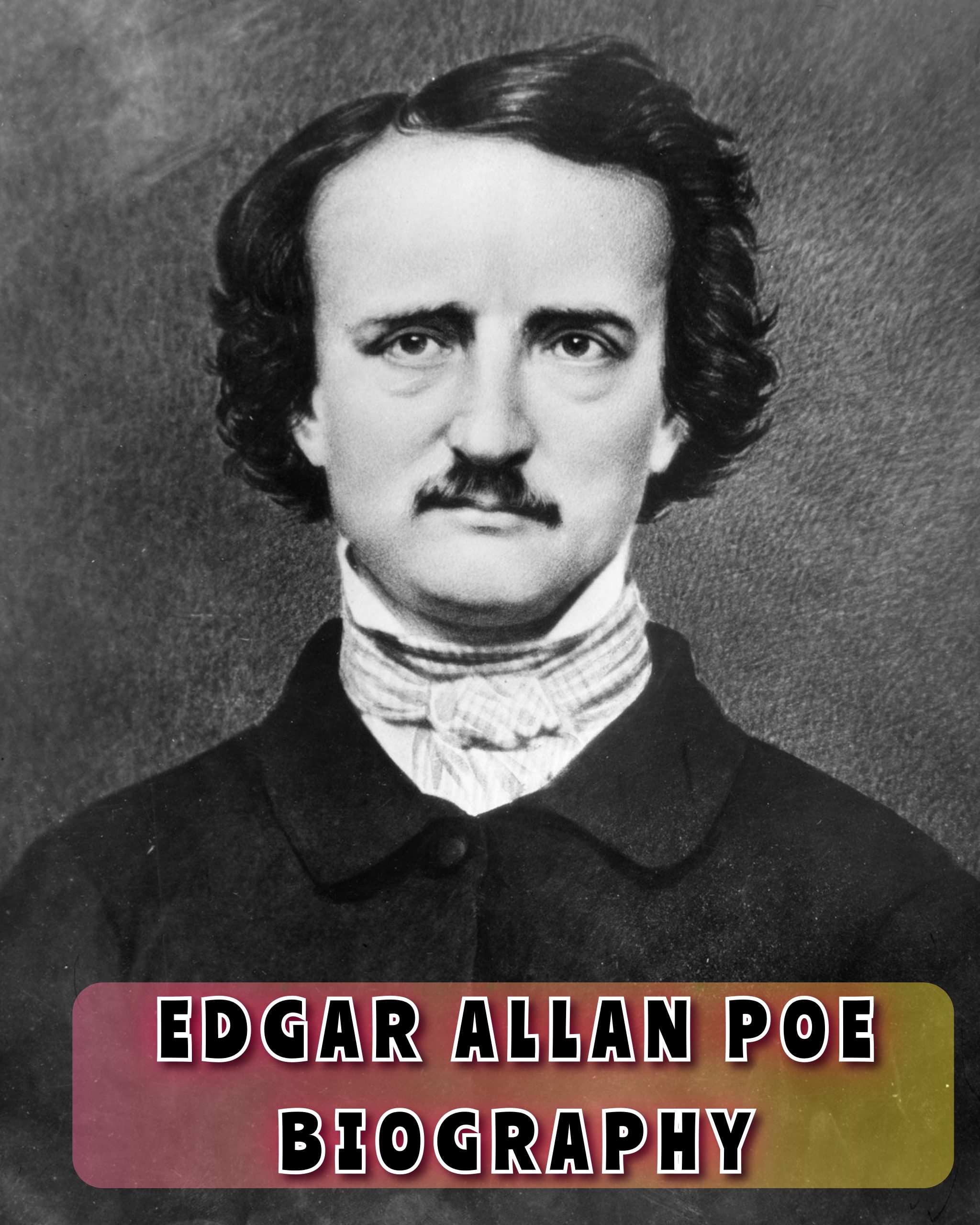
Edgar Allan Poe was born on January 19, 1809, in Boston, Massachusetts, to David Poe Jr. and Elizabeth Arnold Poe, both actors. His father abandoned the family when Poe was very young, and his mother died of tuberculosis in 1811, leaving Poe orphaned at the age of two. He was subsequently taken into the Richmond, Virginia, household of John Allan, a wealthy merchant, and his wife, Frances Allan. Although Poe was raised in the Allan household and used the surname Allan, John Allan never formally adopted him.
Poe spent much of his childhood in Richmond, Virginia, where he received a private education and developed an early interest in literature and poetry. Between 1815 and 1820, he lived with the Allans in Britain while John Allan conducted business there. After returning to Richmond, Poe continued his education and later attended the University of Virginia in 1826. His time at the university was brief, however, as financial difficulties and gambling debts contributed to his departure after about a year.
His relationship with John Allan also became increasingly strained, particularly over money and Poe’s decision to pursue a literary career. After leaving the Allan household, Poe moved to Boston and began publishing poetry. In 1827, he enlisted in the U.S. Army under the name Edgar A. Perry, beginning a difficult but formative period that eventually led him toward a career as a writer, editor and literary critic.
Edgar Allan Poe Education
Edgar Allan Poe received much of his early education in Richmond, Virginia, after being taken into the household of John and Frances Allan. He also spent several years in Britain during his childhood, where he attended schools in Scotland and England. After returning to Richmond, Poe continued his education through private schooling, where he developed a strong interest in literature, languages and poetry.
In 1826, Poe enrolled at the University of Virginia in Charlottesville. He studied subjects including ancient and modern languages, particularly Latin and French. Although he was academically capable, his time at the university was troubled by financial difficulties and gambling debts. Poe left the university after roughly a year and returned to Richmond, where his already strained relationship with John Allan deteriorated further.
Poe’s formal education was never completed, but his intellectual development continued through extensive reading, writing and literary work. His knowledge of literature, languages, philosophy and classical traditions became evident in his later poetry, short stories and critical essays. His self-directed learning ultimately contributed to the distinctive style and literary innovations that made him one of America’s most influential writers.
Edgar Allan Poe Career
Edgar Allan Poe began his literary career in the late 1820s, initially publishing poetry while struggling to establish himself as a professional writer. In 1827, he released his first collection, Tamerlane and Other Poems, anonymously and under the name “A Bostonian.” Around the same period, he joined the U.S. Army, but his long-term ambition remained literature. After leaving military service, Poe increasingly devoted himself to writing, publishing poems, short stories and literary criticism.
During the 1830s and 1840s, Poe worked for several American literary magazines and newspapers, including the Southern Literary Messenger, Burton’s Gentleman’s Magazine and Graham’s Magazine. He became known not only as a creative writer but also as a sharp and sometimes controversial literary critic. His work often explored psychological fear, obsession, death and the darker aspects of the human mind. In 1845, his poem The Raven became a major success and brought him national and international recognition.
Poe also made lasting contributions to several literary genres. His stories “The Murders in the Rue Morgue,” “The Mystery of Marie Rogêt” and “The Purloined Letter” helped establish the foundations of modern detective fiction, while works such as “The Tell-Tale Heart,” “The Black Cat” and “The Fall of the House of Usher” cemented his reputation as a master of psychological and Gothic horror. Despite his growing fame, Poe continued to experience financial difficulties and professional instability. He died in Baltimore on October 7, 1849, at the age of 40, leaving behind a body of work that would profoundly influence literature, particularly horror, mystery, detective fiction and poetry.
Edgar Allan Poe Personal Life and Family
Edgar Allan Poe was born to David Poe Jr. and Elizabeth Arnold Poe, both actors. His father abandoned the family when Poe was still a child, while his mother died of tuberculosis in 1811. Poe was subsequently taken in by John Allan, a wealthy Richmond merchant, and his wife, Frances Allan. Although Poe was raised by the Allans and adopted the middle name “Allan,” John Allan never formally adopted him. Their relationship later became strained, particularly over money and Poe’s literary ambitions.
Poe’s romantic life included several important relationships before and during his marriage. In his youth, he was romantically involved with Sarah Elmira Royster, whom he reportedly intended to marry, but their relationship ended after Poe left Richmond. He was later engaged to Sarah Helen Whitman, a poet from Providence, Rhode Island, in 1848, although the engagement was short-lived and the couple never married. Poe also had a close relationship with Virginia Eliza Clemm, his first cousin, whom he married in 1836 when she was 13 and he was 27.
Poe and Virginia remained married until her death from tuberculosis in 1847. Their marriage produced no children, and Virginia’s prolonged illness and death deeply affected Poe. After her death, Poe’s personal life became increasingly troubled, while his health and financial circumstances remained unstable. He died in Baltimore on October 7, 1849, aged 40. His family relationships, romantic attachments and experiences of bereavement became closely connected with the recurring themes of love, loss, death and grief found throughout his literary work.
Edgar Allan Poe Age, Religion, Nationality, Height and Physical Appearance
Edgar Allan Poe was 40 years old when he died on October 7, 1849; he was born on January 19, 1809, in Boston, Massachusetts. He was American by nationality and spent most of his adult life in the United States, although he lived in Britain briefly during his childhood. Poe’s religious beliefs are less straightforward to define. He was raised in a Christian environment and was familiar with Christian ideas, but he did not consistently identify with a particular denomination, making it more accurate to describe his religion as uncertain or not clearly documented rather than assigning him a specific faith.
Poe’s exact height is not reliably documented, so commonly repeated figures should be treated with caution. Historical descriptions portray him as a slender, pale and dark-haired man with distinctive features. Contemporary accounts and portraits generally depict him with dark hair, a high forehead, deep-set eyes, a prominent nose and a serious, intense expression. His appearance, combined with his literary reputation for writing about mystery, death and the macabre, later contributed to the enduring image of Poe as the archetypal Gothic writer.
Edgar Allan Poe Social Media Presence
Edgar Allan Poe died in 1849, long before the invention of social media, so he did not have personal accounts on platforms such as Instagram, Facebook, X or TikTok. However, his name and literary legacy continue to have a strong presence online through official museums, literary organizations, fan communities and accounts dedicated to his work and life.
On Instagram, readers can find numerous pages dedicated to Poe’s poetry, stories, historical photographs, manuscripts and legacy. One notable account associated with the Edgar Allan Poe Museum is @poemuseum, which shares updates, exhibitions, Poe-related events and material connected to his life and work. Because Poe himself never used social media, these accounts should be understood as institutional or legacy accounts rather than personal profiles belonging to him.
His continued online popularity demonstrates how strongly Poe’s work has endured more than 175 years after his death. Quotes from The Raven, The Tell-Tale Heart and other works frequently circulate across social platforms, while museums and literary communities use Instagram and other digital channels to introduce new generations to his writing, mysterious death and lasting influence on horror, Gothic literature and detective fiction.
Edgar Allan Poe Net Worth
Edgar Allan Poe’s exact net worth at the time of his death is unknown, and it would be misleading to assign him a modern celebrity-style fortune. Poe worked primarily as a writer, editor and literary critic at a time when professional authors generally earned modest and inconsistent incomes. His financial situation was frequently unstable, and he often struggled to support himself through literary work alone.
Poe’s income came from magazine and newspaper salaries, writing fees, book publications and editorial work. For example, during his career he held editorial positions at publications such as the Southern Literary Messenger, Burton’s Gentleman’s Magazine and Graham’s Magazine. His salary from editorial work was modest by modern standards, and even after The Raven made him famous in 1845, Poe did not become wealthy. Historical accounts indicate that he continued to experience financial difficulties throughout his life.
Because there is no reliable record of Poe’s complete assets, debts and earnings, a precise net-worth figure cannot be established. A reasonable historical assessment is that Poe died with little personal wealth and significant financial insecurity, rather than leaving behind a substantial estate. His greatest “fortune” was ultimately his literary legacy: works such as The Raven, The Tell-Tale Heart and The Murders in the Rue Morgue eventually became enormously valuable culturally, even though Poe himself received only a small portion of the wealth his work would generate in later generations.
Legacy
Edgar Allan Poe left an enduring legacy as one of the most influential figures in American literature. His distinctive exploration of death, grief, fear, madness and the darker aspects of the human mind helped shape the development of Gothic fiction and psychological horror. Poems such as The Raven, Annabel Lee and The Bells, along with stories including The Tell-Tale Heart, The Black Cat and The Fall of the House of Usher, continue to be widely read, studied and adapted more than a century and a half after his death.
Poe is also remembered as a pioneer of detective fiction. His stories featuring the brilliant fictional detective C. Auguste Dupin, particularly The Murders in the Rue Morgue, The Mystery of Marie Rogêt and The Purloined Letter, established ideas that became central to the modern detective story, including the analytical detective, mysterious crime and logical investigation. His influence can be seen in later writers such as Arthur Conan Doyle, whose Sherlock Holmes stories drew inspiration from Poe’s Dupin.
Today, Poe’s legacy extends far beyond books and poetry. His life, mysterious death and distinctive Gothic image have inspired films, television, music, theatre, visual art and popular culture around the world. Museums and literary institutions continue to preserve his homes, manuscripts and memorabilia, while his works remain a major part of literature and popular education. Although Poe died relatively young and struggled financially during his lifetime, his influence has grown enormously, securing his place as a foundational figure in horror, mystery, detective fiction and American poetry.
Conclusion
Edgar Allan Poe remains one of the most fascinating and influential figures in American literary history. Despite experiencing personal loss, financial struggles and professional uncertainty, he created works that transformed Gothic literature, psychological horror and detective fiction. From The Raven and The Tell-Tale Heart to The Murders in the Rue Morgue, his writing continues to captivate readers with its themes of mystery, death, love and the human mind. More than 175 years after his death, Poe’s enduring popularity and influence demonstrate that his literary legacy remains firmly established around the world.
Frequently Asked Questions About Edgar Allan Poe
Who was Edgar Allan Poe?
Edgar Allan Poe was an American poet, short-story writer, editor and literary critic best known for his Gothic, horror and mystery works. He is also regarded as a pioneer of modern detective fiction.
When was Edgar Allan Poe born?
Edgar Allan Poe was born on January 19, 1809, in Boston, Massachusetts, USA.
How old was Edgar Allan Poe when he died?
Edgar Allan Poe was 40 years old when he died on October 7, 1849, in Baltimore, Maryland.
What was Edgar Allan Poe famous for?
Poe was famous for works such as “The Raven,” “The Tell-Tale Heart,” “The Black Cat,” “The Fall of the House of Usher” and “The Murders in the Rue Morgue.” His writing helped shape modern horror, Gothic fiction and detective literature.
Who was Edgar Allan Poe’s wife?
Edgar Allan Poe’s wife was Virginia Eliza Clemm Poe, his first cousin. They married in 1836 and remained together until Virginia died of tuberculosis in 1847.
Did Edgar Allan Poe have children?
No, Edgar Allan Poe and Virginia Poe did not have children.
Who was Edgar Allan Poe’s fiancée?
One of Poe’s notable fiancées was Sarah Helen Whitman, a poet from Providence, Rhode Island. They became engaged in 1848, but the relationship ended before they married. Poe also had an earlier romantic relationship with Sarah Elmira Royster.
What was Edgar Allan Poe’s religion?
Poe’s religious beliefs are not clearly documented. Although he was raised in a Christian environment and his writings contain religious references, he did not consistently identify with a specific Christian denomination.
What was Edgar Allan Poe’s nationality?
Edgar Allan Poe was American. He was born in Boston, Massachusetts, and spent most of his life in the United States.
How tall was Edgar Allan Poe?
Poe’s exact height is not reliably established by surviving historical records. Frequently published figures should therefore be treated as estimates rather than confirmed facts.
What was Edgar Allan Poe’s net worth?
Poe’s exact net worth at the time of his death is unknown. He earned money as a writer, editor and literary critic but struggled financially for much of his career and did not die a wealthy man.
How did Edgar Allan Poe die?
Edgar Allan Poe died on October 7, 1849, in Baltimore, Maryland. The exact cause of his death remains a mystery. Historical records do not provide a definitive modern medical diagnosis, and several theories have been proposed.
What is Edgar Allan Poe’s most famous poem?
“The Raven” is generally considered Edgar Allan Poe’s most famous poem. Published in 1845, it brought him significant national attention and remains one of the best-known poems in American literature.
Why is Edgar Allan Poe important?
Poe is important because he helped establish major literary traditions in horror, Gothic fiction, psychological fiction and detective stories. His C. Auguste Dupin stories also influenced the development of modern detective fiction.
Did Edgar Allan Poe have social media accounts?
No. Poe died in 1849, long before social media existed. However, museums and literary organizations maintain social media accounts dedicated to preserving and promoting his legacy, including the Edgar Allan Poe Museum’s Instagram account, @poemuseum.