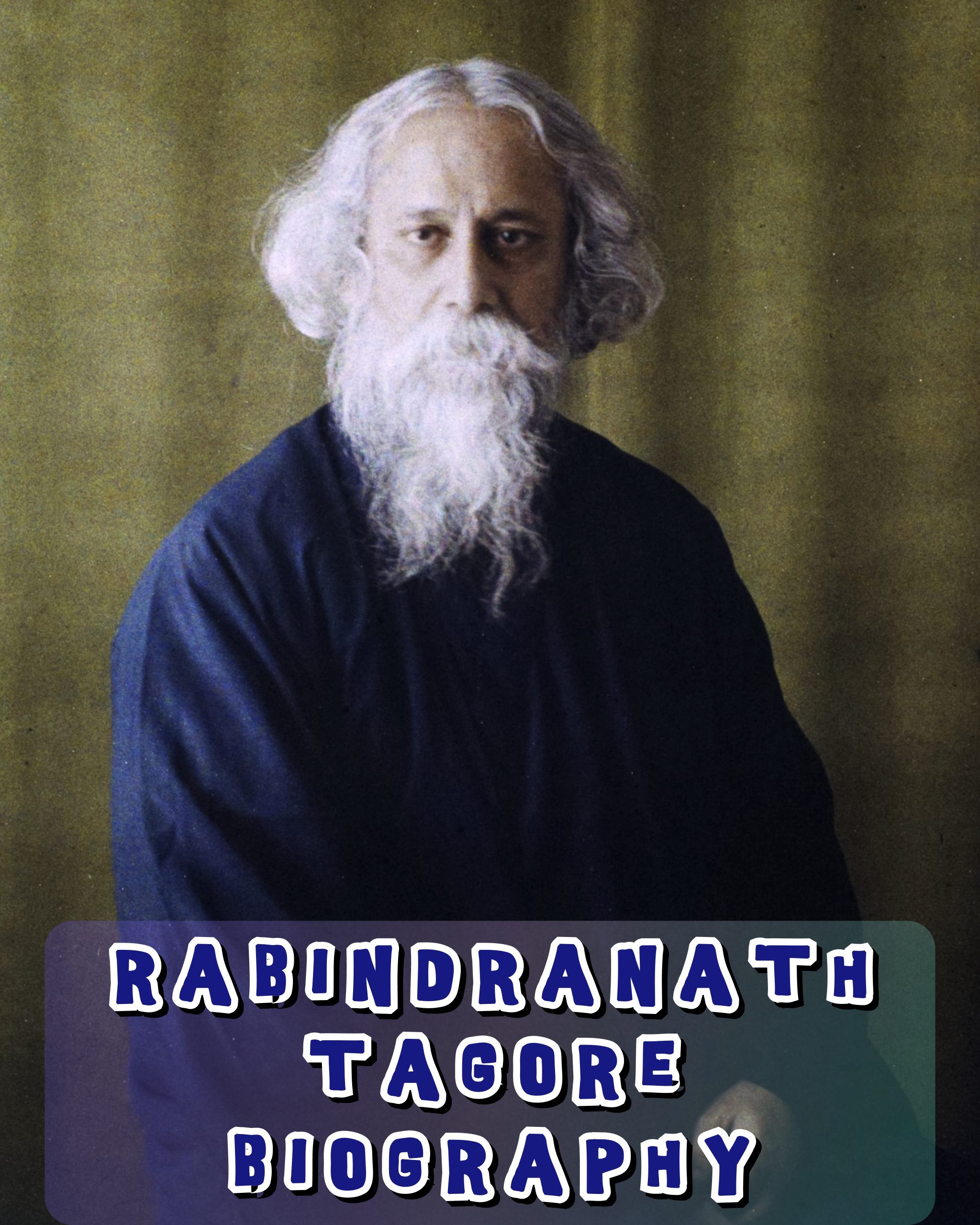
Rabindranath Tagore was born on 7 May 1861 in the Jorasanko mansion of the Tagore family in Calcutta (now Kolkata), British India. He was born into the prominent Tagore family, which played an important role in the Bengal Renaissance. His father, Debendranath Tagore, was a respected philosopher, religious reformer and leader of the Brahmo Samaj, while his mother was Sarada Devi. Growing up in an intellectually and culturally active household exposed Tagore from an early age to literature, music, philosophy, art and social reform.
Tagore was largely educated at home rather than through conventional schooling. He studied Bengali and Sanskrit literature, English, history, science, music and other subjects under private tutors. He began writing poetry when he was very young and developed a deep appreciation for nature and Bengali culture. His family encouraged artistic expression, and several of his older siblings were writers, musicians, artists and thinkers. This creative environment played a major role in shaping his literary interests and worldview.
As a teenager, Tagore began publishing his poems and literary works, initially using the pseudonym Bhanusimha. In 1878, at the age of 17, he travelled to England to study law, but he did not complete his formal legal education. Instead, his time abroad exposed him to Western literature, music and culture, which later influenced his writing. After returning to India, Tagore continued developing his literary career and gradually emerged as one of Bengal’s most influential poets and intellectuals.
Rabindranath Tagore Education
Rabindranath Tagore received much of his early education at home rather than through a conventional school system. His family employed private tutors who taught him Bengali, Sanskrit, English, history, geography, science, literature and music. He also studied classical Indian texts and became deeply interested in poetry, philosophy and the natural world. The intellectually rich environment of the Tagore household allowed him to explore subjects according to his interests and encouraged his early development as a writer.
As a young boy, Tagore briefly attended several educational institutions in Calcutta, including the Oriental Seminary and St. Xavier’s School. However, he was not comfortable with the rigid structure of traditional classroom education and eventually continued his studies at home. His father, Debendranath Tagore, also encouraged him to travel and learn through direct experience. These early experiences helped shape Tagore’s later belief that education should encourage creativity, freedom of thought and a close relationship with nature.
In 1878, at the age of 17, Tagore travelled to England and enrolled at University College London with the intention of studying law. He did not complete a formal university degree, choosing instead to devote himself increasingly to literature, music and intellectual pursuits. His exposure to Western literature, music and culture during his stay in England broadened his perspective and influenced his later creative work. His unconventional educational journey eventually contributed to his own educational philosophy, which he put into practice through the school at Santiniketan and later Visva-Bharati University.
Rabindranath Tagore Career
Rabindranath Tagore began his literary career at an early age, writing poems and short stories while still a teenager. His first works were published under the pen name Bhanusimha, and he quickly gained recognition for his exceptional command of the Bengali language. Over the following decades, he produced an extraordinary body of work that included poetry, novels, plays, essays and short stories, making him one of the greatest figures in Indian literature.
Tagore achieved international fame in 1913 when his English translation of Gitanjali (Song Offerings) earned him the Nobel Prize in Literature, making him the first Asian and the first non-European Nobel laureate in the category. His writings explored themes of humanity, spirituality, love, freedom and nature, while his songs later became known collectively as Rabindra Sangeet, a defining tradition of Bengali music.
Beyond literature, Tagore was a visionary educator, artist and social reformer. In 1901, he founded a school at Santiniketan, which later grew into Visva-Bharati University, promoting holistic and creative education. He also painted hundreds of artworks, travelled extensively to deliver lectures across the world, and composed over 2,000 songs, including “Jana Gana Mana” and “Amar Shonar Bangla,” which became the national anthems of India and Bangladesh respectively.
Rabindranath Tagore Death and Cause of Death
Rabindranath Tagore died on 7 August 1941, at the age of 80, at the Jorasanko mansion in Calcutta (now Kolkata), the same ancestral home where he had been born and raised. His health had deteriorated significantly during the final years of his life, with periods of serious illness and chronic pain. Despite his declining health, he continued writing and remained intellectually active until shortly before his death.
Tagore’s final illness was associated with severe urinary complications and an enlarged prostate. By 1941, his condition had become increasingly serious, and doctors determined that surgery was necessary. He underwent an operation at his Jorasanko home in late July 1941. Historical accounts report that he subsequently developed uraemia and septic complications, and his condition continued to worsen.
The precise underlying cause has been discussed differently in historical accounts, with some medical interpretations suggesting possible prostate cancer, although this has not been established as a definitive diagnosis. What is well documented is that Tagore suffered from severe urinary obstruction, uremia and complications following his final surgery before his death.
Rabindranath Tagore Personal Life and Family
Rabindranath Tagore was born into the influential Tagore family of Jorasanko, one of the prominent families of the Bengal Renaissance. His father, Debendranath Tagore, was a philosopher, religious reformer and an important leader of the Brahmo Samaj, while his mother was Sarada Devi. Tagore grew up surrounded by writers, musicians, artists and intellectuals, including his elder brother Dwijendranath Tagore, a poet and philosopher, and his brother Jyotirindranath Tagore, a playwright, composer and artist. His sister Swarnakumari Devi was also a noted Bengali writer, making the family an important centre of cultural and intellectual activity.
In 1883, Tagore married Mrinalini Devi, who was born Bhabatarini Devi. The couple had five children: Madhurilata (Bela), Rathindranath, Renuka (Rani), Mira and Samindranath. His family life was marked by both happiness and profound personal tragedies, as Tagore lost his wife in 1902 and later experienced the deaths of several of his children. These losses deeply affected him and influenced some of the emotional and spiritual themes found throughout his poetry and other writings.
Tagore’s personal life was also closely connected with his literary and intellectual relationships. He developed a particularly well-known friendship with Victoria Ocampo, the Argentine writer and cultural figure, whom he met during his travels in South America in 1924. Although their relationship has sometimes been portrayed romantically, there is no established evidence that they were engaged or formally became fiancés. Tagore never remarried after Mrinalini Devi’s death and remained devoted to literature, education, art and his work at Santiniketan for the rest of his life.
Rabindranath Tagore Age, Religion, Nationality, Height and Physical Appearance
Rabindranath Tagore was born on 7 May 1861 and died on 7 August 1941, making him 80 years old at the time of his death. He was Indian by nationality and was born in Calcutta, British India. Tagore was raised in the Brahmo Samaj tradition, a reformist movement that emerged within Hindu society, although his spiritual philosophy developed beyond strict religious boundaries and emphasised universal humanism, spirituality and harmony.
Tagore’s exact height is not reliably documented in authoritative historical records, so commonly published height figures should be treated as estimates rather than established fact. Photographs and contemporary descriptions show him as a tall, slender and dignified man, particularly in his later years. He was recognisable for his long flowing white beard, long hair, traditional Indian clothing and calm, contemplative expression, which became iconic representations of the poet and philosopher.
In his later life, Tagore’s distinctive appearance contributed to his worldwide image as a philosopher, poet and spiritual thinker. He frequently wore flowing robes or traditional Bengali attire and was often photographed with his long white beard and hair. His physical appearance, combined with his literary achievements and philosophical outlook, made him one of the most recognisable cultural figures of 20th-century India.
Rabindranath Tagore Social Media Presence
Rabindranath Tagore lived long before the age of social media, so he did not have any official Instagram, Facebook, X or other social media accounts. His literary legacy, however, continues to maintain a strong digital presence through institutions, cultural organisations, publishers and fan communities that share his poems, photographs, writings and teachings.
There is no verified personal Instagram account belonging to Rabindranath Tagore. Accounts using his name or dedicated to his work may exist on Instagram, but they should not be presented as his official personal profile. Readers should therefore be cautious about attributing any modern social-media handle directly to Tagore.
Tagore’s works remain widely circulated online, particularly his poetry, Rabindra Sangeet, quotations and writings on spirituality, education and humanity. His influence also continues through Visva-Bharati, Santiniketan and other cultural institutions that preserve and promote his work for new generations.
Rabindranath Tagore Net Worth
Rabindranath Tagore’s exact net worth at the time of his death in 1941 is not known, because modern-style financial records of his personal wealth were not maintained. He came from the wealthy Tagore family and was involved in managing the family’s ancestral estates, particularly in Shelaidaha, where he served as a zamindar. Historical accounts also indicate that after his father’s death, Tagore received a monthly inheritance of roughly ₹1,250–₹1,500, in addition to income connected with the Maharaja of Tripura, property, jewellery and literary royalties.
Tagore also earned money from his work as a poet, author, composer, lecturer and publisher. His literary royalties were reportedly around ₹2,000 in one period, although this figure should not be interpreted as his total annual income. In 1913, he received the Nobel Prize in Literature, which carried a cash award of approximately £8,000. Rather than simply treating the Nobel money as personal wealth, historical accounts show that Tagore used prize funds for social and developmental projects, including cooperative and educational initiatives.
Because of the absence of a reliable final estate valuation, claims that Tagore had a specific modern net worth—such as a particular amount in crores or millions—are speculative. A more accurate biography should therefore describe him as a financially comfortable member of a wealthy landed family who earned additional income through literature, estates and other activities, while also directing substantial resources toward Santiniketan, education and social development. His financial legacy is better understood through his properties, inherited income, literary earnings and philanthropic projects than through a precise modern net-worth figure.
Legacy
Rabindranath Tagore left an extraordinary legacy in literature, music, art, education and philosophy. As the first Asian Nobel laureate in Literature, he introduced Bengali literature and Indian cultural thought to a global audience. His poetry, novels, short stories, plays and essays explored universal themes such as love, spirituality, freedom, nature, human dignity and the relationship between the individual and society. His Gitanjali remains one of his most celebrated works.
Tagore’s influence also extends to music and national identity. He composed more than 2,000 songs, collectively known as Rabindra Sangeet, which remain an important part of Bengali culture. His song “Jana Gana Mana” became India’s national anthem, while “Amar Shonar Bangla” became Bangladesh’s national anthem. His artistic legacy also includes hundreds of paintings and drawings, demonstrating his creativity beyond poetry and literature.
Education was another central part of Tagore’s lasting legacy. Through Santiniketan and later Visva-Bharati, he promoted an educational philosophy based on creativity, freedom, nature, cultural exchange and international understanding. His ideas continue to influence writers, musicians, artists, educators and intellectuals across the world. More than eight decades after his death, Tagore remains one of the most influential cultural figures in South Asian history and a lasting symbol of India’s literary and intellectual heritage.
Conclusion
Rabindranath Tagore remains one of the most influential figures in Indian and world literature, remembered not only as a Nobel Prize-winning poet but also as a writer, philosopher, composer, artist, educator and social thinker. From his privileged yet intellectually rich upbringing in Bengal to his pioneering work at Santiniketan and his international recognition through Gitanjali, Tagore dedicated his life to creativity, education, spirituality and human unity. His songs, writings and educational ideals continue to inspire millions, while his contribution to the national anthems of India and Bangladesh has given his legacy an enduring place in South Asian history.
Frequently Asked Questions About Rabindranath Tagore
1. Who was Rabindranath Tagore?
Rabindranath Tagore was an Indian poet, writer, philosopher, composer, artist and educator. He won the Nobel Prize in Literature in 1913 for Gitanjali, becoming the first Asian Nobel laureate.
2. When was Rabindranath Tagore born?
Rabindranath Tagore was born on 7 May 1861 in Jorasanko, Calcutta, British India, now Kolkata, West Bengal, India.
3. When did Rabindranath Tagore die?
Rabindranath Tagore died on 7 August 1941 in Calcutta at the age of 80.
4. What was Rabindranath Tagore’s cause of death?
Tagore suffered from serious urinary complications and underwent surgery shortly before his death. His final illness involved uraemia and septic complications, although the precise underlying diagnosis is not certain.
5. Who was Rabindranath Tagore’s wife?
Rabindranath Tagore’s wife was Mrinalini Devi, whom he married in 1883. They had five children together.
6. How many children did Rabindranath Tagore have?
Rabindranath Tagore and Mrinalini Devi had five children: Madhurilata, Rathindranath, Renuka, Mira and Samindranath.
7. Why did Rabindranath Tagore win the Nobel Prize?
Tagore won the 1913 Nobel Prize in Literature for his deeply sensitive and original poetry, particularly the English translation of his collection Gitanjali (Song Offerings).
8. What is Rabindranath Tagore famous for?
Rabindranath Tagore is famous for writing Gitanjali, composing Rabindra Sangeet, founding Santiniketan, winning the Nobel Prize in Literature and writing “Jana Gana Mana,” India’s national anthem.
9. What was Rabindranath Tagore’s religion?
Tagore was raised in the Brahmo Samaj tradition, a reformist movement associated with Hindu society. His personal philosophy developed into a broad spiritual and humanistic worldview.
10. What was Rabindranath Tagore’s nationality?
Rabindranath Tagore was Indian. He was born in Calcutta during British rule in India and became one of the most influential figures in Indian cultural history.
11. What is Rabindranath Tagore’s most famous book?
Tagore’s most internationally famous work is Gitanjali (Song Offerings), the collection associated with his 1913 Nobel Prize in Literature.
12. Did Rabindranath Tagore write India’s national anthem?
Yes. Rabindranath Tagore wrote and composed “Jana Gana Mana,” which was later adopted as the national anthem of India.
13. Did Rabindranath Tagore write Bangladesh’s national anthem?
Yes. Tagore wrote and composed “Amar Shonar Bangla,” which became the national anthem of Bangladesh.
14. Did Rabindranath Tagore have an Instagram account?
No. Tagore died in 1941, decades before social media existed, so he did not have an official Instagram or other social-media account. Modern accounts using his name are not his personal profiles.