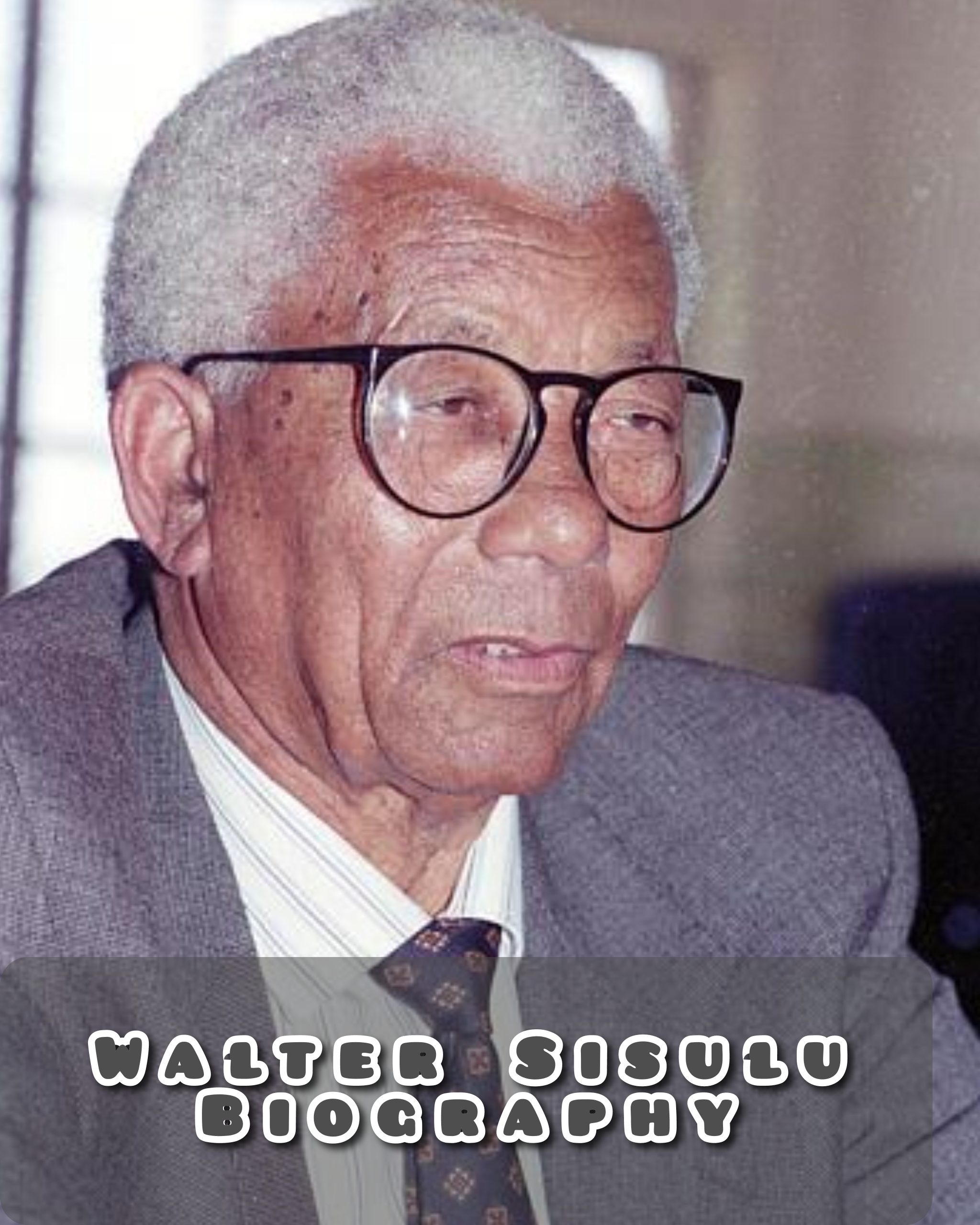
Walter Ulyate Max Sisulu was born on 18 May 1912 in Qutubeni, in the Engcobo district of the former Transkei, South Africa. He was raised in a rural environment during a period when racial discrimination and economic inequality deeply affected Black South Africans. His mother, Alice Mase Sisulu, worked as a domestic worker, while his father, Walter Sisulu Sr., was a white civil servant. Sisulu was brought up largely within his mother’s family and developed an early understanding of the hardships experienced by Black communities.
Sisulu’s formal education was limited. He attended a local school but left around Grade 6 following the death of his uncle, who had been an important influence in his upbringing. His limited access to education did not prevent him from developing a strong interest in politics, social justice and the conditions affecting Black South Africans. As a young man, he moved to Johannesburg in search of employment and better opportunities, where he encountered the harsh realities of racial segregation and discriminatory labour practices.
In Johannesburg, Sisulu worked in various jobs before becoming increasingly involved in political and community activities. His experiences with poverty, racial discrimination and exploitation strengthened his determination to fight for equality and justice. During the 1940s, he became increasingly active in the African National Congress and developed close relationships with other emerging anti-apartheid leaders, including Nelson Mandela and Oliver Tambo. These early experiences laid the foundation for Sisulu’s long political career and his eventual role as one of the most influential figures in South Africa’s struggle against apartheid.
Walter Sisulu Education
Walter Sisulu’s formal education was limited compared with many political leaders of his generation. He attended school in his early childhood in the Transkei but left formal education at around Grade 6 after the death of his uncle, who had played an important role in his upbringing. His early departure from school was largely shaped by family and financial circumstances rather than a lack of ambition. Despite having little formal schooling, Sisulu developed a strong interest in social issues and continued learning through his experiences and interactions with people around him.
After moving to Johannesburg as a young man, Sisulu’s education increasingly took place outside the traditional classroom. His experiences working and living in the city exposed him to the realities of racial discrimination, poverty and unequal opportunities under South Africa’s segregationist system. He became an active reader and developed his political understanding through discussions, community involvement and contact with emerging African political activists. These experiences helped him develop the communication, organisational and leadership skills that later became central to his political career.
Although Sisulu did not attend university or obtain formal higher-education qualifications, his political education became extensive. Through his involvement in the African National Congress and the ANC Youth League, he studied the political and social conditions facing Black South Africans and worked alongside figures such as Nelson Mandela and Oliver Tambo. His education was therefore shaped as much by political activism and practical experience as by formal schooling, eventually helping him become one of the most influential organisers and strategists in the anti-apartheid movement.
Walter Sisulu Career
Walter Sisulu began his working life in Johannesburg after leaving his home region in the Transkei. He took on various jobs, including work in domestic service, bakeries and other forms of manual employment, while witnessing the discrimination and economic hardships experienced by Black South Africans. His experiences in Johannesburg gradually drew him toward political activism, and he became increasingly interested in finding organised ways to challenge racial inequality and the policies that restricted the rights of Black people.
Sisulu joined the African National Congress (ANC) in the 1940s and quickly emerged as an effective organiser. In 1944, he became involved in the formation of the ANC Youth League alongside Nelson Mandela and Oliver Tambo. He later served as ANC secretary-general from 1949 to 1954, using his organisational skills to strengthen the movement and expand its campaigns against apartheid. Sisulu played an important role in the Defiance Campaign of 1952 and became one of the movement’s most influential strategists and leaders.
His political activities eventually brought severe government repression. Sisulu was repeatedly arrested and prosecuted for his opposition to apartheid and was among the senior ANC figures tried in the Rivonia Trial. In 1964, he was sentenced to life imprisonment and spent many years on Robben Island alongside Nelson Mandela and other anti-apartheid leaders. After his release in 1989, Sisulu returned to active political life and helped guide the ANC during the transition toward democracy. Following South Africa’s first democratic elections in 1994, he remained an important elder statesman and respected figure in the country’s new political era, although he did not seek a major government position.
Walter Sisulu Death and Cause of Death
Walter Sisulu died on 5 May 2003 at his home in Orlando, Soweto, Johannesburg, South Africa, just 13 days before his 91st birthday. He was 90 years old. According to South African History Online, Sisulu collapsed while he and his wife, Albertina Sisulu, were preparing to go to bed and died in her arms.
The exact medical cause of Walter Sisulu’s death is not clearly established in the authoritative biographical sources available. Therefore, claims that he died from a specific illness should be treated cautiously unless supported by a reliable medical or archival source. The documented account is that he collapsed suddenly at home on 5 May 2003 and died shortly afterward.
Sisulu’s death marked the passing of one of the central figures in South Africa’s liberation struggle. Nelson Mandela paid tribute to his longtime friend and political comrade, while South Africa remembered Sisulu as a key architect of the anti-apartheid movement. His funeral was held in Soweto on 17 May 2003, and his legacy continues to be associated with the struggle for democracy, equality and freedom in South Africa.
Walter Sisulu Personal Life and Family
Walter Sisulu was married to Albertina Sisulu, one of South Africa’s most prominent anti-apartheid activists and a respected leader in her own right. The couple married in 1944 and remained together for nearly six decades until Walter’s death in 2003. Their relationship was closely connected to the liberation struggle, as both were deeply involved in political activism and often faced government harassment, arrests and restrictions because of their opposition to apartheid. Albertina, who became widely known as the “Mother of the Nation,” continued her activism even while Walter was imprisoned for many years.
Walter and Albertina Sisulu had five children: Max, Mlungisi, Zwelakhe, Lindiwe and Nonkululeko Sisulu. Their children grew up during a particularly difficult period in South African history, with their parents frequently separated by imprisonment, political restrictions and activism. Several members of the family later became involved in public life. Their son Max Sisulu became a prominent politician and served as Speaker of the National Assembly of South Africa from 2009 to 2014, while Lindiwe Sisulu went on to become a senior ANC politician and served in several South African government ministries.
Family and political commitment were closely intertwined throughout Sisulu’s life. His home became associated with the wider anti-apartheid movement, and he maintained close relationships with fellow activists such as Nelson Mandela and Oliver Tambo, whom he worked with for decades. Despite spending many years in prison, Sisulu remained devoted to his family and political ideals. His marriage to Albertina and the achievements of their children form an important part of his personal legacy, extending the Sisulu family’s contribution to South Africa’s political and social history.
Walter Sisulu Age, Religion, Nationality, Height and Physical Appearance
Walter Sisulu was 90 years old when he died on 5 May 2003, having been born on 18 May 1912. He was a South African national and spent most of his life fighting against apartheid and advocating for political equality and democracy. Sisulu was associated with the Christian faith, reflecting the religious background of his family and the broader Christian influence in his community, although detailed information about his personal religious practices is limited. South African History Online notes that Sisulu was baptised at All Saints Mission but also records that he was not particularly religious and questioned some aspects of the Bible.
There is no reliably documented official record of Walter Sisulu’s height, so a precise measurement should not be stated as fact. Photographs and historical footage show him as a Black South African man with a medium-to-tall appearance, an average-to-solid build and a dignified bearing. In his later years, he had a largely bald head with short grey hair around the sides, a prominent forehead and a calm, serious facial expression.
Throughout his public life, Sisulu was often seen wearing formal suits, traditional African clothing or simple conservative attire appropriate to his political and community work. His appearance became closely associated with the image of an elder statesman, particularly after his release from prison and during South Africa’s transition to democracy. Because reliable biographical sources do not provide an official height measurement or extensive physical statistics, these details are best presented cautiously rather than as exact facts.
Walter Sisulu Social Media Presence
Walter Sisulu died in 2003, long before Instagram, Facebook and other modern social-media platforms became widely used. As a result, he did not personally maintain verified social-media accounts or post content online. However, his name and legacy continue to appear on social media through historical archives, South African institutions, museums, political organisations and accounts dedicated to documenting the country’s anti-apartheid history.
On Instagram, there is no reliably verified personal account belonging to Walter Sisulu, so an official Instagram handle should not be presented as his. Content about his life is instead shared by historical and educational accounts, particularly around significant anniversaries connected to his birth, imprisonment, political career and death. Users searching for his legacy may encounter posts using hashtags such as #WalterSisulu, #WalterSisuluLegacy and #AntiApartheid.
His family legacy also continues to receive attention online. His wife, Albertina Sisulu, and their children, including Lindiwe Sisulu, are frequently referenced in historical and political discussions across social platforms. Because Walter Sisulu himself never had social media, readers should be cautious of accounts claiming to represent him personally, especially profiles using his name or photographs without credible verification.
Walter Sisulu Net Worth
There is no reliable public record of Walter Sisulu’s exact net worth at the time of his death in 2003. Unlike modern politicians and public figures, Sisulu did not publicly disclose his personal wealth, and reputable biographical sources do not provide a verified estate valuation. Therefore, any specific figure presented online should be treated as an estimate rather than an established fact.
Sisulu’s early career included several ordinary jobs before he established a real-estate business in Johannesburg in the late 1930s/around 1940. His business, Sitha Investments, was created to help Black and Indian South Africans obtain property and was reportedly the only Black-owned real-estate agency in South Africa at the time. However, his political activism soon became the dominant focus of his life, and he spent many years facing restrictions, imprisonment and persecution rather than pursuing personal wealth.
Based on the available historical record, it is more accurate to describe Walter Sisulu as a political activist and businessman of modest documented means rather than assign him an unsupported multimillion-dollar fortune. For an SEO biography, a cautious estimate of below US$1 million at the time of his death could be used only as an editorial estimate, not as a verified figure. His greatest legacy was his contribution to South Africa’s liberation struggle, particularly his leadership in the ANC and his role in shaping the anti-apartheid movement alongside Nelson Mandela and Oliver Tambo.
Legacy
Walter Sisulu’s legacy is deeply connected to South Africa’s struggle against apartheid and the country’s eventual transition to democracy. As a senior leader of the African National Congress (ANC), he played a crucial role in organising resistance to racial segregation and mobilising communities against discriminatory laws. His leadership, strategic thinking and commitment to equality helped shape the liberation movement, while his close political partnership with Nelson Mandela and Oliver Tambo made him one of the central figures in the struggle for freedom.
Sisulu’s influence extended beyond his political career. His wife, Albertina Sisulu, was herself a leading anti-apartheid activist, and their family continued to contribute to South African public life. Their children, including Lindiwe Sisulu and Max Sisulu, later became involved in politics and public service. Walter’s years of imprisonment, including his time on Robben Island following the Rivonia Trial, further cemented his reputation as a leader who sacrificed his personal freedom for the broader struggle against apartheid.
After his release from prison and the end of apartheid, Sisulu remained an influential elder statesman and symbol of reconciliation and democratic South Africa. He died on 5 May 2003, but his contribution continues to be remembered through historical institutions, public commemorations and educational programmes. Today, Walter Sisulu is regarded as one of the important architects of South Africa’s democratic transformation, remembered not only for his political activism but also for his humility, organisational ability, resilience and lifelong commitment to justice and equality.
Frequently Asked Questions About Walter Sisulu
Who was Walter Sisulu?
Walter Sisulu was a South African anti-apartheid activist and senior African National Congress (ANC) leader. He worked closely with Nelson Mandela and Oliver Tambo and played an important role in the struggle against apartheid and the establishment of democratic South Africa.
When was Walter Sisulu born?
Walter Sisulu was born on 18 May 1912 in Qutubeni, in the Engcobo district of the former Transkei, South Africa.
How old was Walter Sisulu when he died?
Walter Sisulu was 90 years old when he died on 5 May 2003, just 13 days before his 91st birthday.
What was Walter Sisulu’s cause of death?
Walter Sisulu collapsed at his home in Orlando, Soweto, Johannesburg, on 5 May 2003 and died shortly afterward. Reliable biographical sources do not clearly establish a specific medical cause of death.
Who was Walter Sisulu’s wife?
Walter Sisulu’s wife was Albertina Sisulu, a prominent anti-apartheid activist who became widely known as the “Mother of the Nation.” They married in 1944 and remained together until Walter’s death in 2003.
How many children did Walter Sisulu have?
Walter and Albertina Sisulu had five children: Max, Mlungisi, Zwelakhe, Lindiwe and Nonkululeko Sisulu. Some of their children later became involved in South African public and political life.
What was Walter Sisulu’s role in the ANC?
Walter Sisulu was a senior ANC leader and served as the organisation’s secretary-general from 1949 to 1954. He was also involved in the formation of the ANC Youth League and helped organise campaigns against apartheid.
Was Walter Sisulu friends with Nelson Mandela?
Yes. Walter Sisulu and Nelson Mandela were close political comrades and friends for decades. Sisulu played an important role in Mandela’s political development and worked closely with him in the ANC’s struggle against apartheid.
How long was Walter Sisulu in prison?
Walter Sisulu was sentenced to life imprisonment in 1964 following the Rivonia Trial. He spent more than two decades in prison, much of that time on Robben Island, before being released in 1989. South African History Online records that he was released on 15 October 1989 after 26 years in prison.
What was Walter Sisulu’s education?
Walter Sisulu received limited formal education and left school at around Grade 6 after the death of his uncle. He did not attend university, but developed extensive political knowledge through reading, activism and his involvement in the ANC. While imprisoned, he later completed his O-levels and conducted political education among fellow prisoners.
What was Walter Sisulu’s nationality?
Walter Sisulu was South African. He was born in the Transkei region, which was part of South Africa.
What was Walter Sisulu’s religion?
Walter Sisulu was associated with a Christian background, although detailed information about his personal religious practices is limited. Historical records state that he was baptised at All Saints Mission but describe him as not particularly religious.
What was Walter Sisulu’s height?
Walter Sisulu’s exact height is not reliably documented in authoritative biographical sources. Therefore, an exact height should not be stated as fact.
What was Walter Sisulu’s net worth?
Walter Sisulu’s exact net worth is not publicly documented. He worked in business and politics during his lifetime, but there is no reliable source establishing the value of his estate when he died in 2003.
When did Walter Sisulu die?
Walter Sisulu died on 5 May 2003 at his home in Orlando, Soweto, Johannesburg, South Africa.
Why is Walter Sisulu famous?
Walter Sisulu is famous for his leadership in the ANC, opposition to apartheid, close association with Nelson Mandela and major contribution to South Africa’s liberation struggle. He is remembered as one of the important architects of democratic South Africa.