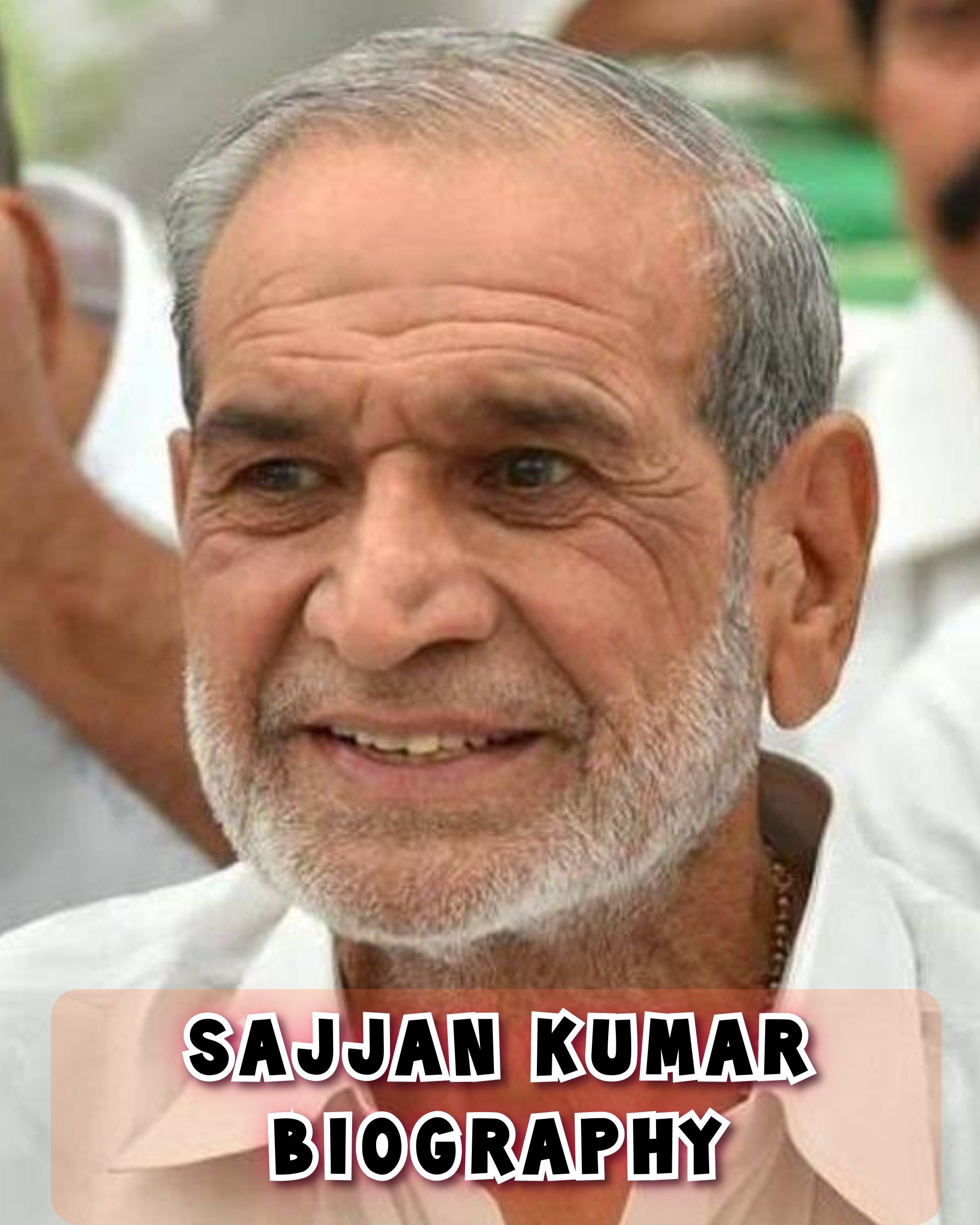
Sajjan Kumar was born on September 23, 1945, in Delhi, to Raghunath Singh and Mee Kaur. He grew up in a modest family at a time when Delhi was undergoing major social and political changes in the years surrounding India’s independence. Reports describe his family as financially modest, and details about his childhood remain relatively limited in the public record.
Kumar received a relatively limited formal education and completed his studies up to the matriculation level. Before entering politics, he worked to support himself and his family, with reports variously describing his early livelihood as running a bakery and, in some accounts, selling tea.
His early working life eventually led him toward local politics in Delhi. Kumar became increasingly involved in political activities during the 1970s and developed a strong presence in the city’s local political network. In 1977, he was elected to the Municipal Corporation of Delhi as a councillor, marking the beginning of a political career that would eventually take him to the Lok Sabha.
Sajjan Kumar Education
Sajjan Kumar’s formal education was limited. According to the official biography published by the Lok Sabha, his educational qualification was recorded as Matriculate, meaning he completed schooling up to the matriculation level.
His 2004 election affidavit provides additional detail, describing him as literate and stating that he studied privately at home. This indicates that his educational background did not follow the conventional university or college route, and there is no reliable record of him completing a higher-education degree.
Despite his limited formal education, Kumar went on to build a significant career in public life. He entered Delhi’s local politics in the 1970s, became a municipal councillor in 1977, and later rose through the Congress organization before being elected to the Lok Sabha.
Sajjan Kumar Career
Sajjan Kumar began his political career in Delhi’s local politics in the late 1970s. In 1977, he was elected as a councillor to the Municipal Corporation of Delhi from Nangloi and subsequently became General Secretary of the Delhi Pradesh Congress Committee (PCC). His growing influence in Delhi politics helped establish him as an important Congress leader, and he was also regarded as a close political associate of Sanjay Gandhi during this period.
Kumar made the transition to national politics in 1980, when he was elected to the 7th Lok Sabha from Outer Delhi on a Congress ticket. He returned to Parliament from the same constituency in 1991 and again in 2004, making him a three-time Lok Sabha MP. During his parliamentary career, he served on committees including the Consultative Committee of the Ministry of Works and Housing, the Committee on Urban Development and the Committee on Members of Parliament Local Area Development Scheme.
His political career was eventually overshadowed by allegations and legal proceedings concerning the 1984 anti-Sikh riots. In December 2018, the Delhi High Court convicted him and sentenced him to life imprisonment in a case involving the killing of five Sikhs, after which he resigned from the Congress. He was later convicted and given another life sentence in February 2025 in a separate 1984-riots murder case. Kumar remained in prison until his death on August 20, 2026, at the age of 80, bringing an end to a political career that had risen from a Delhi councillor to three terms in Parliament but was ultimately defined by the legal consequences of the 1984 violence.
Sajjan Kumar Personal Life and Family
Sajjan Kumar was married to Ram Kaur, according to his official Lok Sabha profile. The parliamentary record states that the couple had one son and two daughters. Unlike his political career, Kumar kept much of his family life away from public attention, and reliable sources provide limited information about his wife and daughters.
His son, Jag Parvesh Kumar, was publicly associated with him and was seen at Safdarjung Hospital following his father’s death in August 2026. Kumar also had a politically active brother, Ramesh Kumar, who represented the South Delhi constituency in the Lok Sabha for the Congress after winning the 2009 general election. The involvement of both Sajjan Kumar and Ramesh Kumar in Delhi politics made the family an important political presence in the capital.
There is no well-established public record indicating that Sajjan Kumar had a fiancée; he was married to Ram Kaur. His later years were dominated by imprisonment and legal proceedings connected with the 1984 anti-Sikh riots. Kumar died on August 20, 2026, after being taken from Tihar Jail to Safdarjung Hospital, leaving behind his wife, one son and two daughters.
Sajjan Kumar Age, Religion, Nationality, Height and Physical Appearance
Sajjan Kumar was born on September 23, 1945, in Delhi, and died on August 20, 2026, at the age of 80, while serving a life sentence in Tihar Jail. He was an Indian national and was associated with the Indian National Congress throughout most of his political career.
Kumar was from a Jat family and is generally described in biographical sources as belonging to the Hindu community. However, detailed information about his personal religious practices is limited in authoritative public records, so it is preferable not to make claims beyond his documented family and community background.
In terms of physical appearance, biographical sources estimated Sajjan Kumar’s height at around 5 feet 10 inches (178 cm) and his weight at approximately 75 kg. He was described as having black eyes and salt-and-pepper hair, particularly in his later years. These physical measurements are approximate rather than official government records.
Sajjan Kumar Social Media Presence
Sajjan Kumar was a veteran politician whose public career largely predated the rise of social media. There is no reliably verified official Instagram account or personal social-media handle that can confidently be attributed to him. Although his name appears in social-media posts and news coverage, these are generally posts by media organizations or other individuals rather than evidence of an official account belonging to Kumar.
Because Sajjan Kumar died on August 20, 2026, any social-media profiles or pages currently using his name should be treated cautiously unless they can be independently verified as authentic. Recent Instagram posts about his death have been published by news organizations, reflecting the renewed public interest in his life, political career and controversial legacy.
For an accurate biography, it is therefore better not to list an Instagram handle for Sajjan Kumar rather than attach an unverified username to him. His public presence today is primarily through newspaper archives, parliamentary records, court reporting and social-media posts from media outlets covering his career and death.
Sajjan Kumar Net Worth
There is no reliable, officially published figure for Sajjan Kumar’s net worth at the time of his death in August 2026. The most useful financial record is his 2004 Lok Sabha election affidavit, in which he declared movable assets of about ₹13.06 lakh, while reporting no immovable assets. The affidavit also listed liabilities of approximately ₹5.20 lakh, including a car loan and government accommodation dues.
Kumar’s income came primarily from his political career and earlier business activities. Before entering politics, he was reported to have been a bakery owner, and he later served three terms as a Member of Parliament. However, using parliamentary salary alone to calculate his lifetime wealth would be misleading because his career also involved business interests and assets, while his 2004 declaration provides only a snapshot of his finances at that time.
Therefore, for an SEO biography, a cautious estimate would be around ₹10–25 lakh based on his last readily verifiable personal asset declaration, rather than claiming a much larger unverified fortune. This should be presented as an approximate historical estimate, not his confirmed 2026 net worth, because there is no publicly verified post-2004 asset declaration establishing how his wealth changed before his death.
Legacy
Sajjan Kumar’s legacy remains deeply controversial and is inseparable from the 1984 anti-Sikh riots, which followed the assassination of Prime Minister Indira Gandhi. His rise from Delhi municipal politics to becoming a three-time Lok Sabha member made him a significant figure in the Congress’s Delhi political establishment. However, allegations concerning his role in the 1984 violence continued for decades and ultimately overshadowed much of his earlier political career.
His legal legacy was shaped by the Delhi High Court’s 2018 conviction, when he was sentenced to life imprisonment for his role in the killing of five members of a Sikh family during the 1984 violence. In 2025, he was convicted in another 1984-riots murder case and received another life sentence. These convictions became a major part of the long-running legal pursuit of accountability for victims and their families.
Sajjan Kumar died on August 20, 2026, at the age of 80, while serving his sentence in prison. His death renewed debate over justice for the victims of the 1984 violence, with survivors and their families continuing to view accountability as an important part of India’s history. Consequently, his political legacy is remembered not simply through his parliamentary career, but primarily through the enduring controversy, court cases and wider historical debate surrounding the 1984 anti-Sikh riots.
Conclusion
Sajjan Kumar’s life reflected a dramatic and ultimately controversial journey through Indian politics, from his modest beginnings and rise in Delhi’s Congress organization to becoming a three-time Lok Sabha member. While his political career established him as an influential figure in Delhi, his name became permanently associated with the 1984 anti-Sikh riots, the subsequent decades-long legal battles and his eventual imprisonment. His death on August 20, 2026, at the age of 80, marked the end of his life but not the continuing historical debate surrounding his role in one of the darkest episodes of modern Indian history.
Frequently Asked Questions About Sajjan Kumar
Who was Sajjan Kumar?
Sajjan Kumar was an Indian politician and former Indian National Congress leader who served as a three-time Member of Parliament from Delhi. He became widely known for his alleged role in the 1984 anti-Sikh riots and was later convicted in cases connected to the violence.
When did Sajjan Kumar die?
Sajjan Kumar died on August 20, 2026, at the age of 80. He died after being taken from Tihar Jail to Safdarjung Hospital in New Delhi while serving a life sentence.
How old was Sajjan Kumar when he died?
Sajjan Kumar was 80 years old when he died. He was born on September 23, 1945, and died on August 20, 2026.
What was Sajjan Kumar’s cause of death?
Sajjan Kumar died after his health deteriorated while he was in Tihar Jail. He was taken to Safdarjung Hospital in Delhi, where he was declared dead. Public reports did not initially establish a definitive cause of death.
Was Sajjan Kumar married?
Yes. Sajjan Kumar was married to Ram Kaur. According to his Lok Sabha profile, they had one son and two daughters.
Who were Sajjan Kumar’s children?
Sajjan Kumar and his wife, Ram Kaur, had one son and two daughters. His son was Jag Parvesh Kumar, who was also associated with politics.
What was Sajjan Kumar’s religion?
Sajjan Kumar was generally described as a Hindu and came from a Jat family. However, detailed information about his personal religious practices is limited in official public records.
What was Sajjan Kumar’s nationality?
Sajjan Kumar was Indian. He was born in Delhi and spent his political career in Indian public life, primarily representing constituencies in Delhi.
What was Sajjan Kumar’s height?
Sajjan Kumar’s height has been estimated at approximately 5 feet 10 inches (178 cm). This figure comes from biographical sources rather than an official government record.
What was Sajjan Kumar’s net worth?
There is no verified 2026 net-worth figure for Sajjan Kumar. His 2004 election affidavit reported movable assets of approximately ₹13.06 lakh, making it more appropriate to describe his net worth as not officially established rather than use an unverified modern estimate.
What was Sajjan Kumar famous for?
Sajjan Kumar was known for his career as a Congress politician and three-time Lok Sabha MP, but he became particularly controversial because of his convictions related to the 1984 anti-Sikh riots.
What happened to Sajjan Kumar after the 1984 riots?
Sajjan Kumar faced legal proceedings for decades following allegations connected to the 1984 violence. The Delhi High Court convicted him in 2018 and sentenced him to life imprisonment, and he was subsequently convicted in another 1984-riots murder case in 2025.
When did Sajjan Kumar become an MP?
Sajjan Kumar was first elected to the Lok Sabha in 1980 from Outer Delhi. He later returned to Parliament in 1991 and 2004, making him a three-time Lok Sabha MP.
Is Sajjan Kumar on Instagram?
There is no reliably verified official Instagram account publicly established as belonging to Sajjan Kumar. Social-media accounts using his name should therefore be treated cautiously unless independently verified.