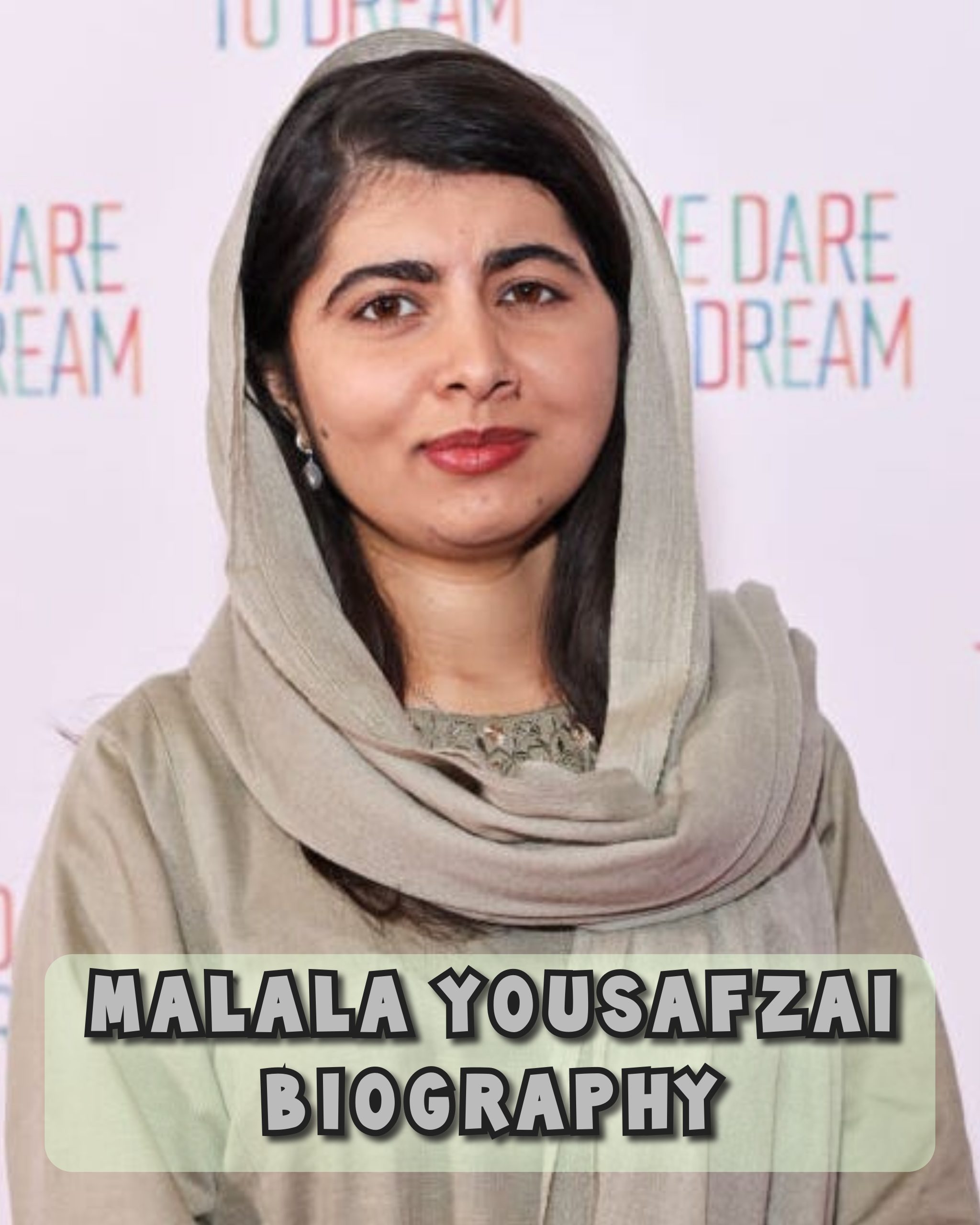
Malala Yousafzai was born on July 12, 1997, in Mingora, the largest city in Pakistan’s Swat Valley, to Ziauddin Yousafzai and Toor Pekai Yousafzai. Her father was a teacher and education activist who founded and ran a school, so education was a major part of Malala’s childhood. From an early age, he encouraged her to learn, speak confidently, and stand up for what she believed was right. That upbringing played an important role in shaping Malala’s strong commitment to education.
As a young girl, Malala attended her father’s school and developed a deep love for learning. Her childhood in Swat was initially peaceful, but conditions changed as the Taliban expanded its influence in the region. The Taliban introduced increasingly strict restrictions on girls and opposed their access to education. For Malala, the threat to girls’ schooling became personal, and she began speaking out about why girls should have the same opportunity to learn as boys, even as doing so became increasingly dangerous.
By her early teenage years, Malala had begun sharing her experiences of life under Taliban rule with a wider audience. In 2009, she wrote an anonymous diary for BBC Urdu under the pseudonym Gul Makai, describing the fear, uncertainty, and disruption caused by the closure and threats against girls’ schools. Her writing and activism gradually attracted international attention, establishing her as a courageous young advocate for girls’ education. These early experiences would ultimately shape the remarkable journey that made her one of the world’s most recognized education activists.
Malala Yousafzai Education
Malala Yousafzai began her education at the school founded by her father, Ziauddin Yousafzai, in Mingora, Pakistan. She was a dedicated student and developed a strong interest in reading, writing, and learning from an early age. Her commitment to education became even stronger as the Taliban imposed restrictions on girls attending school in Pakistan’s Swat Valley. Despite the growing danger, Malala continued to speak publicly about the importance of education for girls.
After the 2012 attack that forced her to leave Pakistan for medical treatment, Malala continued her education in the United Kingdom. She attended Edgbaston High School for Girls in Birmingham, where she completed her secondary education. She maintained her academic ambitions while becoming increasingly involved in international advocacy for girls’ education, balancing her studies with speeches, campaigns, and work connected to the Malala Fund.
In 2017, Malala began studying Philosophy, Politics and Economics (PPE) at the University of Oxford. She graduated in 2020 with a degree in the subject, marking an important academic milestone in her life. Her education at Oxford complemented her activism by giving her an opportunity to study politics, economics, and philosophical ideas while continuing her global campaign to promote access to quality education for girls.
Malala Yousafzai Career
Malala Yousafzai began her public career as a girls’ education activist while she was still a child in Pakistan’s Swat Valley. In 2009, she wrote an anonymous diary for BBC Urdu describing life under Taliban rule and the restrictions placed on girls’ education. Her advocacy gained international attention, and she later became a prominent voice for children’s right to education. In October 2012, she was shot by a Taliban gunman while travelling home from school, but survived the attack and continued her activism after receiving treatment in the United Kingdom.
Following her recovery, Malala became an internationally recognized advocate for girls’ education. In 2013, she co-founded the Malala Fund with her father, Ziauddin Yousafzai, to support girls’ access to secondary education and encourage governments to invest in education. She also addressed the United Nations on her 16th birthday and published her memoir, I Am Malala, the same year. In 2014, her international advocacy earned her the Nobel Peace Prize, which she shared with Indian child-rights activist Kailash Satyarthi, making her the youngest Nobel laureate at the time.
Malala has continued her career as an activist, author, producer, and global education advocate. Through the Malala Fund, she has campaigned for policies that help girls receive 12 years of free, safe, and quality education, while also speaking out about barriers facing girls in countries affected by conflict and discrimination. She has published additional books and worked in film and television production through her company, Extracurricular, while maintaining a prominent role in international discussions about education, women’s rights, and equality.
Malala Yousafzai Personal Life and Family
Malala Yousafzai was born into a close-knit family that played a major role in shaping her character and activism. Her father, Ziauddin Yousafzai, is an educator, activist and co-founder of the Malala Fund, while her mother, Toor Pekai Yousafzai, has remained an important source of support throughout her life. Malala also has two younger brothers, Kushal Yousafzai and Atal Yousafzai. The family relocated to Birmingham, England, after Malala was transported there for medical treatment following the 2012 attack, and they later established their home in the United Kingdom.
In her personal life, Malala married Asser Malik in November 2021 in a small Islamic wedding ceremony in Birmingham. Malik, a Pakistani national who has worked in sports administration, became her husband after they had developed a friendship before their relationship became more serious. Malala has spoken about marriage as a personal decision while continuing to prioritize her education, career and advocacy work. As of 2026, Malala and Asser Malik remain married, and there are no publicly confirmed reports of them having children.
Family continues to be an important part of Malala’s life despite her international career. Her relationship with her father is particularly significant because Ziauddin encouraged her education and supported her activism from childhood. The Yousafzai family’s commitment to equality and education helped shape Malala’s worldview, while her own experiences transformed her into a global advocate for girls’ rights. In July 2026, as she approached her 29th birthday, Malala returned to Pakistan and reflected on the family home in Swat where her journey as an education activist began.
Malala Yousafzai Age, Religion, Nationality, Height and Physical Appearance
As of August 21, 2026, Malala Yousafzai is 29 years old, having been born on July 12, 1997, in Mingora, Swat Valley, Pakistan. She is Pakistani by nationality and is widely known for her international advocacy for girls’ education and human rights. Malala is Muslim and has spoken publicly about the importance of her faith in her life. Her Pakistani heritage and upbringing in the Swat Valley remain important parts of her personal identity and life story.
Malala Yousafzai is commonly reported to be approximately 5 feet 3 inches (160 cm) tall, although publicly available sources can vary slightly regarding her exact height. She has a slim build, dark brown hair and brown eyes, and is often recognized by her modest and elegant style of dress. Her public appearance frequently includes traditional Pakistani clothing, particularly colorful shalwar kameez and headscarves, reflecting her cultural background.
Over the years, Malala’s appearance has changed naturally as she has grown from the schoolgirl who first became internationally known into an adult activist, author and public speaker. She is often seen wearing modest, professional clothing at international events and public appearances. Her distinctive style combines elements of her Pakistani heritage with contemporary fashion, while her public image remains strongly associated with her advocacy for education and girls’ rights.
Malala Yousafzai Social Media Presence
Malala Yousafzai maintains an active presence on social media, where she uses her platforms to share updates about girls’ education, human rights, her advocacy work, and aspects of her personal and professional life. Her social media presence has helped her connect directly with millions of supporters around the world and amplify campaigns led by the Malala Fund.
On Instagram, Malala uses the handle @malala, where she shares photographs, advocacy messages, appearances, and updates about issues affecting girls and young women. Her Instagram account has a large international following, making it one of her most visible platforms for communicating with supporters and raising awareness about girls’ right to education.
Malala also maintains a presence on other major social platforms, including X (formerly Twitter), where she discusses education, equality and current global issues. Through her online platforms and public advocacy, she continues to use her global profile to encourage governments, organizations and individuals to support education and opportunities for girls worldwide.
Malala Yousafzai Net Worth
As of 2026, Malala Yousafzai’s exact net worth is not publicly confirmed, so figures published online should be treated as estimates rather than verified financial statements. Current estimates vary considerably, with some sources placing her wealth around $2 million to $5 million, while a 2026 estimate gives a broader range of $2 million to $10 million. A conservative figure of approximately $3 million to $5 million is therefore more reasonable for a biography when presenting an estimate rather than an established fact.
Malala’s income has historically come primarily from book royalties, paid speaking engagements, media and production work, and other professional activities. Her memoir I Am Malala generated substantial commercial income, with reports in 2016 stating that the book had sold about 1.8 million copies worldwide at that point. Earlier reports also said she could command approximately $152,000 for a speaking engagement, although there is no reliable public evidence showing that this remains her current speaking fee in 2026.
It is important not to confuse Malala’s personal wealth with the finances of the Malala Fund, the nonprofit organization she co-founded with her father. The fund’s money is charitable funding and does not represent Malala’s personal net worth; its publicly reported financial statements show substantial grants, contributions, expenses and charitable assets. Malala is listed as an honorary chairperson with $0 compensation in the organization’s U.S. nonprofit records. Her financial success is therefore better understood through her work as an author, speaker, producer and public figure rather than through the charity she founded.
Legacy
Malala Yousafzai’s legacy is closely connected to her lifelong campaign for girls’ education and equal access to learning. After surviving a Taliban assassination attempt in 2012, she transformed her personal experience into a global movement, becoming one of the most recognizable advocates for the right of every child to receive an education. Her courage and determination have inspired millions of young people and helped bring greater international attention to the barriers preventing girls from attending school.
One of the most important parts of Malala’s legacy is the Malala Fund, which she co-founded with her father, Ziauddin Yousafzai. Through advocacy, grants and partnerships, the organization works to ensure that girls can access 12 years of free, safe and quality education. Malala’s influence has also extended through her books, speeches and international campaigns, allowing her message to reach governments, educators and communities around the world.
Malala’s place in history was further strengthened when she received the 2014 Nobel Peace Prize alongside Kailash Satyarthi, becoming the youngest Nobel laureate. Beyond the award, her legacy represents the power of education, youth leadership and peaceful activism in challenging discrimination and oppression. Her story continues to serve as an example of how one young person’s determination can inspire a worldwide movement for equality and create lasting change for future generations.
Conclusion
Malala Yousafzai’s life story is one of courage, resilience and unwavering commitment to education. From growing up in Pakistan’s Swat Valley to becoming the world’s youngest Nobel Peace Prize laureate, she has used her experiences to advocate for girls who are denied the opportunity to learn. Through the Malala Fund, her books, public speaking and international activism, she continues to campaign for equal access to education and women’s rights. Her journey from a young schoolgirl facing threats to a globally respected activist has made her an enduring symbol of the power of education, hope and peaceful determination.
Frequently Asked Questions About Malala Yousafzai
Who is Malala Yousafzai?
Malala Yousafzai is a Pakistani education activist, author and Nobel Peace Prize laureate known for campaigning for girls’ right to education. She became internationally recognized after surviving a Taliban attack in 2012.
How old is Malala Yousafzai?
Malala Yousafzai is 29 years old as of August 21, 2026. She was born on July 12, 1997, in Mingora, Swat Valley, Pakistan.
Is Malala Yousafzai married?
Yes. Malala Yousafzai married Asser Malik in November 2021 in Birmingham, England. They had a small Islamic wedding ceremony.
Who is Malala Yousafzai’s husband?
Malala Yousafzai’s husband is Asser Malik, a Pakistani sports administrator. The couple married in 2021 and maintain a relatively private personal life.
Does Malala Yousafzai have children?
There are no publicly confirmed reports that Malala Yousafzai and Asser Malik have children as of 2026.
What is Malala Yousafzai famous for?
Malala is famous for advocating girls’ education and women’s rights. She gained global attention after speaking out against restrictions on girls’ education under Taliban rule in Pakistan and later became a leading international education activist.
When did Malala Yousafzai win the Nobel Peace Prize?
Malala won the Nobel Peace Prize in 2014, sharing the award with Indian children’s rights activist Kailash Satyarthi. At 17, she became the youngest person to receive the Nobel Prize.
What happened to Malala Yousafzai in 2012?
On October 9, 2012, Malala was shot by a Taliban gunman while travelling home from school in Pakistan’s Swat Valley. She survived the attack and was transferred to the United Kingdom for specialized medical treatment.
Where did Malala Yousafzai go to university?
Malala studied Philosophy, Politics and Economics (PPE) at the University of Oxford. She graduated in 2020.
What is the Malala Fund?
The Malala Fund is an international nonprofit organization co-founded by Malala Yousafzai and her father, Ziauddin Yousafzai. It campaigns for girls to have access to 12 years of free, safe and quality education.
What books has Malala Yousafzai written?
Malala is best known for her memoir I Am Malala: The Girl Who Stood Up for Education and Was Shot by the Taliban, co-written with journalist Christina Lamb. She has also published children’s books and other works connected to her advocacy.
What is Malala Yousafzai’s net worth?
Malala Yousafzai’s exact net worth is not publicly confirmed. Online estimates vary, but a conservative estimate places her wealth at approximately $3 million to $5 million, based on reported income from books, speaking engagements, media and production work.
What is Malala Yousafzai’s religion?
Malala Yousafzai is Muslim. She has spoken publicly about her faith and its importance in her life.
What is Malala Yousafzai’s nationality?
Malala Yousafzai is Pakistani. She was born in Mingora, Pakistan, and later moved to the United Kingdom following the 2012 attack.
How tall is Malala Yousafzai?
Malala Yousafzai is commonly reported to be approximately 5 feet 3 inches (160 cm) tall, although her exact height has not been officially confirmed.
What is Malala Yousafzai’s Instagram handle?
Malala Yousafzai’s Instagram handle is @malala. She uses the platform to share updates about her advocacy, education campaigns, public appearances and personal life.
What does Malala Yousafzai do now?
Malala continues to work as an education activist, author, producer and advocate for girls’ rights. Through the Malala Fund and her public work, she continues campaigning for girls’ access to secondary education around the world.
Why is Malala Yousafzai important?
Malala is important because she has become a global symbol of girls’ education, courage and peaceful activism. Her advocacy has influenced international conversations about education and inspired young people worldwide to stand up for equal rights.