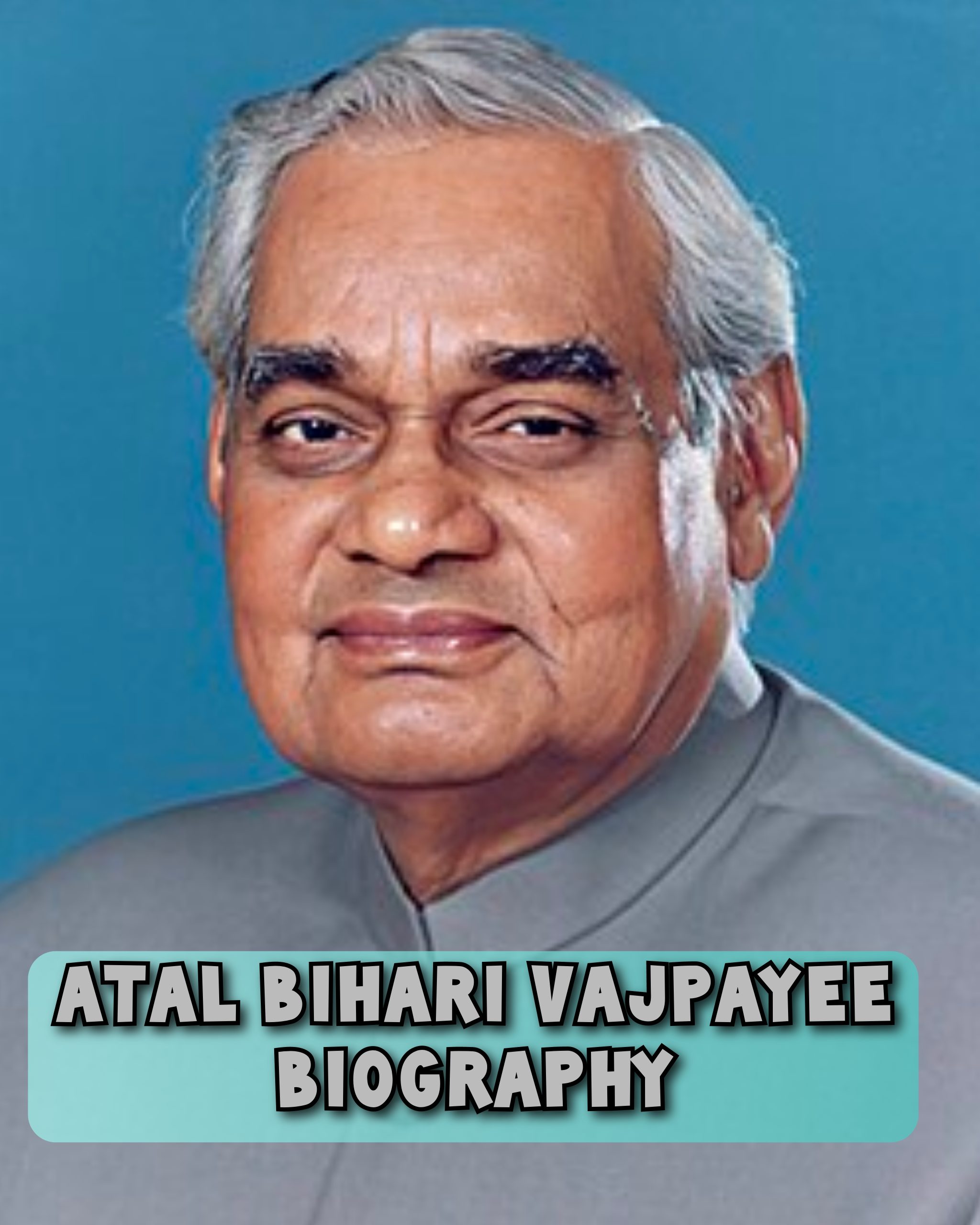
Atal Bihari Vajpayee was born on 25 December 1924 in Gwalior, then part of the princely state of Gwalior in British India. He was born into a middle-class Hindu Brahmin family to Krishna Bihari Vajpayee, a schoolteacher and poet, and Krishna Devi. His father’s profession and literary interests influenced Vajpayee from an early age, helping develop his strong command of Hindi and his lifelong passion for poetry and public speaking.
Vajpayee received his early education in Gwalior, where he showed an interest in literature, debate and public affairs. He later attended Victoria College, Gwalior (now Maharani Laxmi Bai Government College of Excellence), where he studied Hindi, English and Sanskrit. He subsequently pursued postgraduate studies in political science at DAV College, Kanpur, affiliated with Agra University. His academic background, combined with his interest in India’s independence movement, gradually shaped his political outlook.
During his youth, Vajpayee became increasingly involved in nationalist activities and developed an interest in public service. He was associated with the Rashtriya Swayamsevak Sangh (RSS) and later began working as a journalist and writer. His early experiences in journalism, political activism and public speaking laid the foundation for his eventual career in Indian politics and helped establish the distinctive oratory and literary style for which he would become famous.
Atal Bihari Vajpayee Education
Atal Bihari Vajpayee began his formal education in Gwalior, where he developed an early interest in literature, languages, debate and public affairs. He studied at the local schools before enrolling at Victoria College, Gwalior (now Maharani Laxmi Bai Government College of Excellence). During his college years, Vajpayee studied subjects including Hindi, English and Sanskrit, while also developing a reputation for his debating and oratory skills.
After completing his undergraduate studies, Vajpayee moved to DAV College in Kanpur, which was affiliated with Agra University. He pursued a Master’s degree in Political Science and performed well academically. His study of political science deepened his understanding of government, politics, international relations and public administration, subjects that later became important in his long political career.
Alongside his formal education, Vajpayee’s intellectual development was strongly influenced by literature, poetry, journalism and nationalist thought. He became an accomplished Hindi poet and writer and developed the powerful public-speaking style that later distinguished him in Parliament. His combination of academic training, literary talent and political interests helped shape the statesman and parliamentarian he would eventually become.
Atal Bihari Vajpayee Career
Atal Bihari Vajpayee began his public career as a journalist, poet and political activist before entering electoral politics. He became associated with the Rashtriya Swayamsevak Sangh (RSS) and worked as an editor and writer for Hindi publications, using journalism to express his political views and nationalist ideas. His reputation as an impressive Hindi orator and parliamentarian grew rapidly, and in 1957 he was elected to the Lok Sabha from Balrampur, beginning a parliamentary career that would span more than five decades.
Vajpayee became one of the most prominent leaders of the Bharatiya Jana Sangh, serving as its president and helping expand the party’s national influence. After the Emergency, he became a leading figure in the Janata Party government and served as Minister of External Affairs from 1977 to 1979. Following the formation of the Bharatiya Janata Party (BJP) in 1980, Vajpayee became its first president. His moderate political style, parliamentary experience and reputation for persuasive speeches helped establish him as one of India’s most respected opposition leaders.
Vajpayee eventually became Prime Minister of India three times. His first term lasted only 13 days in May 1996, while his second tenure ran from March 1998 to October 1999. He then served a full five-year term from 1999 to 2004, leading the National Democratic Alliance (NDA) government. His premiership was marked by the Pokhran-II nuclear tests in 1998, efforts to improve relations with Pakistan, infrastructure development, economic reforms and the expansion of India’s national highway network. After leaving office in 2004, Vajpayee remained an influential figure in Indian public life until his death in 2018.
Atal Bihari Vajpayee Personal Life and Family
Atal Bihari Vajpayee never married and had no biological children. Although he was engaged to Raj Kumari Kaul during his younger years, the marriage did not take place. Kaul later married Vajpayee’s close friend and fellow college student B. N. Kaul. Despite this, Vajpayee and the Kaul family remained closely connected for decades, and he shared a particularly close relationship with Raj Kumari Kaul.
Vajpayee was born to Krishna Bihari Vajpayee and Krishna Devi in Gwalior. His father was a schoolteacher who was also interested in poetry, an influence that contributed to Vajpayee’s own lifelong passion for Hindi poetry and literature. Vajpayee had several siblings, including his brother Prem Bihari Vajpayee, with whom he shared his early family life in Gwalior. His upbringing in a modest, education-oriented family played an important role in shaping his personality and intellectual interests.
Although Vajpayee never had a wife or biological children, he maintained strong personal relationships with members of the Kaul family. He was especially close to Namita Bhattacharya, Raj Kumari Kaul’s daughter, whom he regarded as a daughter, and her daughter Niharika. Vajpayee’s private life was generally kept away from the political spotlight, and he was known for his simple lifestyle, love of poetry, food and books, and his ability to maintain close friendships across political lines.
Atal Bihari Vajpayee Age, Religion, Nationality, Height and Physical Appearance
Atal Bihari Vajpayee was born on 25 December 1924 in Gwalior, British India, and died on 16 August 2018 in New Delhi at the age of 93. He was an Indian national and was widely identified as a Hindu. Vajpayee’s public life was strongly associated with Indian nationalism, parliamentary democracy and his long-standing role in shaping modern Indian politics.
Vajpayee was known for his distinctive physical appearance, including his tall stature, broad face, expressive eyes and characteristic white hair in his later years. His measured manner of speaking, formal dress and dignified appearance contributed to the statesmanlike image he maintained throughout his political career.
Various websites have published different figures for Vajpayee’s height, and there is no consistently verified official measurement. For accuracy, it is therefore better to avoid presenting a precise height as a confirmed fact. His most recognizable physical characteristics were his tall appearance, neatly combed hair, prominent facial features and calm, dignified presence, particularly during his years as Prime Minister.
Atal Bihari Vajpayee Social Media Presence
Atal Bihari Vajpayee did not have personal social media accounts because he died in 2018, before social media became a major part of the public communication of Indian political leaders. Consequently, there is no verified personal Instagram account or official Instagram handle belonging to Vajpayee himself. Readers should therefore be cautious of social media accounts using his name or presenting themselves as his personal profile.
Today, Vajpayee’s speeches, photographs, poems, political achievements and memorable quotes continue to be shared widely across platforms such as Instagram, Facebook, YouTube and X (formerly Twitter) by political organisations, government institutions, fan communities and admirers. The Government of India’s official pages continue to commemorate his life and legacy, including events surrounding his birth centenary and annual remembrance days.
For Instagram searches, users may come across accounts using names such as @atalbiharivajpayee or similar variations, but these should not be described as Vajpayee’s official personal Instagram handle unless independently verified. His enduring online presence is primarily through archival material and posts from official government and BJP accounts rather than through an account personally operated by him.
Atal Bihari Vajpayee Net Worth
Atal Bihari Vajpayee’s exact net worth at the time of his death in 2018 is not reliably documented in authoritative public sources. Unlike many contemporary politicians, there is no dependable financial record that supports a precise figure in crores or millions of dollars. Therefore, online claims giving a specific net-worth amount should be treated cautiously unless they are supported by official asset declarations or other credible records.
Vajpayee’s principal source of income throughout his working life was his career in journalism, writing and politics, followed by salaries and allowances associated with his long parliamentary career and service as Prime Minister. He served as a Member of Parliament for more than four decades and was Prime Minister for three separate periods, including his major tenure from 1998 to 2004. The official Prime Minister of India’s records confirm his long parliamentary career and his service as Prime Minister, but they do not publish a final personal net-worth figure.
For a biography, it is therefore more accurate to describe Vajpayee’s wealth as undisclosed rather than assigning an unsupported estimate. His financial legacy is better understood through his long public-service career, books and writings, parliamentary service and government positions than through claims of a large personal fortune. Any article stating a specific figure should clearly label it as an unverified estimate, not an established fact.
Legacy
Atal Bihari Vajpayee is remembered as one of the most influential Indian political leaders of the post-independence era. As Prime Minister, he played a major role in shaping India’s political and economic direction while becoming known for his oratory, parliamentary conduct and ability to build political alliances. His leadership of the National Democratic Alliance helped establish coalition politics as an important feature of India’s national government.
One of the defining aspects of Vajpayee’s legacy was his contribution to India’s national security, infrastructure and foreign policy. His government conducted the Pokhran-II nuclear tests in 1998, launched major infrastructure initiatives such as the Golden Quadrilateral, and pursued diplomatic engagement with neighbouring countries, including Pakistan. He also championed improved road connectivity and economic reforms, initiatives that continued to influence India’s development after his tenure.
Beyond politics, Vajpayee left a lasting cultural legacy as a Hindi poet, writer and statesman. His speeches and poems remain widely remembered, while his political approach earned respect from supporters and opponents alike. He received the Bharat Ratna in 2015, India’s highest civilian honour, in recognition of his exceptional contribution to public life. After his death on 16 August 2018, his memorial, Sadaiv Atal, became a place of national remembrance, and his ideas, writings and political legacy continue to be commemorated across India.
Conclusion
Atal Bihari Vajpayee remains one of India’s most respected political leaders, remembered for his long parliamentary career, three terms as Prime Minister, powerful oratory, poetry and commitment to public service. From his early years in Gwalior to becoming a central figure in the BJP and leading India through significant political, economic, security and diplomatic developments, Vajpayee left a lasting mark on the country. His Bharat Ratna, literary contributions and enduring public remembrance reflect the breadth of his influence, while his reputation for statesmanship and parliamentary dignity continues to shape how later generations view his contribution to modern India.
Frequently Asked Questions
Who was Atal Bihari Vajpayee?
Atal Bihari Vajpayee was an Indian politician, poet and statesman who served as the Prime Minister of India three times. He was a founding leader of the Bharatiya Janata Party (BJP) and served as Prime Minister from 1998 to 2004, apart from his brief first term in 1996.
When and where was Atal Bihari Vajpayee born?
Atal Bihari Vajpayee was born on 25 December 1924 in Gwalior, in the former princely state of Gwalior, British India.
How old was Atal Bihari Vajpayee when he died?
Atal Bihari Vajpayee was 93 years old when he died on 16 August 2018 in New Delhi.
What was Atal Bihari Vajpayee’s religion?
Atal Bihari Vajpayee was a Hindu and was born into a Hindu Brahmin family in Gwalior.
Was Atal Bihari Vajpayee married?
No, Atal Bihari Vajpayee never married. He was reportedly engaged to Raj Kumari Kaul in his younger years, but the two did not marry.
Did Atal Bihari Vajpayee have children?
Atal Bihari Vajpayee had no biological children. He was, however, very close to Namita Bhattacharya, the daughter of Raj Kumari Kaul, whom he regarded as his daughter.
What did Atal Bihari Vajpayee study?
Vajpayee studied at Victoria College in Gwalior and later earned a Master’s degree in Political Science from DAV College, Kanpur, which was then affiliated with Agra University.
How many times was Atal Bihari Vajpayee Prime Minister?
Atal Bihari Vajpayee served as Prime Minister of India three times: briefly in 1996, again from 1998 to 1999, and then from 1999 to 2004.
What was Atal Bihari Vajpayee famous for?
Vajpayee was famous for his political leadership, powerful Hindi speeches, poetry, parliamentary oratory and role in shaping the BJP. His government was also associated with the 1998 nuclear tests, major infrastructure projects and important diplomatic initiatives.
What was Atal Bihari Vajpayee’s net worth?
Atal Bihari Vajpayee’s exact net worth is not reliably documented in authoritative public sources. Claims online giving a specific figure should therefore be treated as estimates rather than confirmed financial information.
What awards did Atal Bihari Vajpayee receive?
Atal Bihari Vajpayee received several major honours, including the Padma Vibhushan in 1992 and the Bharat Ratna in 2015, India’s highest civilian award.
When did Atal Bihari Vajpayee die?
Atal Bihari Vajpayee died on 16 August 2018 at the All India Institute of Medical Sciences (AIIMS) in New Delhi after a prolonged illness.
Where is Atal Bihari Vajpayee buried?
Atal Bihari Vajpayee’s final resting place is Sadaiv Atal, his memorial near Raj Ghat in New Delhi, where national leaders and members of the public continue to pay tribute to him.
Did Atal Bihari Vajpayee have an official Instagram account?
No verified evidence indicates that Atal Bihari Vajpayee had a personal official Instagram account. Because he died in 2018, social-media accounts using his name should not automatically be considered his official personal profiles.