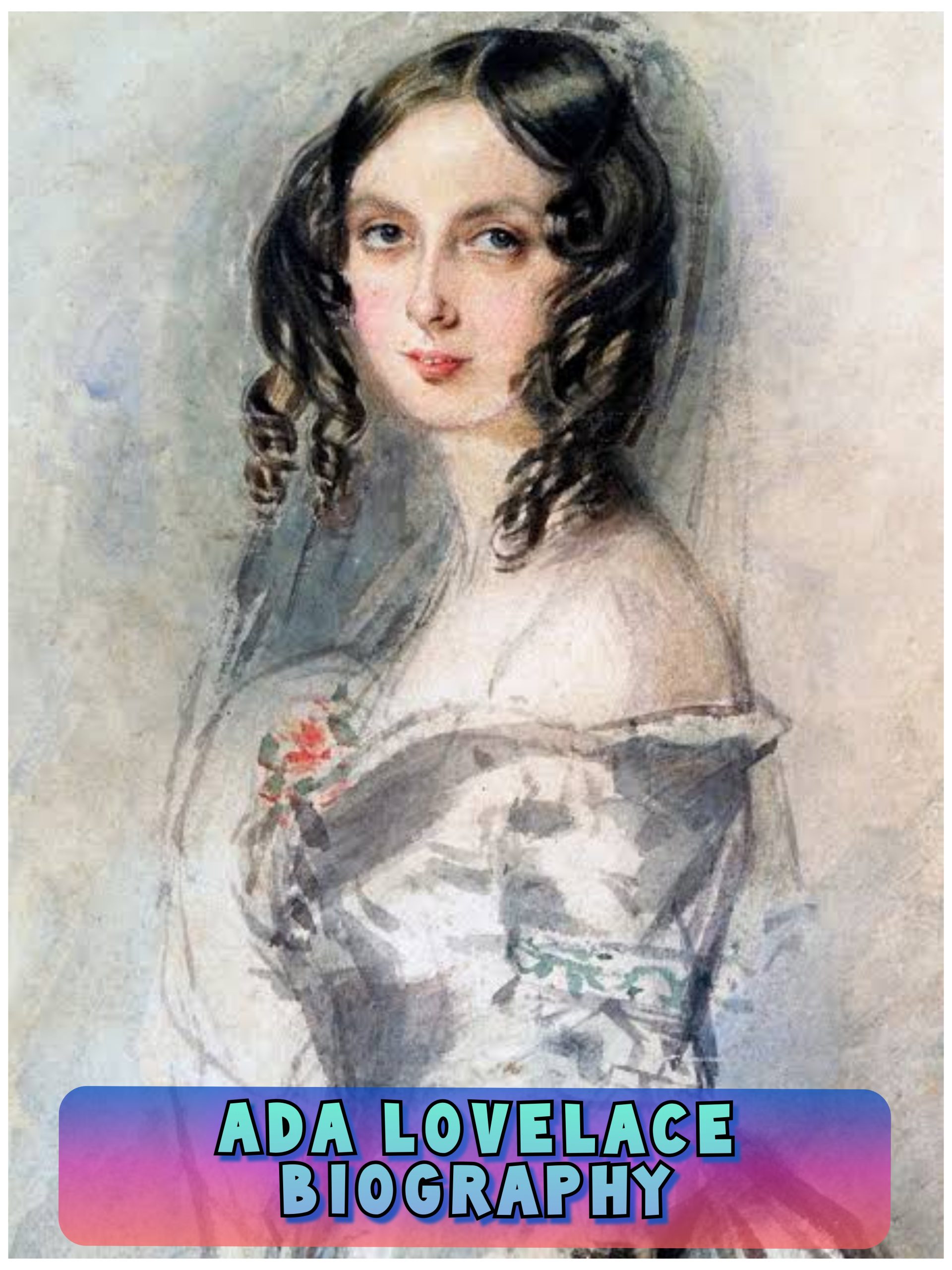
Ada Lovelace was born Augusta Ada Byron on December 10, 1815, in London, England. She was the only legitimate child of the celebrated English Romantic poet Lord Byron and his wife, Anne Isabella Milbanke, a highly educated woman with a strong interest in mathematics. Her parents separated shortly after her birth, and Ada never developed a close relationship with her father, who left England when she was still an infant and died in Greece when she was eight years old.
Raised primarily by her mother, Ada received an unusually rigorous education for a girl in nineteenth-century Britain. Lady Byron encouraged her daughter’s interest in mathematics, science and logic, employing private tutors to educate her. Ada also studied languages, music and other subjects considered appropriate for an aristocratic young woman. Her mathematical education became an important foundation for her later work and helped distinguish her from many women of her generation.
From an early age, Ada demonstrated a remarkable imagination alongside her mathematical abilities. She was fascinated by machines and scientific inventions and became particularly interested in the possibilities of technology. As a teenager, she encountered the work of mathematician and inventor Charles Babbage, whose proposed mechanical calculating machines captured her imagination. This early combination of mathematical discipline and creative thinking would eventually lead her toward the pioneering work that made her one of the most celebrated figures in the history of computing.
Ada Lovelace’s Education
Ada Lovelace received an unusually advanced education for a woman in early nineteenth-century Britain. Her mother, Lady Byron, placed great emphasis on mathematics, logic and science and arranged for Ada to study with private tutors. Her education also included literature, languages, music and geography, giving her a broad intellectual foundation. Mathematics, however, became one of the most important parts of her education and remained a central interest throughout her life.
As a teenager, Ada studied mathematics under Augustus De Morgan, one of the leading mathematicians and logicians of the Victorian era. De Morgan helped develop her understanding of advanced mathematical concepts, while other influential teachers and intellectuals encouraged her interest in science and technology. Ada’s education was largely conducted privately rather than through a university, as women in Britain at the time had very limited access to formal higher education.
Her intellectual development was also influenced by her friendship with Mary Somerville, a respected Scottish mathematician and science writer. Through Somerville, Ada was introduced to important scientific and mathematical circles in London and eventually met Charles Babbage. Her strong mathematical training, combined with her interest in machines and imaginative approach to science, prepared her for her later work on Babbage’s proposed Analytical Engine and helped establish her place in the early history of computing.
Ada Lovelace’s Personal Life and Family
Ada Lovelace was born into a prominent aristocratic family. Her father was the famous English Romantic poet Lord Byron (George Gordon Byron, 6th Baron Byron), while her mother was Anne Isabella Milbanke, later known as Lady Byron. Ada’s parents separated shortly after her birth, and she was raised primarily by her mother. Although she was Lord Byron’s only legitimate child, Ada had several paternal half-siblings. Her relationship with her father was limited because he left England when she was an infant and died in Greece in 1824.
In 1833, Ada met Charles Babbage, the mathematician and inventor whose work on mechanical calculating machines would later become central to her career. Their intellectual friendship became highly significant, as Babbage recognized Ada’s exceptional mathematical ability and encouraged her interest in his proposed Analytical Engine. Ada did not have a documented long-term fiancé before her marriage. In 1835, at the age of 19, she married William King, who became the Earl of Lovelace in 1838, making Ada the Countess of Lovelace.
Ada and William had three children: Byron King-Noel, Viscount Ockham, born in 1836; Anne Isabella Noel Blunt, born in 1837; and Ralph Gordon King-Milbanke, born in 1839. Despite her responsibilities as a wife and mother, Ada continued pursuing mathematics and corresponding with leading intellectuals. Her family life was complicated by periods of ill health and marital difficulties, but she maintained her intellectual ambitions. Ada died on November 27, 1852, aged 36, and was buried beside her father at St Mary Magdalene Church in Hucknall, Nottinghamshire, leaving behind a family legacy as well as an enduring place in the history of computing.
Ada Lovelace’s Career and Work
Ada Lovelace’s most important professional and intellectual contribution came through her work on Charles Babbage’s Analytical Engine, a proposed mechanical general-purpose computer. She became deeply interested in Babbage’s ideas and understood that the machine had possibilities that went far beyond simple numerical calculation.
In 1843, Lovelace translated an article by Luigi Federico Menabrea about the Analytical Engine and added extensive notes of her own. One of these notes contained an algorithm designed to calculate Bernoulli numbers. Her work is widely regarded as the first published computer program, which led to her being recognized as the first computer programmer.
Lovelace’s contribution was particularly remarkable because she understood that a general-purpose machine could potentially manipulate symbols and information rather than simply numbers. She suggested that such a machine might eventually be capable of working with music and other forms of information. Her ideas anticipated important concepts associated with modern computing and helped establish her enduring reputation as a pioneer of computer science.
Ada Lovelace’s. Death and Cause of Death
Ada Lovelace died on November 27, 1852, in London, England, at the age of 36. She had been suffering from a serious illness for several months, and her health deteriorated significantly during the final weeks of her life. Her death came just nine years after the publication of her groundbreaking notes on Charles Babbage’s Analytical Engine.
The generally accepted historical cause of Ada Lovelace’s death was uterine cancer (cancer of the womb). During her final illness, she was treated according to the medical practices of the Victorian era, including bloodletting, which was commonly used at the time but is not considered an effective treatment today. Her final illness was also complicated by severe pain and declining health.
Ada was buried at St Mary Magdalene Church in Hucknall, Nottinghamshire, beside her father, Lord Byron, at her own request. Although she died relatively young, her mathematical work and vision for the potential of mechanical computing later made her an important figure in the history of computer science. Her legacy has continued to grow, with many institutions and organizations honoring her contributions to programming and technology.
Ada Lovelace’s Age, Religion, Nationality, Height and Physical Appearance
Ada Lovelace was born on December 10, 1815, and died on November 27, 1852, making her 36 years old at the time of her death. She was English by nationality and was born in London, England, into an aristocratic British family. Ada was raised within the Christian tradition, although detailed records of her personal religious beliefs and practices are limited, so claims about a specific denomination should be treated cautiously.
There is no reliable historical record of Ada Lovelace’s exact height. Modern websites sometimes publish specific measurements, but these figures are not supported by dependable contemporary documentation and should not be presented as fact. Surviving portraits and written descriptions portray Ada as an elegant Victorian woman with dark hair, light skin, and refined aristocratic features. Her appearance is most commonly known today through painted portraits and illustrations created during her lifetime.
As was typical of wealthy women of her era, Ada was often depicted wearing formal Victorian clothing, including elaborate dresses and carefully styled hair. Her surviving portraits present her with a composed and dignified appearance befitting her aristocratic status. Because photography was still in its early development during her lifetime, most modern representations of Ada’s appearance are based on paintings, drawings and later artistic interpretations rather than photographs.
Ada Lovelace’s Social Media Presence
Ada Lovelace did not have a personal social media presence because she lived in the 19th century and died in 1852, long before the invention of the internet and social networking platforms. Today, however, her name and legacy remain active across social media, where museums, educational organizations, historians and technology communities share information about her life and pioneering contribution to computing.
There is no reliably verified official Instagram account belonging to Ada Lovelace herself. An Instagram/Linktree presence using the handle @Ada.Lovelace currently exists and describes itself as a community focused on Lovelace and her status as a pioneer of computer science, but it should not be presented as an account personally operated by the historical Ada Lovelace.
Her legacy has also inspired dedicated social-media projects. For example, the LEGO Lovelace project created social-media accounts celebrating Ada and reported significant engagement across Facebook, Twitter and Instagram. These modern accounts allow new generations to discover her work, particularly her collaboration with Charles Babbage and her pioneering algorithm for the Analytical Engine.
Ada Lovelace’s Net Worth
Ada Lovelace’s exact net worth cannot be reliably calculated because detailed modern-style financial records of her personal wealth do not survive. She was not a salaried computer programmer or scientist in the modern sense; her work with Charles Babbage was largely intellectual and she did not receive a known professional salary for her contributions to computing. Historical sources instead describe her as a member of the British aristocracy whose household finances were connected to her husband, William King-Noel, and her family’s wealth.
After marrying William King in 1835, Ada became Countess of Lovelace when her husband inherited the title in 1838. This placed her within a wealthy aristocratic household, although it would be misleading to convert that family’s 19th-century wealth directly into a precise modern “net worth.” There is also evidence that Ada experienced financial difficulties later in life, including substantial gambling debts, which further complicates any attempt to estimate her personal wealth at the time of her death.
Estimated net worth: Not reliably available / cannot be established from historical records. For an SEO biography, it is safer to state that Ada Lovelace came from and married into significant British aristocratic wealth, rather than assigning her an unsupported figure such as “$10 million” or “$50 million.” Her importance today comes from her mathematical and computing legacy, not from an independently documented personal fortune.
Legacy
Ada Lovelace’s greatest legacy is her pioneering contribution to the history of computer programming. In 1843, while working on Charles Babbage’s proposed Analytical Engine, she published extensive notes that included an algorithm designed to calculate Bernoulli numbers. The work is widely regarded as the first published computer program, earning her a lasting place as a pioneer of modern computing.
Her legacy extends beyond the algorithm itself. Lovelace understood that a general-purpose computing machine could potentially manipulate symbols and information beyond simple numerical calculations. She imagined that machines could one day work with areas such as music and other forms of creative expression, demonstrating an unusually broad vision of what computing might become. This insight has made her particularly relevant to later discussions about programming, artificial intelligence and digital technology.
Today, Ada Lovelace is celebrated internationally as an important figure in science, technology, engineering and mathematics (STEM) and as an inspiration for women pursuing careers in technology. Her name has been given to the Ada programming language, and institutions, educational programs and events continue to commemorate her achievements. Ada Lovelace Day, observed annually in October, celebrates the contributions of women in STEM and reflects the enduring influence of a mathematician whose ideas anticipated important aspects of the modern computer age.
Conclusion
Ada Lovelace remains one of the most influential figures in the history of computing, remembered not only as the woman who wrote what is widely regarded as the first published computer program, but also for her remarkable vision of what machines could eventually achieve. Born into an aristocratic family and educated in mathematics at a time when opportunities for women were severely limited, she combined scientific reasoning with imagination to recognize possibilities far beyond the technology of her era. Although she died at just 36, her work with Charles Babbage and her ideas about the Analytical Engine established a legacy that continues to inspire programmers, scientists, engineers and women in STEM around the world.
Frequently Asked Questions About Ada Lovelace
Who was Ada Lovelace?
Ada Lovelace was an English mathematician and writer best known for her work on Charles Babbage’s Analytical Engine. She is widely regarded as the first computer programmer because of the algorithm she published in 1843.
When was Ada Lovelace born?
Ada Lovelace was born on December 10, 1815, in London, England. Her birth name was Augusta Ada Byron.
How old was Ada Lovelace when she died?
Ada Lovelace was 36 years old when she died on November 27, 1852.
What was Ada Lovelace’s cause of death?
Ada Lovelace’s generally accepted cause of death was uterine cancer, also described as cancer of the womb. She died in London in 1852.
Who were Ada Lovelace’s parents?
Ada Lovelace was the daughter of the famous English poet Lord Byron and Anne Isabella Milbanke, later Lady Byron. Her parents separated shortly after her birth.
Was Ada Lovelace married?
Yes. Ada Lovelace married William King in 1835. He later became the Earl of Lovelace, making her the Countess of Lovelace.
Did Ada Lovelace have children?
Yes. Ada Lovelace had three children with William King-Noel: Byron King-Noel, Viscount Ockham; Anne Isabella Noel Blunt; and Ralph Gordon King-Milbanke.
What did Ada Lovelace do?
Ada Lovelace was a mathematician and writer who studied Charles Babbage’s proposed Analytical Engine. Her published notes included an algorithm for calculating Bernoulli numbers.
Why is Ada Lovelace famous?
Ada Lovelace is famous for writing what is widely considered the first published computer program and for recognizing that computers could eventually do more than numerical calculations.
Was Ada Lovelace the first computer programmer?
Yes, she is widely recognized as the first computer programmer. Her 1843 notes on Babbage’s Analytical Engine contained an algorithm intended to be processed by the machine.
What was Ada Lovelace’s net worth?
Ada Lovelace’s exact net worth is unknown. She belonged to the British aristocracy and married into an aristocratic family, but there is no reliable historical figure that can be converted into a precise modern net-worth estimate.
What was Ada Lovelace’s nationality?
Ada Lovelace was English and British, having been born in London, England.
What was Ada Lovelace’s religion?
Ada Lovelace was raised within the Christian tradition. However, reliable historical evidence is insufficient to confidently identify a specific denomination as her personal religious affiliation.
How tall was Ada Lovelace?
Ada Lovelace’s exact height is not reliably documented. Specific height figures commonly published online are not supported by dependable historical records.
Did Ada Lovelace have social media?
No. Ada Lovelace died in 1852, long before the invention of social media. Modern social-media accounts using her name are operated by organizations, projects or individuals rather than Ada herself.
What is Ada Lovelace’s greatest legacy?
Ada Lovelace’s greatest legacy is her pioneering contribution to computer programming and computing theory. Her work demonstrated an early understanding of how a general-purpose machine could process information beyond simple mathematical calculations.
What programming language was named after Ada Lovelace?
The Ada programming language was named in her honor. It was developed for the U.S. Department of Defense and became an important language for software requiring high reliability and safety.
Where is Ada Lovelace buried?
Ada Lovelace is buried at St Mary Magdalene Church in Hucknall, Nottinghamshire, England, beside her father, Lord Byron.