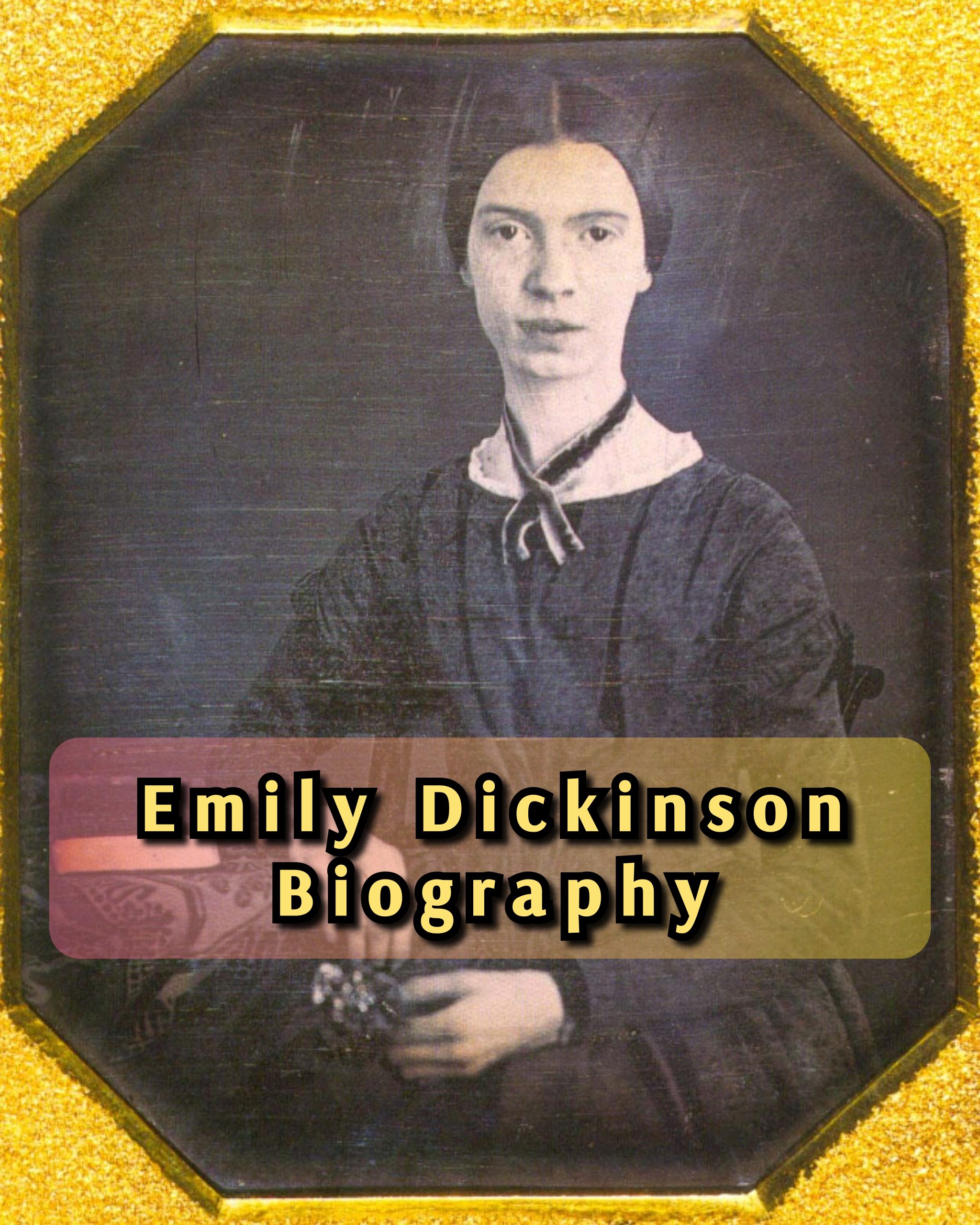
Emily Elizabeth Dickinson was born on December 10, 1830, at the Dickinson Homestead on Main Street in Amherst, Massachusetts. She was the middle child of Edward Dickinson and Emily Norcross Dickinson, with an older brother, William Austin Dickinson, commonly known as Austin, and a younger sister, Lavinia Dickinson. Her father was a prominent lawyer and political figure in Amherst, while her family was closely connected with the development of the town and Amherst College.
When Emily was nine, her family moved to a house on what is now North Pleasant Street in Amherst. Her childhood included school, reading, church activities, music, gardening, baking, letter writing and walks around Amherst. Although she later became famous for her secluded lifestyle, accounts of her youth show that she was socially active and maintained numerous friendships. Her early friends included Abiah Root, Abby Wood, Emily Fowler and Susan Gilbert, who later became her sister-in-law.
Death and religion became important subjects in Dickinson’s thinking from an early age. Several deaths among friends and relatives, including her young cousin Sophia Holland, confronted her with questions about mortality and immortality. Her childhood home was also located close to the Amherst cemetery, an environment that contributed to the recurring imagery of death and burial in her later poetry.
Emily Dickinson Education
Emily Dickinson received an unusually strong formal education for a young woman in nineteenth-century America. After attending an Amherst district school, she entered Amherst Academy, where she studied for approximately seven years. Her education exposed her to literature, history, science, religion and other subjects that later contributed to the breadth of her poetry and correspondence.
In 1847, Dickinson entered Mount Holyoke Female Seminary, now Mount Holyoke College. She remained there for approximately one year, making it the longest period she spent away from home. The experience was significant because the institution provided a structured educational and religious environment during a period when Dickinson was thinking deeply about faith and personal identity.
Her education continued beyond formal schooling through extensive reading, correspondence and intellectual engagement. Dickinson developed a wide-ranging knowledge of literature, religion, science, nature and contemporary events. Her later writing demonstrates the influence of this broad intellectual curiosity, and the Emily Dickinson Museum describes her as an artist whose intellectual intensity is central to understanding her work.
Emily Dickinson Career
Emily Dickinson’s career was centered on poetry and correspondence. Although she began writing poems as a teenager, her most intense period of poetic production occurred between approximately 1858 and 1865. During those years she composed and revised hundreds of poems dealing with love, grief, nature, death, faith, doubt and the human mind. By age 35, she had written more than 1,100 concise poems.
Dickinson’s approach to publication was unusual. She privately assembled about 800 poems into handmade booklets known as fascicles, but most of her poetry remained unseen by the public during her lifetime. She shared poems with selected friends and correspondents, including Susan Dickinson and Thomas Wentworth Higginson. A few poems appeared in print during her lifetime, but the overwhelming majority were published only after her death.
Her posthumous literary career transformed her into one of the most important American poets. After Dickinson died in 1886, her sister Lavinia and Mabel Loomis Todd helped bring her poems to publication. Later editors and scholars worked to restore more of Dickinson’s original punctuation, capitalization and wording. Her surviving body of work contains almost 1,800 poems and a large collection of letters.
Emily Dickinson Personal Life and Family
Emily Dickinson never married and had no children. Her closest family relationships included her brother Austin and younger sister Lavinia. Austin married Emily’s close friend Susan Huntington Gilbert in 1856, and the couple lived next door to Emily at The Evergreens. Austin and Susan had three children—Ned, Martha and Gilbert—who became important figures in Emily’s family life.
Dickinson maintained significant friendships and emotional relationships throughout her life. Susan Dickinson was particularly important, receiving more than 250 poems from Emily during their approximately forty-year relationship. Dickinson also had important relationships with people such as Benjamin Newton, Samuel Bowles, Reverend Charles Wadsworth and Thomas Wentworth Higginson. Some surviving letters, including the mysterious “Master Letters,” have led scholars to investigate possible romantic relationships, although the identity of their intended recipient remains uncertain.
In her later years, Dickinson became increasingly secluded at the Homestead, although the idea that she completely isolated herself from everyone is an oversimplification. She continued to receive family members and selected visitors. She also developed a romance with Judge Otis Phillips Lord, a widower and longtime acquaintance of the Dickinson family. Surviving drafts indicate that marriage may have been considered, but the relationship did not result in marriage. Lord died in 1884, two years before Dickinson.
Emily Dickinson Age, Religion, Nationality, Height and Physical Appearance
Emily Dickinson was 55 years old when she died on May 15, 1886. She was American and spent virtually her entire life in Amherst, Massachusetts. She was raised within the Christian culture of nineteenth-century New England and engaged deeply with questions of God, faith, salvation, death and immortality, although she did not formally join her family’s church. Contemporary descriptions portray her as small and slender, with reddish hair and striking eyes. The Emily Dickinson Museum cites a description suggesting she may have stood around 5 feet 2 inches, while other historical estimates place her closer to 5 feet 3 inches, so her exact height cannot be established with certainty.
Emily Dickinson Social Media Presence
Emily Dickinson herself never had social-media accounts because she lived from 1830 to 1886. Her literary legacy, however, has a substantial modern digital presence. The Emily Dickinson Museum maintains an Instagram account at @emilydickinson.museum, where it shares information about Dickinson, her poetry, the Homestead, The Evergreens and museum activities.
The museum’s digital presence has become an important way for modern audiences to encounter Dickinson’s work and historical world. Its online programs, collections, educational resources and social-media content help connect contemporary readers with manuscripts, objects and places associated with the poet.
Emily Dickinson Net Worth
Emily Dickinson’s exact net worth is not known, and there is no reliable historical financial record that can be converted into a modern celebrity-style net-worth figure. Unlike a modern professional poet or author, she did not earn a regular salary from a large publishing career. Most of her approximately 1,800 poems remained unpublished during her lifetime, meaning her literary work did not generate the type of substantial commercial income associated with her reputation today.
Dickinson did, however, grow up in a financially established Amherst family. Her father, Edward Dickinson, was a lawyer and prominent community figure, and the family owned the Homestead and maintained a substantial household. Her financial circumstances therefore reflected her family’s position more than income from her poetry. Because surviving records do not establish a complete personal balance sheet, assigning her a precise net worth would be speculative.
For SEO purposes, online sources sometimes attach numerical net-worth estimates to historical figures, but there is no authoritative figure for Emily Dickinson’s personal net worth. A responsible estimate is therefore not reliably calculable, rather than a fabricated dollar amount. Her greatest measurable legacy is literary: her surviving manuscripts, letters and poems have become enormously valuable culturally and academically, while the Dickinson family homes and collections are now preserved for the public.
Legacy
Emily Dickinson’s legacy rests primarily on the originality and lasting influence of her poetry. Her poems are recognized for their compressed language, unusual punctuation, slant rhyme, distinctive capitalization and exploration of subjects including death, love, nature, faith, doubt and consciousness. The Emily Dickinson Museum describes her poetry as among the finest in the English language.
Her reputation expanded dramatically after her death. Her sister Lavinia and Mabel Loomis Todd helped bring the poems to public attention, while later editors and scholars worked to understand Dickinson’s manuscripts and preserve the characteristics of her original writing. Her poems are now studied internationally and remain central to American literary history.
Her physical legacy also survives in Amherst. The Emily Dickinson Museum now encompasses the Homestead, where Emily was born, lived and died, and The Evergreens, the neighboring home of Austin, Susan and their children. In 2026, the museum continues preservation work on the Homestead, including replacement of its aging roof and research connected with a larger restoration project.
Conclusion
Emily Dickinson’s life was centered on Amherst, family, reading, correspondence, gardening and poetry, yet the literary world she created eventually reached audiences around the globe. She wrote nearly 1,800 poems, most of which were not publicly known during her lifetime, and died at age 55 in 1886. Her unconventional poetic style, intense examination of human experience and extraordinary body of surviving work have secured her place as a major American poet, while the continuing preservation of her home, manuscripts and family history keeps her legacy alive for new generations.
Frequently Asked Questions About Emily Dickinson
1. Who was Emily Dickinson?
Emily Dickinson was an American poet born in Amherst, Massachusetts, in 1830. She became one of the most influential poets in American literature, leaving nearly 1,800 poems and numerous letters.
2. How old was Emily Dickinson when she died?
Emily Dickinson was 55 years old when she died on May 15, 1886, in Amherst, Massachusetts.
3. What was Emily Dickinson’s cause of death?
Her death certificate listed Bright’s disease, a historical term associated with kidney disease. Modern research into her symptoms has suggested severe hypertension and possible heart failure, but the precise medical cause cannot be established with certainty.
4. Was Emily Dickinson married?
No. Emily Dickinson never married and had no children. She did have significant friendships and romantic relationships, including a later-life relationship with Judge Otis Phillips Lord.
5. What are Emily Dickinson’s most famous poems?
Some of her best-known poems include “Because I could not stop for Death,” “Hope is the thing with feathers,” “I heard a Fly buzz—when I died,” “I’m Nobody! Who are you?” and “My Life had stood—a Loaded Gun.”
6. Where was Emily Dickinson educated?
She attended an Amherst district school, studied at Amherst Academy for about seven years and attended Mount Holyoke Female Seminary, now Mount Holyoke College, for approximately one year.
7. What religion was Emily Dickinson?
Dickinson was raised in a Christian environment and wrote extensively about God, faith, death and immortality. However, she did not formally join her family’s church.
8. How tall was Emily Dickinson?
Historical descriptions suggest that Dickinson was short and slender. The Emily Dickinson Museum cites an estimate of approximately 5 feet 2 inches, although other historical estimates place her around 5 feet 3 inches, so her exact height is uncertain.
9. What was Emily Dickinson’s net worth?
There is no reliable documented figure for Emily Dickinson’s personal net worth. She did not have a conventional professional publishing income, and most of her poems were unpublished during her lifetime.
10. What is Emily Dickinson best known for?
Emily Dickinson is best known for her highly distinctive poetry, including her unconventional punctuation, compressed language, slant rhyme and explorations of death, nature, love, faith and the human experience. Her work is now regarded as among the finest poetry in the English language.