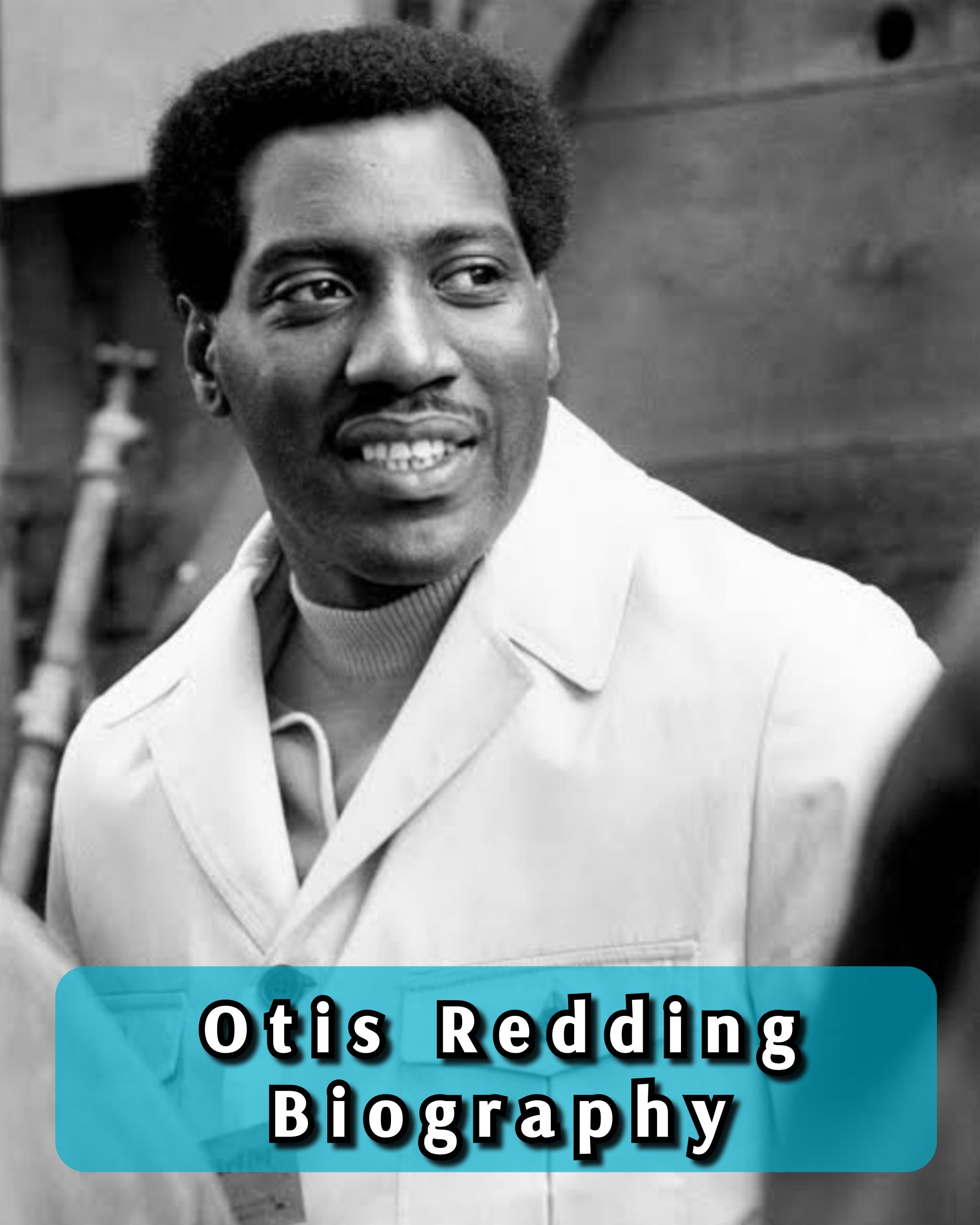
Otis Ray Redding Jr. was born on September 9, 1941, in Dawson, Georgia, United States. His family moved to Macon, Georgia, when he was two years old, and Macon became the community most closely associated with his upbringing and later musical career. From an early age, Redding was exposed to gospel music and began developing the powerful singing style that would eventually make him one of the best-known voices in soul music.
Redding began singing and performing while he was still young. He sang in the choir at Vineville Baptist Church and participated in his school’s band. As a teenager, he entered talent shows at Macon’s Douglass Theatre, where his commanding voice quickly distinguished him from other young performers. He won the theatre’s talent competition 15 consecutive times, after which he was no longer permitted to compete.
In 1958, Redding joined Johnny Jenkins and the Pinetoppers, giving him an important opportunity to perform professionally. He also appeared in talent shows promoted by local radio personality Hamp Swain. These early experiences helped him build a reputation in Macon before he eventually traveled to Memphis for the recording session that changed his career.
Otis Redding Education
Otis Redding attended Ballard Hudson High School in Macon, Georgia, where he participated in the school band. His formal education, however, was not completed. The Otis Redding Foundation specifically notes that although he did not finish his academic studies, he understood the importance of education and later became committed to helping young people obtain educational opportunities.
Redding’s practical musical education largely came through church singing, school performances, local talent competitions and professional work with Johnny Jenkins and the Pinetoppers. These experiences allowed him to develop his voice, stage presence and understanding of rhythm and blues at a time when the Southern music scene was undergoing major changes.
Education remained important to Redding even after his music career became successful. By 1967, he was planning a summer camp for young people at his Georgia ranch that would combine athletic activities with lessons in areas such as civics and economics. The foundation established in his honor later continued this educational vision through music, writing and arts programs for young people.
Otis Redding Career
Otis Redding’s professional breakthrough came in 1962, when he drove Johnny Jenkins to Memphis for a recording session at Stax Records. When Jenkins’ session ended with studio time remaining, Stax co-owner Jim Stewart allowed Redding to record a couple of songs. One of those recordings, “These Arms of Mine,” became Redding’s debut single and established him as a promising new soul singer.
Redding subsequently recorded a series of influential songs, including “I’ve Been Loving You Too Long,” “Respect,” “Try a Little Tenderness,” and “These Arms of Mine.” His performances were known for their emotional intensity, vocal power and strong relationship with audiences. He toured widely, performing in the United States and internationally, and his appearance at the Monterey International Pop Festival in 1967 helped introduce his music to a broader rock audience.
Redding also expanded beyond performing. In 1965, he established Jotis Records, while also developing business and property interests. His final major recording, “(Sittin’ On) The Dock of the Bay,” was written with Steve Cropper and became his signature song. Released after his death in 1968, it became a major commercial success and earned Redding two Grammy Awards at the 11th Annual Grammy Awards.
Otis Redding Personal Life and Family
Otis Redding met Zelma Atwood in 1959, and the two married in August 1961. Their relationship remained central to Redding’s personal life as his career grew. The couple eventually moved their family to a 300-acre property known as The Big O Ranch in Round Oak, Georgia, in 1965.
Redding and Zelma had three children: Dexter Redding, Karla Redding-Andrews and Otis Redding III. A fourth daughter, Demetria Redding, was adopted by Zelma after Otis’s death. The Redding family later became closely involved in protecting his musical catalogue and continuing his philanthropic work.
Redding’s family has played a significant role in preserving his name and work. His widow, Zelma Redding, became the head of his estate and later founded the Otis Redding Foundation. His daughter Karla Redding-Andrews serves as the foundation’s vice-president and executive director, while the family has continued supporting music and arts education in Middle Georgia.
Otis Redding Death and Cause of Death
Otis Redding died on December 10, 1967, at the age of 26, when the twin-engine aircraft carrying him crashed into Lake Monona near Madison, Wisconsin. The crash occurred while he was traveling with members of the Bar-Kays. Redding and six other people on board died, while Bar-Kays member Ben Cauley survived. Contemporary accounts and later biographical records describe the aircraft accident as the cause of Redding’s death.
The precise cause of the aircraft crash was never definitively established. Redding’s death came only weeks before the release of “(Sittin’ On) The Dock of the Bay,” which became his first No. 1 hit and one of the most recognizable songs associated with his career.
Otis Redding Age, Religion, Nationality, Height and Physical Appearance
Otis Redding was 26 years old when he died. He was an American singer and songwriter born in Georgia and raised primarily in Macon. He was brought up in a Baptist Christian environment and sang in the choir at Vineville Baptist Church from an early age. Biographical sources commonly list his height at approximately 6 feet to 6 feet 1 inch (183–185 cm) and his weight at around 220 pounds. He had a large, athletic build and a commanding physical presence that complemented his energetic and emotionally expressive performance style.
Otis Redding Net Worth
There is no reliably documented official figure for Otis Redding’s exact net worth at the time of his death, so specific figures frequently published online should be treated as estimates rather than verified financial records. His income came primarily from record sales, songwriting, live performances and music-related business activities during the 1960s.
Redding was a commercially successful touring performer by the time of his death. Historical accounts indicate that his concerts generated substantial income, while his business interests included Jotis Records, real estate and other investments. His 300-acre Big O Ranch was another significant asset associated with his family.
Because his career ended at only 26, estimating his wealth from a modern celebrity-net-worth figure would be misleading. A more defensible description is that Redding had accumulated considerable assets and earning power for a musician of his age, and his estate subsequently continued generating value from his recordings, publishing, licensing and use of his name and image. His widow Zelma and daughter Karla have been involved in managing these interests.
Legacy
Otis Redding became one of the most influential voices associated with Southern soul. The Rock & Roll Hall of Fame describes his performances as exceptionally powerful and emotionally expressive, and his recordings continue to be studied and celebrated as important contributions to soul and rock music. He was inducted into the Rock & Roll Hall of Fame in 1989.
His greatest posthumous achievement came with “(Sittin’ On) The Dock of the Bay.” The recording won two Grammy Awards in 1969: Best Rhythm & Blues Vocal Performance, Male, and Best Rhythm & Blues Song, with songwriting credit shared by Redding and Steve Cropper. The recording was also inducted into the Grammy Hall of Fame in 1998.
Redding’s legacy also extends beyond music. The Otis Redding Foundation, established by Zelma Redding in 2007, carries forward his commitment to education and youth empowerment through programs involving music, writing and instrumentation. The foundation’s work demonstrates how Redding’s original interest in helping young people has continued through his family and community initiatives.
Conclusion
Otis Redding’s life was brief but extraordinarily influential. From his beginnings singing in a Baptist church choir and winning talent shows in Macon to becoming an internationally recognized soul performer, he established a musical legacy that continued growing after his death. His marriage to Zelma Atwood, his children, his commitment to education and his recordings—particularly “(Sittin’ On) The Dock of the Bay”—remain central to his story. More than five decades after his death, his music continues to be preserved through his family, estate, foundation and the institutions that recognize his contribution to American music.
Frequently Asked Questions
Who was Otis Redding?
Otis Redding was an American soul singer and songwriter best known for songs such as “Try a Little Tenderness,” “These Arms of Mine,” “I’ve Been Loving You Too Long” and “(Sittin’ On) The Dock of the Bay.”
How old was Otis Redding when he died?
Otis Redding was 26 years old when he died on December 10, 1967.
When was Otis Redding born?
Otis Redding was born on September 9, 1941, in Dawson, Georgia, United States. His family moved to Macon when he was two years old.
Who was Otis Redding’s wife?
Otis Redding’s wife was Zelma Atwood, whom he met in 1959 and married in August 1961.
How many children did Otis Redding have?
Otis Redding had three biological children—Dexter Redding, Karla Redding-Andrews and Otis Redding III. His daughter Demetria Redding was adopted by Zelma after Otis’s death.
What caused Otis Redding’s death?
Otis Redding died in a plane crash on December 10, 1967, when the aircraft carrying him crashed into Lake Monona near Madison, Wisconsin. The precise cause of the crash was never conclusively determined.
What was Otis Redding’s biggest song?
“(Sittin’ On) The Dock of the Bay” is widely recognized as Otis Redding’s signature song. It became a major posthumous hit and won two Grammy Awards in 1969.
What was Otis Redding’s height?
Otis Redding is commonly reported as being approximately 6 feet to 6 feet 1 inch tall.
What was Otis Redding’s religion?
Otis Redding was raised in a Baptist Christian environment and sang in the choir at Vineville Baptist Church during his youth.
Was Otis Redding in the Rock & Roll Hall of Fame?
Yes. Otis Redding was inducted into the Rock & Roll Hall of Fame in 1989.
Did Otis Redding win a Grammy?
Yes. Redding received two Grammy Awards in 1969 for “(Sittin’ On) The Dock of the Bay”: Best Rhythm & Blues Vocal Performance, Male, and Best Rhythm & Blues Song. He was also later honored with a Grammy Lifetime Achievement Award in 1999.
What is Otis Redding’s legacy?
Otis Redding’s legacy includes his influential soul recordings, celebrated live performances, Rock & Roll Hall of Fame induction, Grammy recognition and the continuing educational work of the Otis Redding Foundation.