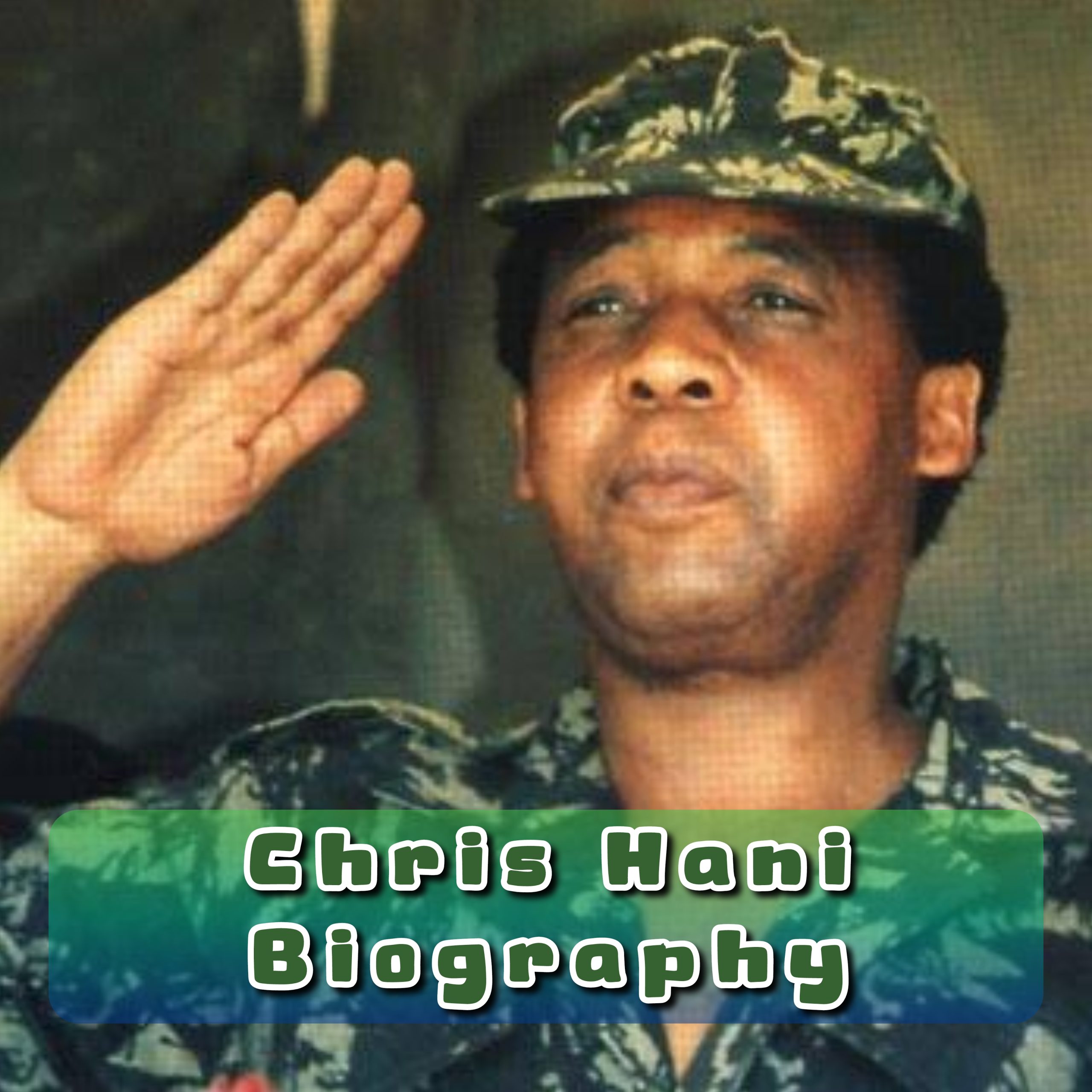
Chris Hani was born Martin Thembisile Hani on 28 June 1942 in Sabalele, a rural village in the Cofimvaba region of the former Transkei, now part of South Africa’s Eastern Cape. He was the son of Gilbert and Mary Hani and grew up in a large family. South African History Online identifies him as the fifth of six children, although some historical records describe the family differently. His father was a migrant worker who had to leave home to find employment, while his mother managed the household and family farm. These early experiences exposed Hani to poverty, racial inequality and the economic difficulties faced by Black South Africans under apartheid.
Hani was raised in a Catholic household and was described as a devout Christian during his childhood. As a young boy, he attended a Roman Catholic school and at one stage wanted to become a priest. His father, however, did not support that career choice and Hani continued his education elsewhere. His childhood was also shaped by the political environment of apartheid. He became increasingly aware of racial discrimination and the inequalities produced by the country’s political and economic system.
His political awareness developed particularly during his school years. In 1954, some of his teachers lost their jobs after protesting against the introduction of Bantu Education, an experience that helped deepen Hani’s understanding of racial discrimination. By the age of 15, he had joined the African National Congress Youth League (ANCYL). His decision was influenced by the arrest of ANC leaders during the 1956 Treason Trial. From that point, political activism increasingly became the central direction of his life.
Chris Hani Education
Chris Hani’s academic progress was remarkable considering the circumstances in which he grew up. He attended Matanzima Secondary School in Cala before moving to Lovedale, one of the Eastern Cape’s prominent mission schools. He reportedly progressed rapidly through school, completing two grades in a single year on more than one occasion. He matriculated from Lovedale in 1958, with subjects including English, Xhosa, Latin, History, Mathematics and Hygiene.
In 1959, Hani enrolled at the University of Fort Hare in Alice, Eastern Cape. Fort Hare was an important intellectual and political centre for Black South Africans, and his time there had a major influence on his political development. He encountered Marxist ideas and developed a deeper understanding of the relationship between racial oppression, economic inequality and political power. Hani later wrote that his exposure to Marxism strengthened his non-racial perspective.
Hani ultimately completed a Bachelor of Arts degree in Latin and English, graduating in 1962 from Rhodes University in Grahamstown, according to the South African Communist Party and South African History Online. After university, he initially intended to pursue law and began articles at the Cape Town law firm Scheffer and Scheffer. He did not complete his legal articles, however, because his political involvement and commitment to the liberation struggle increasingly dominated his life.
Chris Hani Career
Chris Hani’s political career began while he was still a teenager. He joined the ANC Youth League in 1957 and became increasingly active in the liberation movement. In 1961, he joined the South African Communist Party (SACP), and in 1962 he became one of the early volunteers of uMkhonto weSizwe (MK), the armed wing of the ANC. His political activities eventually forced him into exile as apartheid security forces intensified their repression of liberation activists.
Hani received military and political training outside South Africa and became a prominent figure in MK. In 1967, he served as a political commissar during the joint ANC-ZAPU military campaign associated with the Wankie/Sipolilo campaign in present-day Zimbabwe. He later worked in Botswana, Zambia, Lesotho and Mozambique as part of the liberation movement’s underground and military structures. In Lesotho, he played a major role in organising ANC and MK operations before moving to Lusaka in 1982 after several assassination attempts.
Hani rose through the ranks of MK, eventually becoming its Chief of Staff in 1987. He became one of the best-known figures within the ANC’s armed struggle and remained a senior member of the ANC National Executive Committee. In December 1991, he was elected General Secretary of the South African Communist Party, a position he held until his assassination in 1993. During South Africa’s transition away from apartheid, Hani became one of the country’s most prominent political figures.
Chris Hani Personal Life and Family
Chris Hani married Limpho Sekamane, who became known as Limpho Hani, in Lusaka in 1974. Limpho was from Lesotho and was herself affected by the repression of the apartheid-era security authorities. Historical records indicate that she was detained by South African police during the liberation struggle. Her marriage to Hani meant that the family spent significant periods living in exile while Hani continued his political and military activities.
Chris and Limpho Hani had three daughters: Neo Hani, Nomakhwezi Hani and Lindiwe Hani. Neo was born in 1973, Nomakhwezi in 1978 and Lindiwe in 1981, according to the historical timeline documenting Hani’s life. The family’s life was heavily affected by Hani’s political activities, his years in exile and repeated attempts against his life.
By the early 1990s, the Hani family had returned to South Africa as the country entered negotiations to dismantle apartheid. On the morning of 10 April 1993, Hani was accompanied by his 15-year-old daughter Nomakhwezi when he was shot outside their home in Dawn Park, Boksburg. His wife Limpho and daughters Neo and Lindiwe were away from the house at the time.
Chris Hani Death and Cause of Death
Chris Hani died on 10 April 1993, aged 50, after being shot outside his home in Dawn Park, Boksburg, near Johannesburg. His assassination occurred during one of the most politically sensitive periods in South African history, as negotiations to end apartheid were progressing toward democratic elections.
The gunman was Janusz Waluś, a Polish immigrant and anti-communist who was associated with the white right wing. Conservative Party MP Clive Derby-Lewis was also implicated in the assassination. Hani was shot in front of his teenage daughter Nomakhwezi. His death generated widespread shock and heightened fears that political violence could derail South Africa’s transition to democracy.
Hani’s assassination became one of the defining events of the final period of apartheid. Nelson Mandela addressed the nation immediately afterward and appealed for calm and disciplined action, while Hani’s funeral drew enormous public attention. Mandela’s funeral address specifically remembered Hani’s wife, Limpho, his daughters and his wider family.
Chris Hani Age, Religion, Nationality, Height and Physical Appearance
Chris Hani was 50 years old when he died on 10 April 1993. He was born on 28 June 1942 and was a South African national. Hani was raised as a Roman Catholic Christian and was described in historical accounts as a devout Christian during his childhood. His exact height is not reliably documented in authoritative biographical sources, so a specific height should not be presented as fact. Photographs of Hani show a Black South African man with a solid build, closely cropped dark hair and a distinctive moustache, although details of his physical appearance naturally vary across photographs taken at different stages of his life.
Chris Hani Social Media Presence
Chris Hani did not have social-media accounts because he died in 1993, long before Instagram and other modern social-media platforms existed. Consequently, there is no verified official Instagram handle for Chris Hani. Any Instagram account using his name should therefore not automatically be regarded as his personal or official account. Modern posts and commemorative pages about Hani generally focus on his historical contribution, speeches, photographs and remembrance rather than representing personal social-media activity.
Chris Hani Net Worth
There is no reliable historical record establishing Chris Hani’s personal net worth. He was primarily a political activist, liberation movement organiser, military commander and SACP leader rather than a businessperson whose wealth was publicly documented. His career included political and organisational responsibilities within the ANC, MK and SACP, but available authoritative biographies do not provide a verified personal wealth figure.
Because Hani lived much of his adult life in exile and devoted his time to political and military activities, conventional salary information is also limited. Although he later served as General Secretary of the SACP, reliable historical sources do not establish a documented annual salary from which a credible personal net-worth calculation could be made. It would therefore be misleading to attach a precise dollar or rand figure to his wealth.
For SEO purposes, websites may publish estimated “Chris Hani net worth” figures, but such numbers should be treated as speculative unless accompanied by documentary evidence. A responsible biography should state that Chris Hani’s net worth is not publicly verified rather than presenting an invented estimate as fact. His historical significance rests primarily on his political leadership, military role and influence during the anti-apartheid struggle.
Legacy
Chris Hani remains one of the most remembered figures associated with South Africa’s anti-apartheid struggle. His work in the ANC, MK and SACP placed him at the centre of the liberation movement for decades. He rose from a young activist in the Eastern Cape to become Chief of Staff of MK and, later, General Secretary of the SACP.
His assassination also gave his legacy a particular place in South Africa’s transition to democracy. Hani was killed only about a year before South Africa’s first democratic general election in 1994. His death generated widespread mourning and raised fears about escalating political violence, while Nelson Mandela and other leaders publicly called for restraint and continuation of the transition process.
Hani continues to be commemorated through memorial events, educational initiatives, historical research and public monuments. His life is frequently examined in discussions about apartheid, political resistance, the ANC, MK, the SACP and South Africa’s transition to democracy. His name has also been attached to institutions and public places, ensuring that his story remains part of South Africa’s historical memory.
Conclusion
Chris Hani’s biography is the story of a rural Eastern Cape child who became a university graduate, anti-apartheid activist, MK commander and General Secretary of the South African Communist Party. Born Martin Thembisile Hani in 1942, he entered politics as a teenager and spent much of his adult life fighting apartheid through the ANC and its armed wing. His marriage to Limpho Hani and his three daughters formed an important part of his personal life, while his assassination in 1993 placed him permanently within the history of South Africa’s transition to democracy. More than three decades after his death, Chris Hani remains a significant subject of historical study and public remembrance.
Frequently Asked Questions About Chris Hani
Who was Chris Hani?
Chris Hani was a South African anti-apartheid activist, military commander and politician who served as Chief of Staff of uMkhonto weSizwe and General Secretary of the South African Communist Party.
What was Chris Hani’s real name?
Chris Hani’s birth name was Martin Thembisile Hani. “Chris” was adopted as his political name and was reportedly the name of one of his brothers.
When was Chris Hani born?
Chris Hani was born on 28 June 1942 in Sabalele, in the Cofimvaba region of the former Transkei, now in South Africa’s Eastern Cape.
How old was Chris Hani when he died?
Chris Hani was 50 years old when he was assassinated on 10 April 1993.
Who was Chris Hani’s wife?
Chris Hani’s wife was Limpho Hani, formerly Limpho Sekamane. They married in Lusaka in 1974.
Did Chris Hani have children?
Yes. Chris Hani and Limpho Hani had three daughters: Neo, Nomakhwezi and Lindiwe Hani.
Where did Chris Hani study?
Chris Hani studied at Lovedale and later attended the University of Fort Hare and Rhodes University. He graduated with a BA in Latin and English in 1962.
What did Chris Hani do?
Chris Hani was an ANC activist, SACP leader and senior member of uMkhonto weSizwe. He became Chief of Staff of MK in 1987 and General Secretary of the SACP in 1991.
When did Chris Hani die?
Chris Hani died on 10 April 1993 in Boksburg, South Africa.
How did Chris Hani die?
Chris Hani was assassinated by gunshot outside his home in Dawn Park, Boksburg. Janusz Waluś was convicted in connection with the killing, while Clive Derby-Lewis was also implicated.
What was Chris Hani’s religion?
Chris Hani was raised as a Roman Catholic Christian and was described by historical sources as a devout Christian during his childhood.
What was Chris Hani’s height?
Chris Hani’s exact height is not reliably documented in authoritative historical sources, so a specific measurement should not be treated as verified.
What was Chris Hani’s net worth?
There is no reliable publicly documented figure for Chris Hani’s net worth. Available historical sources do not provide sufficient salary or asset information to calculate a trustworthy estimate.
Did Chris Hani have an Instagram account?
No verified personal Instagram account belonged to Chris Hani. He died in 1993, before Instagram existed, so Instagram accounts using his name are not evidence of a personal account.
What is Chris Hani remembered for?
Chris Hani is remembered primarily for his role in the anti-apartheid struggle, his leadership within uMkhonto weSizwe and the SACP, and his assassination during the critical period leading to South Africa’s democratic transition.