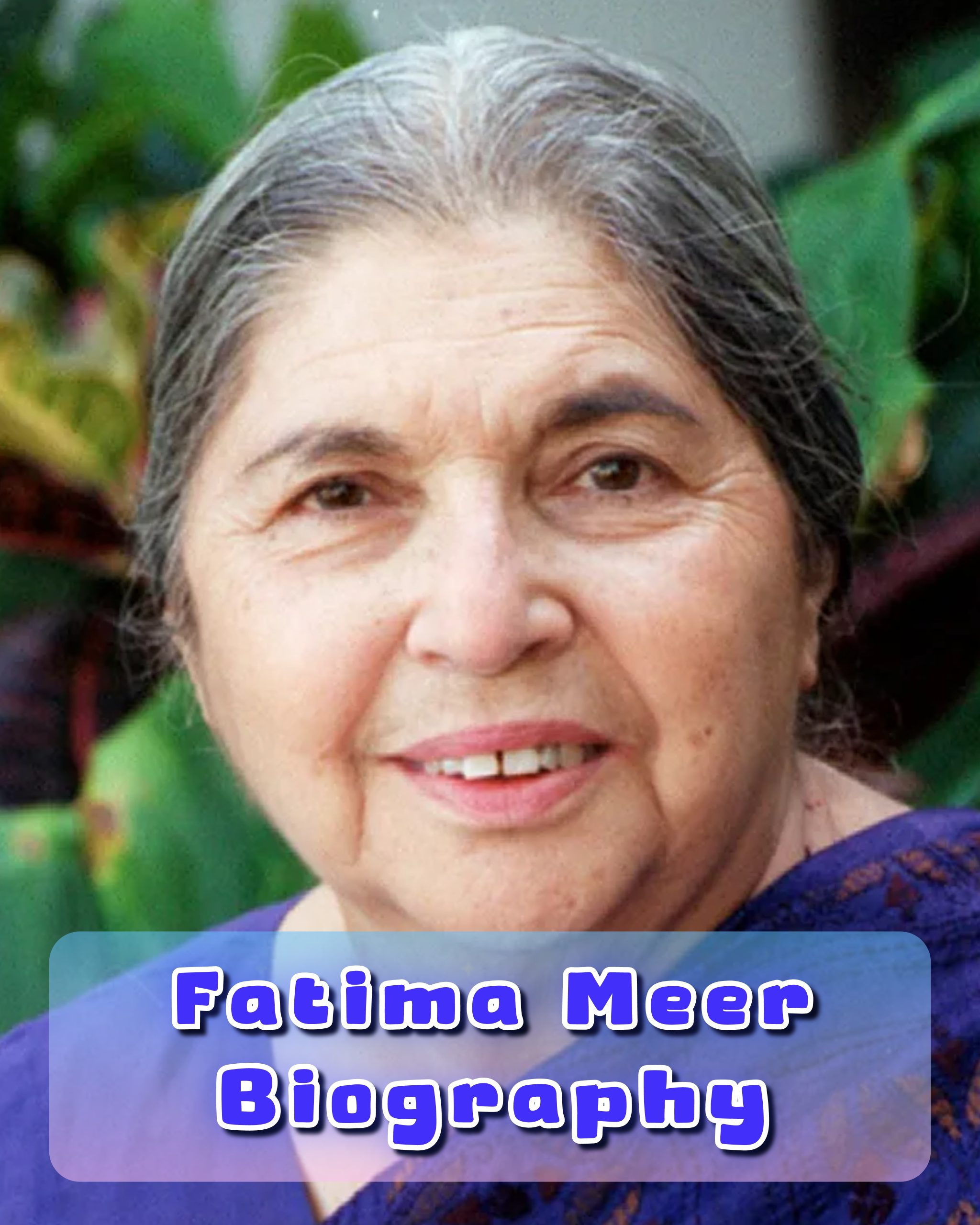
Fatima Meer was born on 12 August 1928 in Grey Street, Durban, South Africa, into a large Muslim family. She was the second of nine children born to Moosa Meer and Rachel Farrel, who later took the Muslim name Amina. Her father, Moosa Meer, was originally from Surat, Gujarat, and was the editor and publisher of Indian Views, a newspaper aimed at the Gujarati-speaking Muslim community of Southern Africa. Her mother was of Jewish and Portuguese ancestry and had converted to Islam.
Growing up in Durban exposed Meer to racial discrimination and political inequality from an early age. Her father’s commitment to education, journalism, religious tolerance and opposition to racial discrimination had a major influence on her development. Meer also worked in her family’s newspaper as a young girl, giving her early experience with writing, communication and public affairs.
Meer became politically active while still a teenager. In 1944, at about 16 years old, she helped raise £1,000 for famine relief in Bengal. Two years later, during the 1946 Indian Passive Resistance Campaign, she established the Student Passive Resistance Committee while still in high school. Her involvement brought her into wider political activism and helped establish her as a prominent young voice against racial discrimination in South Africa.
Fatima Meer Education
Fatima Meer attended Durban Indian Girls’ High School, where she distinguished herself academically and became involved in political activism. Her secondary-school years were particularly important because they coincided with her first major involvement in organized resistance against discriminatory legislation affecting South Africa’s Indian community.
After high school, Meer continued her studies at university, including a period at the University of the Witwatersrand. She subsequently attended the University of Natal, now the University of KwaZulu-Natal, where she studied sociology. Her academic development was significant because university education remained relatively inaccessible to many Black South Africans during the apartheid era.
Meer earned both a Bachelor’s degree and a Master’s degree in Sociology from the University of Natal. Her academic training became the foundation for her later career as a sociologist, lecturer, researcher, writer and social activist. UKZN describes her as the first Black woman appointed to teach sociology at a designated White South African university.
Fatima Meer Career
Fatima Meer’s career combined academia, sociology, writing, publishing, education and human-rights activism. In 1956, she joined the staff of the University of Natal as a sociology lecturer and remained associated with the institution until 1988. Her appointment was historically significant because she became the first Black woman lecturer at a White South African university.
Beyond the university, Meer founded or participated in numerous educational and community-development initiatives. In 1972, she became a founding member of the Institute for Black Research, which combined research, publishing and educational outreach. She also founded the Natal Education Trust, which helped raise funds to build schools in African townships, and established educational projects including the Tembalishe Tutorial College.
Meer was also a prolific author and publisher, producing or contributing to more than 40 books. Among her best-known works was Higher Than Hope, her authorized biography of Nelson Mandela. Her writings dealt with apartheid, race, social inequality, women’s rights, education and South African society. Her academic and political work earned her numerous awards and international recognition.
Her activism resulted in repeated government restrictions and detention. She was banned from public activities, detained without trial in 1976 and spent part of that detention in solitary confinement. After her release, she and her family survived an assassination attempt. Despite these pressures, Meer continued her educational, social and political work for decades.
Fatima Meer Personal Life and Family
Fatima Meer married Ismail Chota Meer in 1951. Ismail Meer was a prominent lawyer and anti-apartheid activist who was also involved in South Africa’s liberation movement. Their marriage combined family life with political activism, and the couple became closely associated with the struggle against apartheid.
Fatima and Ismail Meer had three children: Shamin, Shehnaz and Rashid Meer. Their son Rashid died in a car accident in 1995, a devastating loss for the family. Ismail Meer died in 2000 after decades of activism and public service.
Meer also maintained close relationships with several prominent figures in the anti-apartheid movement. She had a longstanding friendship with Nelson Mandela and his family and worked closely with Winnie Madikizela-Mandela, including during their involvement in the Black Women’s Federation. Winnie Mandela later described Meer as a close friend, sister and adviser.
Fatima Meer Death and Cause of Death
Fatima Meer died in Durban, South Africa, on 12 March 2010, according to South African History Online’s current biography record. She was 81 years old. She was buried at Brooke Street Cemetery in Durban.
South African History Online’s timeline records that Meer died at St Augustine’s Hospital following a stroke she had suffered approximately two weeks earlier. Some secondary institutional accounts give 13 March as the date of death, but the current South African History Online biography record lists 12 March 2010.
Fatima Meer Age, Religion, Nationality, Height and Physical Appearance
Fatima Meer was 81 years old when she died in 2010. She was a South African national and a committed Muslim whose faith was an important part of her worldview and humanitarian work. Biographical accounts describe her as short and petite, but also as an energetic and commanding public speaker. A precise, reliably documented height in centimetres or feet is not available in the major biographical sources, so a specific numerical height should not be presented as fact.
Fatima Meer Social Media Presence
Fatima Meer died in 2010, before Instagram became a major social-media platform, so she did not have a verified personal Instagram account. There is therefore no authoritative Instagram handle that can responsibly be attributed to her. Modern social-media pages or accounts using her name should not automatically be treated as official. Her work is instead preserved through institutions such as South African History Online and the University of KwaZulu-Natal, which continue to publish material and organize memorial events relating to her life and legacy.
Fatima Meer Net Worth
There is no reliable publicly documented figure for Fatima Meer’s personal net worth. Unlike contemporary entertainers or business personalities, Meer was primarily an academic, author, publisher and activist, and reputable biographical sources do not provide a verified wealth figure.
Her professional income would have included earnings from her academic career at the University of Natal, as well as possible income associated with writing, publishing and other professional activities. However, surviving sources do not provide sufficiently reliable salary records that would allow her lifetime earnings to be calculated accurately.
For SEO purposes, websites sometimes publish numerical net-worth estimates for historical figures, but those figures should be treated cautiously unless supported by documentary evidence. A responsible biography should therefore state that Fatima Meer’s exact net worth is unknown and was not publicly established rather than presenting an unsupported number as fact.
Legacy
Fatima Meer’s legacy is closely connected with the struggle against apartheid, social justice, education and human rights in South Africa. She was a scholar and activist who used sociology, writing and education as tools for challenging racial inequality. Her career at the University of Natal and her extensive publishing work established her as an important intellectual voice.
Her contribution also extended beyond academic institutions. Through organizations such as the Institute for Black Research, Natal Education Trust and various community initiatives, Meer worked to expand educational opportunities and support disadvantaged communities. She was also involved in women’s organizations and campaigns addressing racial discrimination and social inequality.
Her influence remains visible through continuing academic and public commemorations. The University of KwaZulu-Natal has held the Professor Fatima Meer Memorial Lecture, using her life and work as a basis for discussions about social justice and contemporary societal issues. Her books, activism and educational initiatives continue to provide material for researchers and students studying apartheid, gender, sociology and South African history.
Conclusion
Fatima Meer was a South African sociologist, author, educator and anti-apartheid activist whose life brought together scholarship, faith, family and public service. From her teenage activism in Durban to her academic career at the University of Natal, her work with disadvantaged communities and her extensive writing, she remained involved in the struggle against racial inequality throughout her life. Although she died in 2010 at the age of 81, her contribution to South African education, human rights, women’s activism and social justice continues to be remembered through her writings, institutions and memorial programs.
Frequently Asked Questions About Fatima Meer
Who was Fatima Meer?
Fatima Meer was a South African sociologist, academic, author, publisher and anti-apartheid activist. She was also a prominent advocate for human rights, education, women’s rights and social justice.
When was Fatima Meer born?
Fatima Meer was born on 12 August 1928 in Grey Street, Durban, South Africa.
How old was Fatima Meer when she died?
Fatima Meer was 81 years old when she died in March 2010.
When did Fatima Meer die?
Fatima Meer died on 12 March 2010 in Durban, South Africa.
What was Fatima Meer’s cause of death?
Fatima Meer died following a stroke. South African History Online’s timeline states that she died at St Augustine’s Hospital after suffering the stroke about two weeks earlier.
Who was Fatima Meer’s husband?
Fatima Meer’s husband was Ismail Chota Meer, a lawyer and anti-apartheid activist. They married in 1951.
How many children did Fatima Meer have?
Fatima Meer and Ismail Meer had three children: Shamin, Shehnaz and Rashid. Their son Rashid died in a car accident in 1995.
What did Fatima Meer study?
Fatima Meer studied sociology and earned both bachelor’s and master’s degrees at the University of Natal, now the University of KwaZulu-Natal.
Where did Fatima Meer work?
Fatima Meer worked at the University of Natal from 1956 to 1988, where she taught sociology. She was the first Black woman appointed to a teaching position at a White South African university.
What books did Fatima Meer write?
Fatima Meer produced or contributed to more than 40 books. One of her most famous works was Higher Than Hope, an authorized biography of Nelson Mandela.
What religion was Fatima Meer?
Fatima Meer was Muslim. Her Islamic faith was an important part of her personal worldview and her commitment to social justice and humanitarian work.
What was Fatima Meer’s nationality?
Fatima Meer was South African. She was born in Durban and spent most of her life working in South Africa.
Did Fatima Meer have an Instagram account?
No verified personal Instagram account belonging to Fatima Meer is documented. She died in 2010, before Instagram became widely used, so social-media accounts currently using her name should not automatically be considered official.
What was Fatima Meer’s net worth?
Fatima Meer’s exact net worth is not publicly known. Reliable biographical sources do not provide a verified personal wealth figure, making specific online estimates difficult to substantiate.