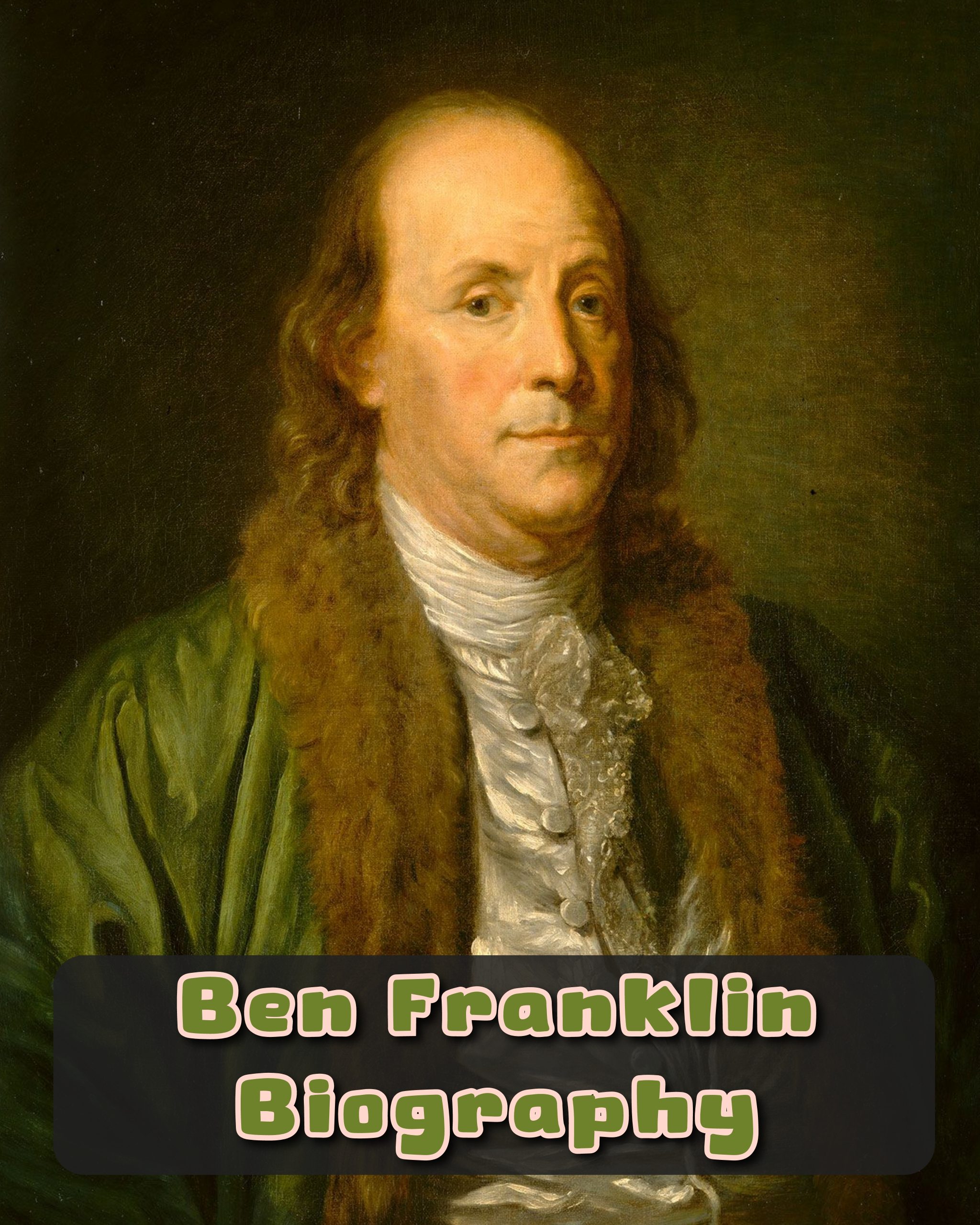
Benjamin Franklin was born on January 17, 1706, in Boston, Massachusetts, then part of the Massachusetts Bay Colony. He was the son of Josiah Franklin, a candle and soap maker, and Abiah Folger Franklin. Franklin grew up in a large family and was raised in a religious household influenced by the Puritan tradition. His parents initially hoped that he might enter the ministry, but his extraordinary curiosity and love of reading eventually pushed him toward a very different path.
Franklin showed an interest in reading and writing from an early age. His formal schooling was limited, and as a boy he was eventually removed from school to help his father. At the age of 12, he became an apprentice to his older brother James Franklin, a printer. This experience introduced him to the world of newspapers, books, political debate and publishing and became one of the most important foundations of his future career.
As a teenager, Franklin became increasingly independent and ambitious. In 1723, at the age of 17, he left Boston and traveled to Philadelphia, where he found work as a journeyman printer. His move to Philadelphia marked a major turning point in his life. Within several years, he had established himself as a printer and publisher, eventually becoming one of the most influential intellectual and civic figures in colonial America.
Benjamin Franklin Education
Benjamin Franklin did not receive the kind of extensive university education associated with many prominent intellectuals of his era. His formal education was relatively brief, and much of his intellectual development came through self-education. The Library of Congress describes him as a man with little formal education who nevertheless went on to establish scholarly societies, libraries and educational institutions.
Franklin’s apprenticeship under his brother James became an important part of his practical education. Working in a printing shop exposed him to books, newspapers, political arguments and philosophical ideas. He also became an enthusiastic reader and developed his writing skills through constant practice. While working in London as a young man, he published his first pamphlet, A Dissertation on Liberty and Necessity, Pleasure and Pain, in 1725.
His education continued throughout adulthood through experimentation, correspondence, reading and participation in intellectual societies. Franklin helped establish the Library Company of Philadelphia and played an important role in the development of what became the University of Pennsylvania. His life became a powerful example of self-directed learning, practical education and intellectual curiosity.
Benjamin Franklin Career
Benjamin Franklin had one of the most varied careers of any American historical figure. He first became successful as a printer and publisher, eventually acquiring the Pennsylvania Gazette. In 1732, he began publishing Poor Richard’s Almanack under the pseudonym Richard Saunders. The publication became extremely popular and profitable, selling thousands of copies annually and spreading Franklin’s practical advice, humor and observations throughout the colonies.
Franklin was also a scientist and inventor. His investigations into electricity made him internationally famous, particularly his experiments involving lightning and electrical charge. He became associated with inventions and innovations such as the lightning rod, bifocal glasses and the Pennsylvania fireplace or Franklin stove. His scientific reputation eventually earned him recognition in Britain and other parts of Europe.
His political and diplomatic career became equally important. Franklin served as a colonial representative in London and later became one of the leading American diplomats in Europe. He returned to America in 1775 and served in the Continental Congress, where he participated in the drafting and signing of the Declaration of Independence. He later served as a diplomat in France and played a crucial role in securing French support for the American Revolution and negotiating the Treaty of Paris that ended the Revolutionary War. He also participated in the Constitutional Convention and signed the United States Constitution in 1787.
Benjamin Franklin Personal Life and Family
Benjamin Franklin married Deborah Read in 1730. Their relationship had begun years earlier, and Deborah became his wife and an important part of his private life. Franklin and Deborah remained married until her death in 1774. Franklin was frequently away from Philadelphia for long periods because of his political and diplomatic responsibilities, particularly during his years in London and France.
Franklin’s family included his son William Franklin, who became the last colonial governor of New Jersey. William’s political allegiance created a painful division between father and son during the American Revolution. While Benjamin supported American independence, William remained loyal to Britain. Their disagreement became one of the most dramatic personal conflicts in Franklin’s life. Franklin also had a son, Francis Folger Franklin, who died in childhood, and a daughter, Sarah Franklin Bache, who survived him and became an important member of Philadelphia society.
Franklin’s daughter Sarah, often called Sally, married Richard Bache. Franklin remained closely connected with his daughter and her family during his later years. He also had a wide circle of friends, intellectual associates and political colleagues, including figures such as George Washington, John Adams and Thomas Jefferson. His family relationships, friendships and correspondence provide historians with important insights into the private side of one of America’s most public figures.
Benjamin Franklin Death and Cause of Death
Benjamin Franklin died on April 17, 1790, in Philadelphia, Pennsylvania, at the age of 84. He was buried at Christ Church Burial Ground in Philadelphia, where he rests beside his wife, Deborah. The Franklin Institute identifies complications from pleurisy as the cause of death. Historical accounts also describe a serious lung infection and empyema associated with his final illness.
Franklin’s final illness reportedly involved fever, chest pain, coughing and difficulty breathing. An abscess developed in his lungs during the final days of his life. Despite his declining health, Franklin remained an intellectually active figure almost until the end of his life.
His death occurred only a few years after the adoption of the United States Constitution. Franklin therefore lived long enough to witness the American Revolution, independence, the creation of the new American government and the adoption of the Constitution.
Benjamin Franklin Age, Religion, Nationality, Height and Physical Appearance
Benjamin Franklin was 84 years old when he died in 1790. He was born in Boston and became an American statesman after the American Revolution; the Franklin Institute notes that he was born an Englishman and died an American. Franklin was raised in a Puritan religious environment but later became associated with Deism, although historians continue to debate the precise development and character of his religious beliefs. He believed in God and placed strong emphasis on morality, virtue and good works, while rejecting important elements of orthodox Christian doctrine.
Franklin’s height is commonly reported as approximately 5 feet 9 inches (1.75 metres), although precise measurements from his lifetime are not as firmly documented as modern biographical statistics. Portraits and descriptions portray him as a solidly built man with a distinctive appearance, particularly in his later years when he became famous for wearing spectacles and a fur cap. His recognizable image eventually became one of the most famous portraits associated with the American Founding Fathers.
Legacy
Benjamin Franklin’s legacy is exceptionally broad because he succeeded in several different fields rather than becoming famous for only one achievement. He is remembered as a printer, writer, inventor, scientist, diplomat, statesman, civic organizer and Founding Father. His career demonstrated how scientific curiosity, practical problem-solving and public service could be combined in one life.
Franklin’s Autobiography also became one of the most influential works of American literature. Written over several decades and left unfinished, it became an enduring account of self-improvement, work, ambition and civic participation. The Library of Congress describes it as an important historical document and one of the most enduringly popular examples of the autobiography genre.
His political and civic legacy remains particularly significant. Franklin helped create institutions that promoted education, science, communication and public welfare, while his diplomatic work helped secure the international support that was crucial to the American Revolution. His contributions are being revisited during the 2026 250th anniversary period of American independence, making Franklin’s life and ideas especially relevant to contemporary discussions of the nation’s founding and democratic tradition.
Conclusion
Benjamin Franklin’s life represents an extraordinary journey from a modest childhood in Boston to international prominence as a printer, scientist, inventor, diplomat and Founding Father of the United States. Despite having limited formal education, he became one of the leading intellectual figures of the eighteenth century through self-directed learning, experimentation and public service. His marriage to Deborah Read, complicated relationship with his son William, scientific discoveries, diplomatic achievements and contributions to American independence all form important parts of his story. More than two centuries after his death, Franklin remains a defining figure in American history, and his ideas about education, civic responsibility, innovation and self-improvement continue to influence generations.
Frequently Asked Questions About Benjamin Franklin
Who was Benjamin Franklin?
Benjamin Franklin was an American printer, writer, scientist, inventor, diplomat and statesman who became one of the Founding Fathers of the United States. He helped draft and sign the Declaration of Independence, represented the United States in France and participated in the Constitutional Convention.
When was Benjamin Franklin born?
Benjamin Franklin was born on January 17, 1706, in Boston, Massachusetts Bay Colony.
How old was Benjamin Franklin when he died?
Benjamin Franklin was 84 years old when he died on April 17, 1790.
Who was Benjamin Franklin’s wife?
Benjamin Franklin’s wife was Deborah Read. They married in 1730 and remained married until Deborah’s death in 1774.
How many children did Benjamin Franklin have?
Benjamin Franklin’s family included William Franklin, Francis Folger Franklin and Sarah Franklin Bache. Francis died as a child, while William and Sarah survived into adulthood.
What was Benjamin Franklin’s religion?
Benjamin Franklin was raised in a Puritan religious environment but later identified with Deism. His religious beliefs were complex, and historians continue to debate how his views developed throughout his life.
What was Benjamin Franklin famous for?
Benjamin Franklin was famous for his work as a Founding Father, scientist, inventor, printer, writer, diplomat and statesman. He is particularly remembered for his experiments with electricity, the lightning rod, Poor Richard’s Almanack, his diplomatic work in France and his contributions to the American Revolution.
Did Benjamin Franklin go to college?
Benjamin Franklin did not attend college. He had limited formal schooling and became largely self-educated through reading, writing, scientific experimentation and intellectual associations.
What was Benjamin Franklin’s cause of death?
Benjamin Franklin died from complications associated with pleurisy. Historical accounts also describe empyema and a serious lung infection during his final illness.
How tall was Benjamin Franklin?
Benjamin Franklin is commonly reported to have been approximately 5 feet 9 inches (1.75 metres) tall, although precise historical measurements are less certain than modern biographical records.
What was Benjamin Franklin’s net worth?
There is no reliable modern equivalent of Benjamin Franklin’s net worth. He accumulated substantial wealth through printing, publishing, investments and public service, but historical estimates cannot be converted reliably into a modern celebrity-style net-worth figure. A responsible biography should therefore avoid presenting an unsupported exact dollar amount.
Where is Benjamin Franklin buried?
Benjamin Franklin is buried at Christ Church Burial Ground in Philadelphia, Pennsylvania, beside his wife, Deborah.
Why is Benjamin Franklin still important today?
Benjamin Franklin remains important because his influence spans science, journalism, education, civic institutions, diplomacy and the founding of the United States. His Autobiography and ideas about self-improvement have also had a lasting influence on American culture.