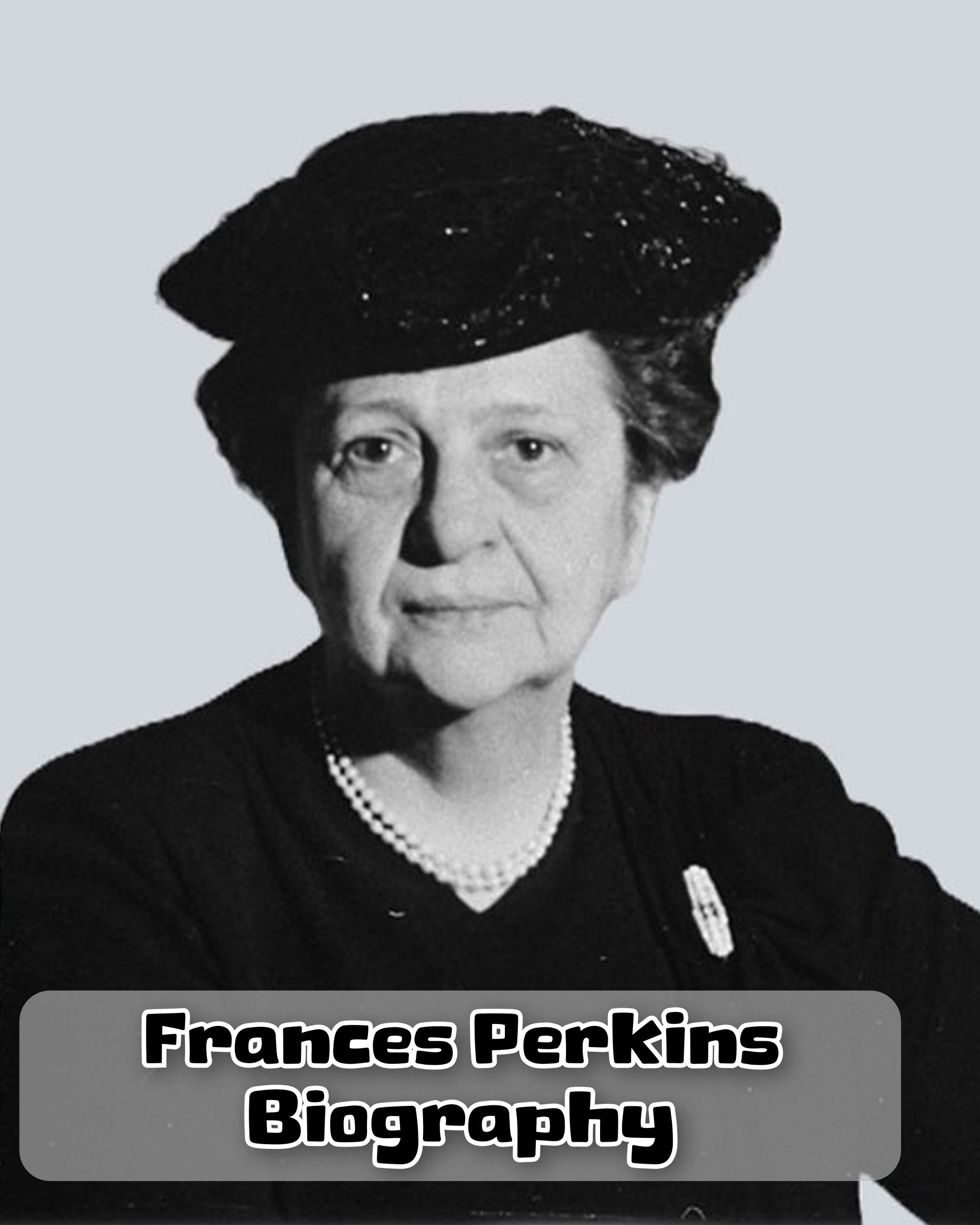
Frances Coralie Perkins was born Fannie Coralie Perkins on April 10, 1880, in Boston, Massachusetts. She was the daughter of Frederick William Perkins and Susan E. Bean Perkins. Although she was born in Boston, her family had deep roots in Maine. Her father came from Newcastle, Maine, while her mother had roots in Bethel. In 1882, Frederick moved the family to Worcester, Massachusetts, where he established a stationery and paper-goods business. Frances nevertheless remained closely connected to Maine and spent many childhood summers at her grandmother’s family homestead in Newcastle, a place she later regarded as her “true home.”
Perkins grew up in a relatively strict and conservative household alongside her younger sister, Ethel. Her father placed considerable emphasis on education and introduced his daughters to classical literature and even Greek grammar at a young age. Her childhood experiences also exposed her to the sharp contrast between comfortable middle-class life and poverty. When she encountered poor children at school, she became curious about why poverty existed, an early question that eventually developed into her lifelong commitment to social reform and workers’ rights.
Her formative years in Worcester helped develop the independence that later characterized her public career. At a time when women were generally expected to become wives and homemakers rather than pursue ambitious professional careers, Perkins pursued higher education and eventually entered social reform. Her experiences at school, in settlement houses and among working-class communities convinced her that government had a responsibility to protect vulnerable people from dangerous working conditions and extreme poverty.
Frances Perkins Education
Frances Perkins attended Worcester Classical High School, where she completed a college-preparatory education. Her father’s encouragement was particularly important because advanced education for women was still relatively unusual during her youth. After graduating, she enrolled at Mount Holyoke College in South Hadley, Massachusetts, in 1898.
At Mount Holyoke, Perkins studied physics, with minors in chemistry and biology, and graduated in 1902. She was active in student life and eventually became president of her class. One of the most influential experiences of her college years was studying American economic history and learning about the conditions faced by industrial workers. She also became acquainted with reform ideas that would eventually redirect her professional ambitions toward social and economic policy.
After college, Perkins continued her education while working in social reform. She studied sociology and economics at the University of Pennsylvania’s Wharton School and later attended the New York School of Philanthropy. She subsequently studied at Columbia University, earning a master’s degree in economics and sociology. Her combination of scientific education, economics, sociology and practical social-work experience gave her an unusually broad foundation for a future government policymaker.
Frances Perkins Career
Frances Perkins began her working life as a teacher but increasingly turned toward social reform. While living in Chicago, she worked with settlement organizations including Hull House, associated with Jane Addams, and Chicago Commons, where she encountered poverty, unemployment and difficult living conditions firsthand. In 1907, she moved to Philadelphia to become general secretary of the Philadelphia Research and Protective Association, an organization concerned with protecting vulnerable immigrant women and girls.
In 1910, Perkins became executive secretary of the New York Consumers League, where she campaigned for better working conditions, shorter working hours and stronger health and safety regulations. Her career changed dramatically after she witnessed the Triangle Shirtwaist Factory fire on March 25, 1911, in which 146 people died, many of them young immigrant women. The tragedy strengthened her determination to make workplace safety a government responsibility.
Perkins subsequently held important positions in New York government and became closely associated with Franklin D. Roosevelt. When Roosevelt was governor of New York, Perkins served as New York State Industrial Commissioner, helping develop labor and social-welfare policies. In 1933, after Roosevelt became president, he selected Perkins as U.S. Secretary of Labor. She became the first woman ever to serve in a U.S. presidential Cabinet and remained in the position throughout Roosevelt’s presidency from 1933 to 1945.
As Labor Secretary, Perkins became one of the most important architects of the New Deal. She played a major role in the development and implementation of the Social Security Act of 1935, unemployment insurance, minimum-wage protections, maximum-hour legislation and child-labor restrictions. She also helped shape federal labor policy during the Great Depression and World War II. Her 12-year tenure remains the longest of any U.S. Secretary of Labor.
After leaving the Cabinet in 1945, Perkins served on the U.S. Civil Service Commission during the Truman administration from 1946 to 1952. She later became a lecturer and professor at Cornell University’s School of Industrial and Labor Relations. She also wrote The Roosevelt I Knew, a bestselling 1946 book about Franklin D. Roosevelt and their years working together.
Frances Perkins Personal Life and Family
Frances Perkins married Paul Caldwell Wilson on September 26, 1913. Wilson was a New York political figure and civil servant. Perkins made the unusual decision to retain her own surname after marriage, becoming known publicly as Frances Perkins rather than Mrs. Wilson. Her decision reflected her strong sense of professional identity and independence. Historical records also document that she defended her right to retain her maiden name.
Perkins and Wilson had one surviving child, their daughter Susanna Perkins Wilson, born on December 30, 1916. Perkins’ family responsibilities were complicated by Wilson’s deteriorating mental health after Susanna’s birth. He experienced serious mental-health difficulties and spent periods in institutions, leaving Perkins to carry much of the responsibility for the household while she pursued an extraordinarily demanding public career.
Perkins’ relationship with Susanna was complicated over the years, although she remained an important part of her grandson Tomlin’s life. Paul Wilson died following a stroke on December 31, 1952. Frances Perkins continued working and teaching after leaving federal government and remained connected to her family’s Maine roots until her death in 1965.
Frances Perkins Age, Religion, Nationality, Height and Physical Appearance
Frances Perkins was 85 years old when she died on May 14, 1965, in New York City. She was an American citizen and was born in Boston, Massachusetts. Perkins was raised in the Congregational tradition but converted to the Episcopal Church in 1905 and remained a committed Episcopalian for the rest of her life. The Episcopal Church formally recognized her in 2009 as a notable saint and designated May 13 as her feast day as a “Public Servant and Prophetic Witness.”
There is no reliable historical source establishing Frances Perkins’ exact height, so a precise height should not be stated as fact. Contemporary descriptions portray her as a relatively small, composed woman with dark eyes, a pointed chin and distinctive high cheekbones. She was also famous for her conservative clothing and characteristic felt tricorn hat, which became closely associated with her public image.
Frances Perkins Social Media Presence
Frances Perkins did not have social-media accounts because she died in 1965, decades before platforms such as Instagram existed. Therefore, there is no authentic personal Instagram handle for Frances Perkins and it would be misleading to assign one to her.
However, her historical work is actively promoted online by the Frances Perkins Center, which maintains educational resources about her life and legacy. The Center’s Instagram account is @francesperkinscenter, and it has been used to share information about Perkins and the preservation of her historical legacy.
Frances Perkins Net Worth
There is no credible historical record of Frances Perkins’ personal net worth at the time of her death. Modern celebrity-style websites sometimes assign numerical net-worth estimates to historical figures, but those figures are generally speculative and should not be presented as documented facts.
Perkins’ income came primarily from public service and later academic work rather than from private business ownership or entertainment. Before becoming Secretary of Labor, she earned a $12,000 annual salary as New York State Industrial Commissioner in 1932. Contemporary reporting also indicated that the federal Cabinet position paid approximately what she had been earning in New York.
Because there is no reliable record of her assets, investments, property holdings and liabilities at the time of her death, a responsible biography should describe her net worth as unknown rather than inventing a dollar figure. Her historical importance came from her public service and policy achievements rather than personal wealth.
Legacy
Frances Perkins’ most enduring legacy is her contribution to the development of the American social safety net. As Roosevelt’s Labor Secretary, she helped shape policies that became central to the New Deal, particularly Social Security, unemployment insurance, minimum-wage protections, shorter working hours and child-labor restrictions. These policies transformed the federal government’s role in protecting workers and families.
Her achievement as the first woman to serve in a U.S. presidential Cabinet was equally historic. Perkins demonstrated that a woman could occupy one of the highest positions in the federal government while directly influencing national economic and labor policy. Her career helped establish a precedent for generations of women entering American government and public administration.
Her legacy continues to receive institutional recognition. The Frances Perkins Homestead in Newcastle, Maine, became the Frances Perkins National Monument in 2024, while in March 2026 she was inducted into the Maine Women’s Hall of Fame. Her name also lives on through the Frances Perkins Building, the headquarters of the U.S. Department of Labor. These honors demonstrate the continuing significance of her contributions to workers, women and American social policy.
Frances Perkins’ Death and Cause of Death
Frances Perkins died on May 14, 1965, in New York City, at the age of 85. She was buried in Newcastle, Maine, near the family homestead that had remained an important part of her life.
Reliable historical sources confirm her date and place of death, but they do not provide a sufficiently authoritative account of a specific immediate medical cause to justify stating one as fact. For that reason, the safest biographical wording is that Perkins died in New York City at age 85.
Conclusion
Frances Perkins remains one of the most influential women in American political and labor history. From her childhood in Massachusetts and Maine to her education at Mount Holyoke and Columbia, she developed a lifelong commitment to social justice and workers’ rights. Her service as Franklin D. Roosevelt’s Labor Secretary made her the first woman in a U.S. presidential Cabinet and placed her at the center of the New Deal’s transformation of American labor and social policy. Although no reliable modern figure can establish her personal net worth or exact height, her historical value is far easier to measure: her influence can be seen in Social Security, labor protections and the expanded role of government in protecting working people. Her 2026 induction into the Maine Women’s Hall of Fame further demonstrates that Frances Perkins’ legacy, career, education, family story, faith and pioneering role in American government continue to attract historical interest more than six decades after her death.
Frequently Asked Questions About Frances Perkins
Who was Frances Perkins?
Frances Perkins was an American social reformer and politician who served as U.S. Secretary of Labor from 1933 to 1945 under President Franklin D. Roosevelt. She was the first woman to serve in a U.S. presidential Cabinet.
When was Frances Perkins born?
Frances Perkins was born on April 10, 1880, in Boston, Massachusetts.
How old was Frances Perkins when she died?
Frances Perkins was 85 years old when she died on May 14, 1965, in New York City.
Who was Frances Perkins’ husband?
Frances Perkins’ husband was Paul Caldwell Wilson, whom she married in 1913. She kept the surname Perkins after their marriage.
Did Frances Perkins have children?
Yes. Frances Perkins and Paul Wilson had one surviving daughter, Susanna Perkins Wilson, born in December 1916.
What did Frances Perkins study?
Frances Perkins studied physics at Mount Holyoke College, with minors in chemistry and biology. She later studied sociology and economics and earned a master’s degree from Columbia University.
What was Frances Perkins famous for?
Frances Perkins was famous for becoming the first woman in a U.S. presidential Cabinet and for helping develop major New Deal policies, including Social Security, unemployment insurance, labor protections and minimum-wage legislation.
Was Frances Perkins religious?
Yes. Frances Perkins was a committed Episcopalian. She converted from Congregationalism to the Episcopal Church in 1905, and the Episcopal Church later recognized her as a notable saint and public servant.
What was Frances Perkins’ net worth?
Frances Perkins’ exact net worth is unknown because reliable historical records do not provide a complete accounting of her personal wealth. Her documented income came primarily from government service and later academic work.
How tall was Frances Perkins?
Frances Perkins’ exact height has not been reliably documented in authoritative historical sources, so a precise height should not be given as fact.
Does Frances Perkins have an Instagram account?
No. Frances Perkins died in 1965 and therefore did not have a personal Instagram account. The Frances Perkins Center maintains the Instagram account @francesperkinscenter to promote her history and legacy.
What is Frances Perkins’ legacy?
Frances Perkins is remembered as a pioneering woman in American government and a principal architect of New Deal labor and social-welfare policies. Her work helped shape Social Security, unemployment insurance, workplace protections and federal labor standards.
What recent honor did Frances Perkins receive?
In March 2026, Frances Perkins was inducted into the Maine Women’s Hall of Fame, recognizing her lasting contributions to Maine women, American workers and public service.
What is the Frances Perkins National Monument?
The Frances Perkins National Monument in Newcastle, Maine, preserves the family homestead that played an important role in Perkins’ life and legacy. The monument was established in 2024.
What book did Frances Perkins write about Franklin D. Roosevelt?
Frances Perkins wrote The Roosevelt I Knew, a bestselling 1946 book about Franklin D. Roosevelt and their years working together in New York and Washington.
What was Frances Perkins’ greatest achievement?
One of Frances Perkins’ greatest achievements was helping establish the Social Security system and other New Deal labor protections while serving as Secretary of Labor under Franklin D. Roosevelt.
What happened to Frances Perkins’ family after her death?
Frances Perkins’ husband, Paul Caldwell Wilson, died in 1952. Her daughter, Susanna Perkins Wilson, survived her, and Perkins remained connected to her grandson Tomlin until her death in 1965.