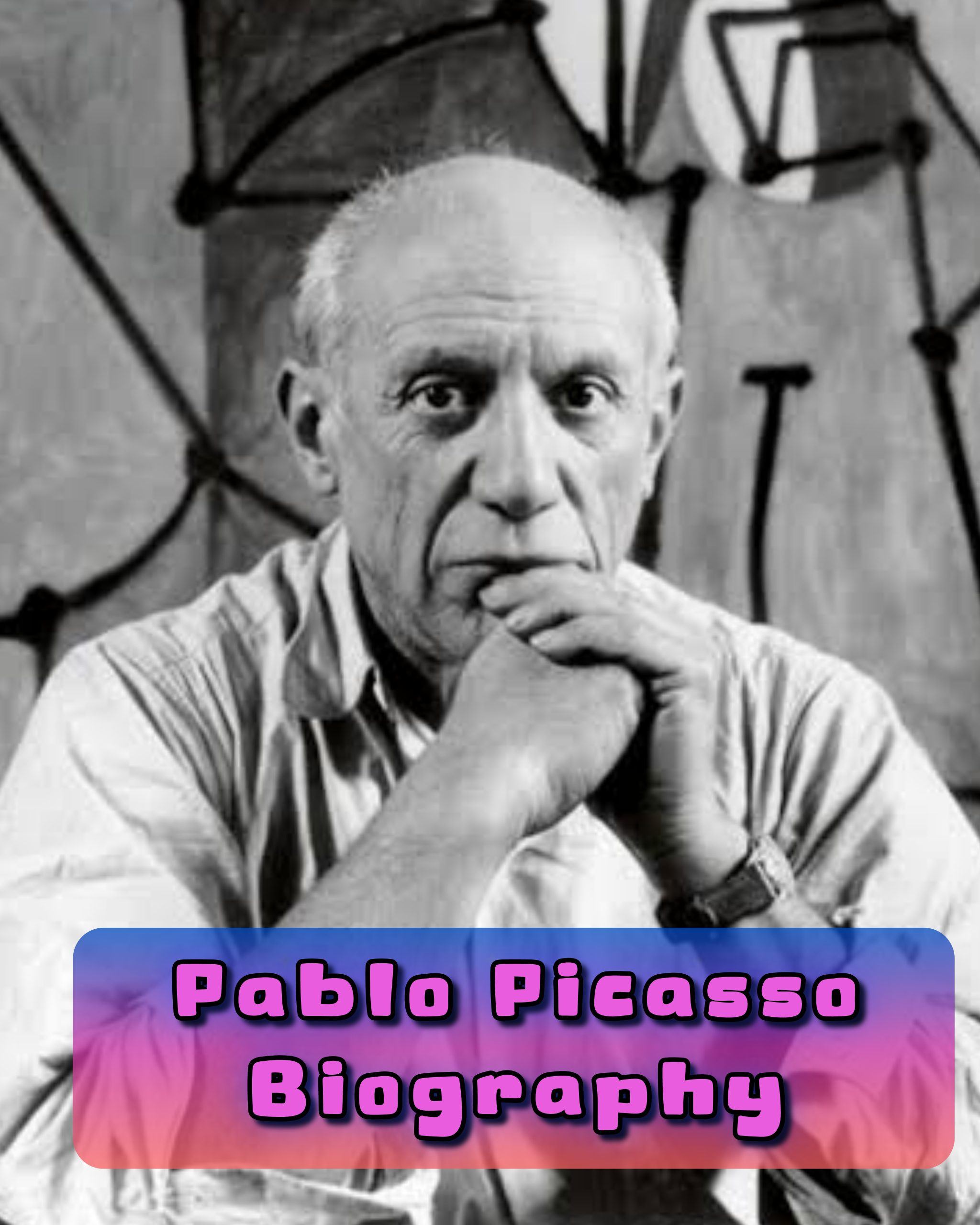
Pablo Ruiz Picasso was born on October 25, 1881, in Málaga, Spain, to José Ruiz Blasco and María Picasso y López. His father, commonly known as Don José or Pepe, was a painter, drawing teacher and curator of Málaga’s municipal museum, while his mother was a housewife who was very close to her children. Growing up in an artistic household had a profound influence on Picasso, who was exposed to drawing, painting and museums from an exceptionally young age. The Musée Picasso Paris records that his father regularly took him to the museum and encouraged his interest in art.
Picasso spent his early childhood between Málaga and La Coruña after his father accepted a teaching position in northern Spain. Although he was not particularly interested in conventional schooling, he was fascinated by drawing and spent much of his time creating pictures. His father recognized his unusual talent and began guiding his artistic development. By the age of eight, Picasso had painted The Little Yellow Picador, an early work that already demonstrated his remarkable ability to compose figures and scenes. He also developed an early fascination with pigeons and bullfighting.
A significant childhood tragedy occurred in 1895 when Picasso’s younger sister, Concepción, known as Conchita, died from diphtheria at the age of seven. The loss deeply affected him and later influenced some of his artistic and emotional development. That same year, the family moved to Barcelona after José Ruiz Blasco received a teaching position there. Barcelona subsequently became an important center of Picasso’s artistic development and introduced him to the city’s vibrant cultural and avant-garde environment.
Pablo Picasso Education
Picasso’s formal artistic education began in La Coruña, where his father taught at the local School of Fine Arts. He studied drawing and art while continuing to produce illustrations and paintings outside the classroom. His extraordinary ability became increasingly apparent during these formative years, and his academic training gave him a strong command of traditional drawing, painting, composition and perspective.
In September 1895, at just 14 years old, Picasso was admitted to Barcelona’s School of Fine Arts, La Lonja. He performed exceptionally well in the entrance examinations, completing a drawing test in a single day despite being given considerably more time. At La Lonja, he received rigorous academic training in drawing and painting, including classical and religious subjects. One of his important early paintings, The First Communion, was exhibited in Barcelona in 1896.
In October 1897, Picasso enrolled at the Real Academia de San Fernando in Madrid, one of Spain’s most prestigious art schools. His time there was relatively brief, and he soon returned to Barcelona. Rather than following a conventional academic path, Picasso increasingly sought artistic freedom and inspiration outside the classroom. His experiences in Barcelona, Madrid and Horta de Sant Joan helped him move beyond academic traditions and toward the experimental approach that would eventually transform modern art.
Pablo Picasso Career
Pablo Picasso’s career spanned more than seven decades and encompassed painting, sculpture, drawing, printmaking, ceramics, collage, stage design and writing. After moving between Barcelona, Madrid and Paris, he became increasingly connected with Europe’s avant-garde artistic circles. His early career included the Blue Period, characterized by predominantly blue tones and themes of poverty, loneliness and melancholy, followed by the Rose Period, which introduced warmer colors and subjects such as circus performers.
Picasso became one of the principal creators of Cubism, working closely with Georges Braque to challenge traditional ideas of perspective and representation. His groundbreaking 1907 painting Les Demoiselles d’Avignon became a landmark in the development of modern art. He subsequently explored collage, assemblage and sculpture while continuing to reinvent his visual language.
His career also extended beyond conventional painting. Picasso designed sets and costumes for the Ballets Russes, worked in ceramics, produced prints and created major sculptures. His political engagement became particularly visible during the Spanish Civil War. In 1937, he painted Guernica, one of the most famous anti-war artworks in history, following the bombing of the Basque town during the Spanish Civil War. His work continued to evolve after World War II, and he remained remarkably productive during his final decades. The Musée Picasso Paris records that even in his eighties and nineties, he continued creating paintings, drawings and other works.
Pablo Picasso Personal Life and Family
Picasso’s personal life was complicated and closely intertwined with his art. He married Russian ballerina Olga Khokhlova in 1918 after meeting her through the Ballets Russes. Their son, Paulo Picasso, was born in 1921. Picasso and Olga eventually separated, although their marriage was not formally dissolved for many years. The relationship had a significant place in Picasso’s art, with Olga appearing in numerous portraits and family scenes.
Picasso later became involved with Marie-Thérèse Walter, who became an important model and companion. Their daughter, Maria de la Concepción Picasso, better known as Maya, was born in 1935. Picasso subsequently had relationships with figures including photographer and artist Dora Maar and painter Françoise Gilot. Gilot and Picasso had two children together: Claude Picasso, born in 1947, and Paloma Picasso, born in 1949.
Picasso’s final wife was Jacqueline Roque, whom he met in the early 1950s. They married in 1961 and remained together during the final years of his life. Jacqueline became an important subject in his later paintings and shared his final decades with him at locations including the Notre-Dame-de-Vie residence in Mougins. Picasso therefore had four children: Paulo, Maya, Claude and Paloma.
Pablo Picasso Death and Cause of Death
Pablo Picasso died on April 8, 1973, at his home, Notre-Dame-de-Vie, in Mougins, France. He was 91 years old. According to the Musée Picasso Paris, he died after becoming seriously unwell during the night and passed away at approximately 11:45 a.m. He was buried two days later in the grounds of the Château de Vauvenargues, near Aix-en-Provence.
Biographical records commonly report the cause of death as heart failure, with some sources describing it as heart and lung failure. His death came after a long and exceptionally productive artistic career that continued almost until the end of his life.
Pablo Picasso Age, Religion, Nationality, Height and Physical Appearance
Pablo Picasso was 91 years old when he died in 1973. He was Spanish by nationality, having been born in Málaga, although he spent much of his adult life in France. He was raised in a Catholic environment but is widely described in biographical accounts as having later identified as an atheist. Picasso was approximately 1.62 metres (5 feet 3¾ inches) tall. Photographs from different periods of his life show him as a compact, stocky man with distinctive facial features, dark hair that became increasingly gray and white with age, a prominent forehead, and an intense, penetrating gaze.
Legacy
Pablo Picasso’s legacy is inseparable from the transformation of modern art. Alongside Georges Braque, he helped develop Cubism, a movement that challenged conventional assumptions about perspective, space and representation. His willingness to continually change his artistic language made him one of the defining creative figures of the 20th century. His influence can be seen across painting, sculpture, collage, printmaking, ceramics, graphic design and contemporary visual culture.
Works such as Les Demoiselles d’Avignon and Guernica have become cultural landmarks far beyond the art world. Guernica in particular has endured as a universal symbol of the suffering caused by war. Picasso’s portraits, sculptures and experimental works also demonstrated that an artist could continually reinvent familiar subjects rather than remain tied to one recognizable style.
Picasso’s influence remains strong decades after his death. Museums continue to organize exhibitions devoted to his different periods, techniques and relationships with other artists. His works remain subjects of scholarship, collecting and public debate, while institutions such as the Musée Picasso Paris preserve and reinterpret his enormous body of work. His artistic output and continuing cultural influence have ensured that Pablo Picasso remains one of the most studied and recognizable artists in modern history. The Musée Picasso Paris continues to document his career from his childhood through his final years.
Conclusion
Pablo Picasso’s life was a remarkable journey from a gifted child in Málaga to one of the most influential artists in world history. His formal education provided a foundation, but his willingness to challenge artistic conventions ultimately transformed modern art. Through Cubism, Guernica, sculpture, ceramics and countless other works, Picasso demonstrated an extraordinary capacity for experimentation and reinvention. Although he died in 1973 at the age of 91, his work continues to shape conversations about creativity, modernism and the possibilities of artistic expression, securing his place as a lasting figure in global art history.
Frequently Asked Questions About Pablo Picasso
Who was Pablo Picasso?
Pablo Picasso was a Spanish painter, sculptor, printmaker, ceramicist and draftsman who became one of the most influential artists of the 20th century. He is especially famous for co-founding Cubism and creating works such as Les Demoiselles d’Avignon and Guernica.
When was Pablo Picasso born?
Pablo Picasso was born on October 25, 1881, in Málaga, Spain.
How old was Pablo Picasso when he died?
Pablo Picasso was 91 years old when he died on April 8, 1973.
Who was Pablo Picasso’s wife?
Pablo Picasso’s final wife was Jacqueline Roque, whom he married in 1961. His first wife was Russian ballerina Olga Khokhlova, whom he married in 1918.
How many children did Pablo Picasso have?
Pablo Picasso had four children: Paulo Picasso, Maya Ruiz-Picasso, Claude Picasso and Paloma Picasso. Their mothers were Olga Khokhlova, Marie-Thérèse Walter and Françoise Gilot.
Who was Pablo Picasso’s daughter Maya?
Maya Ruiz-Picasso, whose full name was María de la Concepción Picasso, was Picasso’s daughter with Marie-Thérèse Walter. She was born in 1935.
Who was Pablo Picasso’s son?
Picasso’s first child was Paulo Picasso, born in 1921 to Picasso and his first wife, Olga Khokhlova.
What was Pablo Picasso’s most famous painting?
One of Pablo Picasso’s most famous paintings is Guernica, created in 1937. Other highly influential works include Les Demoiselles d’Avignon, The Old Guitarist, Girl before a Mirror and The Weeping Woman.
What was Pablo Picasso’s education?
Picasso studied at the School of Fine Arts in La Coruña, Barcelona’s La Lonja School of Fine Arts and the Royal Academy of San Fernando in Madrid. His education gave him a strong academic foundation in drawing and painting before he developed his experimental style.
What nationality was Pablo Picasso?
Pablo Picasso was Spanish. He was born in Málaga, Spain, although he spent much of his adult and professional life in France.
What religion was Pablo Picasso?
Picasso was raised in a Catholic environment but is generally described in biographical accounts as having later identified as an atheist.
How tall was Pablo Picasso?
Pablo Picasso was approximately 1.62 metres (5 feet 3¾ inches) tall according to biographical records.
When did Pablo Picasso die?
Pablo Picasso died on April 8, 1973, in Mougins, France, at the age of 91.
What was the cause of Pablo Picasso’s death?
Pablo Picasso’s death is commonly reported as resulting from heart failure, with some biographical records describing heart and lung failure.
What is Pablo Picasso’s legacy?
Pablo Picasso’s legacy is his enormous contribution to modern art, particularly his role in developing Cubism and his influence on painting, sculpture, collage, printmaking and ceramics. His work continues to influence artists, museums, scholars and popular culture around the world.