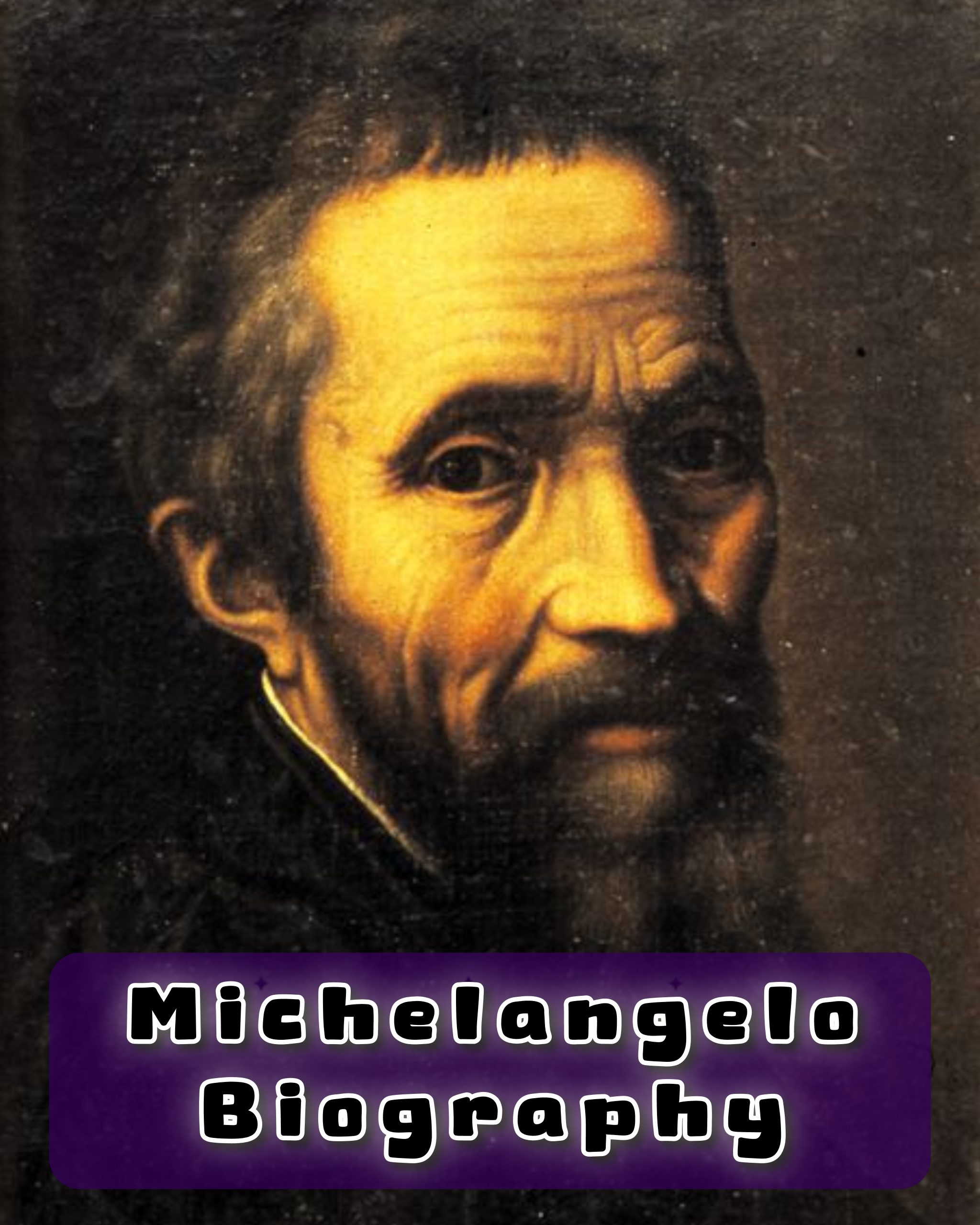
Michelangelo di Lodovico Buonarroti Simoni, widely known simply as Michelangelo, was born on March 6, 1475, in Caprese, a small town in the Republic of Florence, Italy. His father, Lodovico di Leonardo Buonarroti Simoni, was a member of a respected Florentine family and held a government position. Michelangelo was the second of five sons, and although he was born outside Florence, the family maintained strong connections with the city that would become central to his artistic development.
When Michelangelo was still a young child, his family returned to Florence. He grew up during one of the most remarkable periods of the Italian Renaissance, when Florence was becoming a major center of art, learning, literature and political influence. His exposure to the artistic culture of Florence played an important role in shaping his ambitions. From an early age, Michelangelo showed a stronger interest in drawing and art than in the traditional career his family expected of him.
His father initially opposed the idea of Michelangelo becoming an artist because artistic occupations were not considered suitable for a family of their social standing. Nevertheless, Michelangelo persisted. As a teenager, he entered the workshop of the celebrated Florentine painter Domenico Ghirlandaio. This marked the beginning of a professional artistic journey that would eventually make him one of the most influential artists in Western history. The Metropolitan Museum of Art notes that his early training was in painting before he developed his extraordinary reputation as a sculptor.
Michelangelo Buonarroti Education
Michelangelo’s formal artistic education began in the workshop of Domenico Ghirlandaio in Florence. Around the age of 13, he was exposed to the techniques of fresco painting, drawing and composition. His apprenticeship provided him with practical training and introduced him to the discipline required to produce large-scale Renaissance artworks. One of his earliest known paintings, The Torment of Saint Anthony, is believed to date from around 1487–1488, when he was approximately 12 or 13 years old.
Michelangelo’s education expanded beyond Ghirlandaio’s workshop when he came into contact with the powerful Medici family. He became associated with the household of Lorenzo de’ Medici, known as Lorenzo the Magnificent, where he encountered classical sculpture, literature and leading intellectuals of Renaissance Florence. This environment exposed him to ancient Greek and Roman artistic ideals and helped develop the distinctive understanding of the human body that became a defining feature of his work.
He also learned through direct observation, drawing and the study of human anatomy. Historical accounts associate him with anatomical studies and dissections, which helped him understand muscles, bones and the structure of the human body. His training eventually expanded into sculpture, architecture, painting and poetry. Rather than receiving a conventional university education, Michelangelo’s intellectual and artistic education was largely shaped by workshops, patrons, classical sources, observation and years of practical experience.
Michelangelo Buonarroti Career
Michelangelo’s career developed rapidly in Florence and later in Rome, where he worked for powerful patrons, including members of the Medici family and several popes. His reputation as a sculptor grew dramatically after the creation of works such as the Pietà and David. The David, completed in 1504, became one of the defining masterpieces of Renaissance sculpture and demonstrated his extraordinary ability to transform marble into a highly expressive human figure.
In Rome, Michelangelo received major commissions from the papacy. Pope Julius II commissioned him to work on an ambitious tomb project in the early 1500s. Although the project changed considerably over time, it resulted in the famous sculpture of Moses. Michelangelo also produced the monumental ceiling frescoes of the Sistine Chapel, commissioned by Julius II. The ceiling, unveiled in 1512, became one of the greatest achievements of Renaissance painting.
Michelangelo later painted The Last Judgment on the altar wall of the Sistine Chapel and devoted increasing attention to architecture. He worked on major projects in Florence, including the Medici Chapel and Laurentian Library, and eventually became chief architect of St. Peter’s Basilica in Vatican City. He served in that position for approximately 17 years, contributing significantly to the development of the basilica’s monumental dome. His career therefore extended far beyond sculpture and included painting, architecture, drawing and poetry.
Michelangelo Buonarroti Personal Life and Family
Michelangelo never married and had no known wife, fiancé or biological children. Unlike many famous Renaissance figures, he devoted much of his life to his artistic work, commissions and spiritual interests. His closest family relationships included his father, Lodovico, and his brothers. He remained financially involved with members of his family and became concerned with the Buonarroti family’s social position and finances.
Although Michelangelo never had a conventional marriage, his personal relationships have attracted considerable scholarly attention. He formed an especially important friendship with Tommaso de’ Cavalieri, a young Roman nobleman to whom he dedicated drawings and poems. He also developed a close friendship with Vittoria Colonna, a noblewoman and poet whom he met later in life. Scholars generally describe his relationship with Colonna as deeply affectionate and spiritual rather than a conventional romantic relationship.
Michelangelo’s poetry and correspondence also provide important evidence about his emotional and spiritual life. His relationships with men have been the subject of extensive historical discussion, particularly because later editors altered some of the pronouns in his poetry, changing references to male companions into female ones. Modern scholarship has examined these changes as part of the complicated history of how Michelangelo’s private life was represented after his death.
Michelangelo Buonarroti Death and Cause of Death
Michelangelo died on February 18, 1564, in Rome at the age of 88. He died only a few weeks before his 89th birthday. By the final years of his life, he had already achieved extraordinary fame and was recognized as one of the greatest living artists of his generation.
The precise modern medical cause of Michelangelo’s death is not firmly established in the historical record. He was elderly and had experienced declining health in his final years. Therefore, it is more accurate to state that he died from natural causes associated with old age and illness rather than claim a specific disease without reliable historical evidence.
Following his death, Michelangelo’s body was initially buried in Rome, but his remains were later transferred to Florence. He was ultimately buried in the Basilica of Santa Croce, where his monumental tomb became an important part of Florence’s artistic heritage.
Michelangelo Age, Religion, Nationality, Height and Physical Appearance
Michelangelo was 88 years old when he died in 1564. He was Italian by cultural and historical identity and was born in the Republic of Florence, making him a Renaissance Florentine. He was a Christian and his work was deeply connected to Catholic religious culture, particularly through his commissions for the Vatican and major Christian subjects such as the Pietà, Sistine Chapel ceiling and The Last Judgment. His exact height is not reliably documented in surviving historical records, so claims giving a precise measurement should be treated cautiously. Contemporary and later portraits show a slender, strong-featured man with a prominent nose, deep-set eyes and a serious expression. Portraits and historical descriptions provide a better indication of his appearance than modern height estimates.
Legacy
Michelangelo’s legacy rests on his extraordinary ability to work across several artistic disciplines. He was a sculptor, painter, architect, draftsman and poet whose career represented the Renaissance ideal of the artist as an intellectual and creative genius. His works demonstrated an exceptional understanding of anatomy, movement, proportion and emotional expression. The Metropolitan Museum of Art describes his disegno—drawing and conceptual design—as central to his artistic practice.
His most famous creations remain among the world’s most recognizable artworks. David became an enduring symbol of Renaissance Florence, while the Pietà remains one of the most celebrated sculptures in St. Peter’s Basilica. The Sistine Chapel ceiling transformed the possibilities of monumental fresco painting, while The Last Judgment demonstrated his ability to combine enormous scale with powerful human emotion and religious symbolism.
Michelangelo’s influence continued long after his death. Later artists studied his muscular figures, dramatic poses, architectural ideas and approach to the human body. His reputation was already enormous during his lifetime, and later generations strengthened his status as one of the defining figures of Western art. His works continue to attract millions of visitors, while museums and scholars continue to study previously overlooked drawings, attributions and details of his creative process.
Conclusion
Michelangelo Buonarroti remains one of the most important figures in the history of art. Born in 1475, he rose from a young Florentine apprentice to become a celebrated sculptor, painter, architect and poet whose masterpieces shaped the Renaissance and influenced generations of artists. From David and the Pietà to the Sistine Chapel and St. Peter’s Basilica, his achievements transformed European art. Although he died in 1564 at the age of 88, Michelangelo’s artistic legacy remains alive more than four centuries later, making his biography, family, education, career, religion, death and achievements subjects of continuing worldwide interest.
Frequently Asked Questions About Michelangelo
Who was Michelangelo?
Michelangelo Buonarroti was an Italian Renaissance artist known primarily as a sculptor, painter, architect and poet. He created David, the Pietà, the Sistine Chapel ceiling and many other major works.
When was Michelangelo born?
Michelangelo was born on March 6, 1475, in Caprese in the Republic of Florence.
How old was Michelangelo when he died?
Michelangelo was 88 years old when he died on February 18, 1564.
When did Michelangelo die?
Michelangelo died on February 18, 1564, in Rome.
What was Michelangelo’s cause of death?
The precise medical cause of Michelangelo’s death is not firmly documented. He died at the age of 88 after experiencing declining health in his final years, so his death is generally understood as resulting from natural causes associated with old age and illness.
Was Michelangelo married?
No. Michelangelo never married and had no known wife or fiancé.
Did Michelangelo have children?
There is no reliable historical evidence that Michelangelo had biological children.
What religion was Michelangelo?
Michelangelo was a Christian living and working within the Catholic religious culture of Renaissance Italy. His major religious commissions included the Sistine Chapel ceiling, The Last Judgment and the Pietà.
What nationality was Michelangelo?
Michelangelo was Italian in historical and cultural identity. He was born in the Republic of Florence, which was an independent state before the formation of modern Italy.
What was Michelangelo’s height?
Michelangelo’s exact height is not reliably documented. Precise figures sometimes published online should therefore be treated as estimates rather than established facts.
What is Michelangelo most famous for?
Michelangelo is most famous for sculptures such as David and the Pietà, the Sistine Chapel ceiling, The Last Judgment, and his architectural work on St. Peter’s Basilica.
Did Michelangelo paint the Sistine Chapel?
Yes. Michelangelo painted the ceiling of the Sistine Chapel between 1508 and 1512 under the commission of Pope Julius II. He later painted The Last Judgment on the chapel’s altar wall.
Where is Michelangelo buried?
Michelangelo is buried in the Basilica of Santa Croce in Florence, Italy.
What was Michelangelo’s greatest achievement?
There is no single universally accepted greatest achievement. David, the Pietà, the Sistine Chapel ceiling and his architectural work at St. Peter’s Basilica are all regarded as landmark achievements.
What is Michelangelo’s legacy?
Michelangelo’s legacy is his enormous influence on Western art. His achievements in sculpture, painting, architecture and drawing established him as one of the central figures of the Renaissance and one of history’s most influential artists.